Decoding Your First Paycheck: Understanding Deductions and Net Pay in 2026

Decoding Your First Paycheck: Understanding Deductions and Net Pay in 2026
Congratulations! You’ve landed a new job, and that first paycheck is just around the corner. It’s an exciting milestone, but for many, the moment they actually see their paycheck, a common question arises: "Where did all my money go?" You might have agreed on a fantastic salary, only to find the amount deposited into your bank account is significantly less. This difference is due to a variety of deductions that are subtracted from your gross pay to arrive at your net pay. Understanding these deductions is crucial for effective financial planning, and in this comprehensive guide, we’ll walk you through everything you need to know about your first paycheck deductions in 2026.
The world of payroll can seem complex, filled with acronyms and percentages. However, by breaking it down, you’ll gain clarity and confidence in managing your finances. This article will cover the essential components of your paycheck, from mandatory taxes to voluntary benefit contributions, ensuring you’re well-equipped to understand every line item.
Gross Pay vs. Net Pay: The Fundamental Difference
Before diving into the specifics of first paycheck deductions, it’s vital to understand the distinction between gross pay and net pay. This is the cornerstone of paycheck comprehension.
What is Gross Pay?
Gross pay is the total amount of money you earn before any deductions are taken out. This is usually the salary or hourly wage you agreed upon with your employer. If you’re paid an annual salary of $60,000, your gross pay for a bi-weekly period would be $60,000 / 26 = $2,307.69 (assuming 26 pay periods in a year). It includes:
- Your regular wages or salary.
- Overtime pay.
- Commissions.
- Bonuses.
- Tips.
- Any other taxable income or benefits provided by your employer before deductions.
What is Net Pay?
Net pay, often referred to as "take-home pay," is the amount of money you actually receive after all deductions have been subtracted from your gross pay. This is the figure that gets deposited into your bank account or is issued as a physical check. When discussing your first paycheck deductions, understanding how these deductions whittle down your gross pay to your net pay is the primary goal.
Mandatory Deductions: The Non-Negotiables
Certain deductions are legally required by federal, state, and sometimes local governments. These are non-negotiable and apply to nearly all employees. Familiarizing yourself with these will clarify a significant portion of your first paycheck deductions.
1. Federal Income Tax
The U.S. federal government collects income tax to fund various public services. The amount withheld from your paycheck depends on several factors, including your income level, filing status (single, married filing jointly, etc.), and the allowances you claimed on your Form W-4. When you start a new job, you’ll fill out a W-4, which tells your employer how much federal income tax to withhold. It’s crucial to fill this out accurately to avoid owing a large sum at tax time or having too much withheld, which results in a smaller refund.
2. State Income Tax (Where Applicable)
In addition to federal income tax, most states also levy their own income tax. The rates and rules vary significantly from state to state, with some states having no state income tax at all (e.g., Florida, Texas, Washington, Nevada, South Dakota, Wyoming, Alaska, and Tennessee for earned income). If you live and work in a state with income tax, this will be another mandatory deduction from your first paycheck deductions.
3. Local Income Tax (Where Applicable)
Some cities, counties, or other local jurisdictions also impose income taxes. These are less common than state taxes but can add another layer of deductions, particularly in certain metropolitan areas. Always check if your specific location has local income taxes.
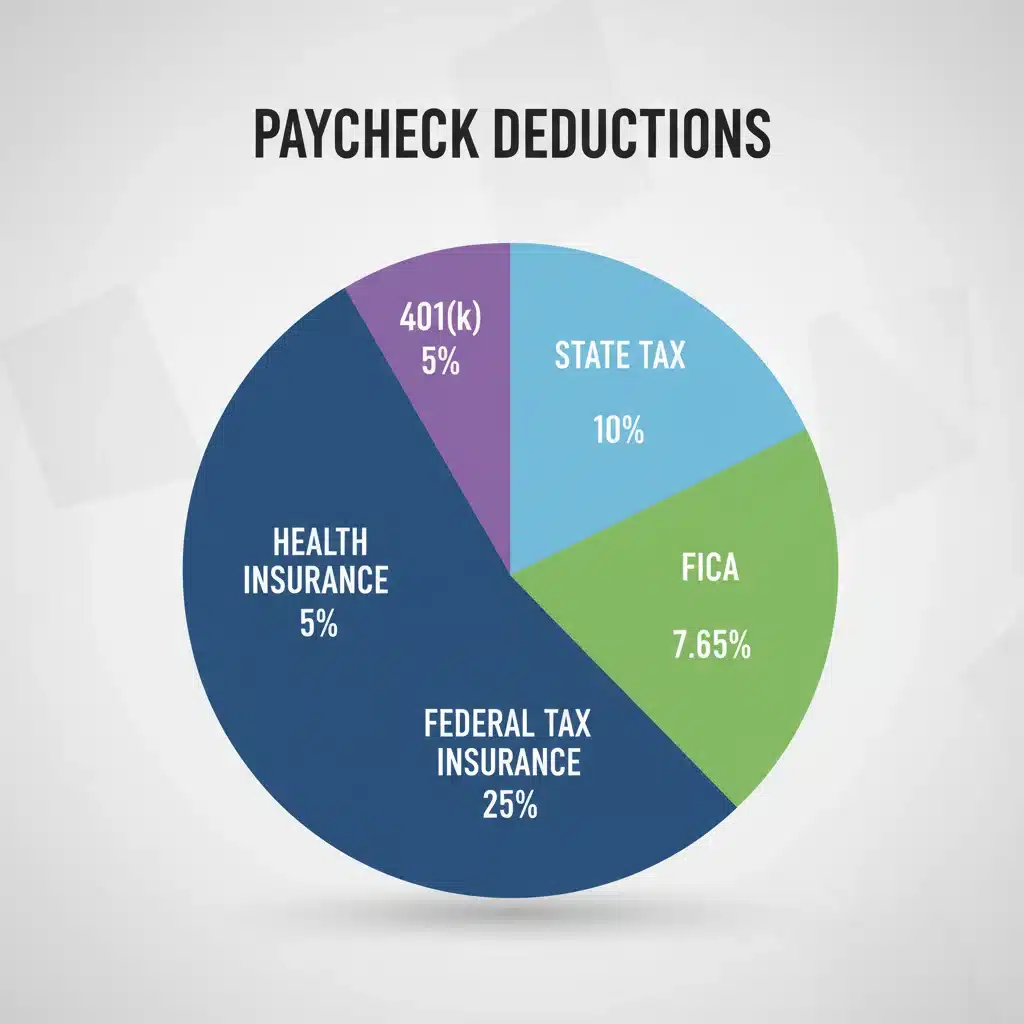
4. FICA Taxes (Social Security and Medicare)
FICA stands for the Federal Insurance Contributions Act. These taxes fund Social Security and Medicare, which provide benefits for retirees, the disabled, and children of deceased workers, as well as healthcare for the elderly. FICA taxes are split into two components:
- Social Security Tax: As of 2026, employees typically pay 6.2% of their gross wages up to an annual earnings limit (which is adjusted annually for inflation). Your employer also pays an equal 6.2%.
- Medicare Tax: Employees typically pay 1.45% of all their gross wages, with no income limit. Your employer also pays an equal 1.45%. Additionally, high-income earners (above certain thresholds) may be subject to an Additional Medicare Tax.
FICA taxes are a significant part of your first paycheck deductions and continue throughout your working life.
Voluntary Deductions: Shaping Your Financial Future
Beyond the mandatory government taxes, you’ll likely encounter a range of voluntary deductions. These are contributions you authorize your employer to take from your paycheck, often to fund benefits or savings plans. Understanding these is key to maximizing your compensation package and planning for the future.
1. Health Insurance Premiums
If your employer offers health, dental, or vision insurance, you’ll typically pay a portion of the premium through paycheck deductions. The amount varies widely based on the plan you choose (e.g., individual vs. family coverage, PPO vs. HMO) and your employer’s contribution. These deductions are often pre-tax, meaning they are taken out before income taxes are calculated, which can lower your taxable income.
2. Retirement Contributions (e.g., 401(k), 403(b))
Many employers offer retirement plans like a 401(k) (for for-profit companies) or a 403(b) (for non-profits and educational institutions). Contributing to these plans is an excellent way to save for retirement, and often, employers offer a matching contribution, which is essentially free money! Your contributions are usually pre-tax, reducing your current taxable income. This is one of the most impactful voluntary first paycheck deductions you can make.
3. Flexible Spending Accounts (FSAs) and Health Savings Accounts (HSAs)
- FSAs: These accounts allow you to set aside pre-tax money for eligible healthcare or dependent care expenses. The catch is that FSA funds are typically "use-it-or-lose-it" by the end of the plan year, though some plans offer a grace period or a small carryover.
- HSAs: Available only if you have a High-Deductible Health Plan (HDHP), HSAs are tax-advantaged savings accounts that can be used for healthcare expenses. Unlike FSAs, HSA funds roll over year to year and can even be invested. They offer a triple tax advantage: tax-deductible contributions, tax-free growth, and tax-free withdrawals for qualified medical expenses.
Both FSAs and HSAs are powerful tools for reducing your taxable income and managing healthcare costs, making them valuable first paycheck deductions to consider.
4. Life and Disability Insurance
Your employer might offer group life insurance or short-term/long-term disability insurance. While some basic coverage might be provided at no cost, you often have the option to purchase additional coverage through payroll deductions. These are important for financial security in unforeseen circumstances.
5. Union Dues
If you are part of a labor union, your union dues will typically be deducted directly from your paycheck. This ensures your membership remains active and you benefit from union representation and services.
6. Loan Repayments or Garnishments
In some cases, deductions might be taken for loan repayments (e.g., an employer-sponsored loan) or wage garnishments mandated by a court order (e.g., for child support, alimony, or unpaid debts). These are less common but are important to be aware of.
Understanding Your Paycheck Stub: A Line-by-Line Guide
Your paycheck stub (or online portal) is your primary source of information regarding your earnings and deductions. It’s essential to review it carefully each pay period, especially your first few. While formats vary, most stubs will include:
- Employee Information: Your name, address, employee ID.
- Employer Information: Company name, address.
- Pay Period Dates: The start and end dates of the period for which you are being paid.
- Pay Date: The date you receive your payment.
- Gross Pay: Your total earnings before any deductions.
- Hours Worked/Rate: If you’re hourly, this will show your regular hours, overtime hours, and corresponding rates.
- Deductions Section: This is where all your first paycheck deductions will be itemized. Look for categories like:
- Federal Withholding (FWT)
- State Withholding (SWT)
- Social Security (SS or OASDI)
- Medicare (Med)
- Health Insurance
- 401(k) or Retirement
- FSA/HSA
- Other specific deductions
- Net Pay: Your take-home pay after all deductions.
- Year-to-Date (YTD) Totals: These columns show the cumulative amounts earned and deducted since the beginning of the year. Very useful for tracking your annual earnings and contributions.
Strategies for Managing Your First Paycheck
Now that you understand the components of your first paycheck deductions, let’s look at how to manage that money effectively.
1. Create a Budget
This is arguably the most important step. Knowing your net pay allows you to create a realistic budget. Track your income and expenses to ensure you’re not spending more than you earn. Allocate funds for essentials like rent, utilities, groceries, and transportation, and then for discretionary spending and savings.
2. Review Your W-4 Annually (or When Life Changes)
Your W-4 determines how much federal income tax is withheld. If you get married, have a child, or experience other significant life changes, revisit your W-4 to ensure your withholdings are accurate. This prevents nasty surprises at tax time. For your first paycheck deductions, ensure your initial W-4 is filled out correctly.
3. Maximize Employer Matching Contributions to Retirement Plans
If your employer offers a 401(k) or 403(b) match, contribute at least enough to get the full match. This is 100% return on your investment instantly and is a crucial part of long-term wealth building. Don’t leave free money on the table!
4. Build an Emergency Fund
Once your budget is in place, prioritize building an emergency fund. Aim for 3-6 months’ worth of living expenses in a readily accessible savings account. This financial cushion is vital for unexpected events like job loss, medical emergencies, or car repairs.
5. Understand Your Benefits Package
Your benefits package is a significant part of your total compensation. Take the time to understand all the options available, from health insurance to life insurance and retirement plans. Make informed decisions about which voluntary first paycheck deductions are right for your situation.
6. Automate Savings
Set up automatic transfers from your checking account to your savings account or investment accounts each payday. This "pay yourself first" strategy ensures you consistently save without having to think about it.
Common Questions About Paycheck Deductions
Q: Why is my net pay so much lower than my gross pay?
A: This is a very common experience! The difference is due to the mandatory and voluntary deductions discussed. Federal, state, and local income taxes, FICA taxes (Social Security and Medicare), and potentially health insurance premiums and retirement contributions, all add up significantly. It’s why understanding your first paycheck deductions is so important.
Q: Can I change my deductions?
A: Yes, you can. You can adjust your federal and state income tax withholdings by submitting a new Form W-4 (and state equivalent) to your employer. You can also typically adjust your contributions to voluntary deductions like 401(k)s, FSAs, or HSAs during open enrollment periods or when you have a qualifying life event.
Q: What if I think there’s an error on my paycheck?
A: If you notice any discrepancies or have questions about your paycheck, contact your HR or payroll department immediately. It’s crucial to get errors corrected promptly.
Q: Are all deductions pre-tax?
A: No. Many deductions, like health insurance premiums and traditional 401(k) contributions, are pre-tax, meaning they reduce your taxable income. Other deductions, such as Roth 401(k) contributions, are post-tax. It’s important to understand the tax implications of each deduction.

The Importance of Financial Literacy for Your First Paycheck
Understanding your first paycheck deductions is more than just knowing where your money goes; it’s a fundamental aspect of financial literacy. It empowers you to make informed decisions about your spending, saving, and investing. When you comprehend the impact of taxes and benefits, you can better plan for your financial goals, whether that’s saving for a down payment, paying off student loans, or building a robust retirement fund.
Ignoring your paycheck details can lead to missed opportunities, such as not taking advantage of an employer’s 401(k) match, or to financial stress if you consistently overspend because you miscalculated your take-home pay. By actively reviewing your pay stub and understanding each line item, you’re taking control of your financial future.
Looking Ahead to 2026: What to Expect
While the core principles of paycheck deductions remain consistent, specific tax rates, contribution limits, and regulations can change annually. As we move further into 2026, it’s wise to stay updated on any new legislation or adjustments that might impact your take-home pay. Government agencies like the IRS typically release updated tax information towards the end of the preceding year or early in the new year.
For example, the Social Security wage base (the maximum amount of earnings subject to Social Security tax) is adjusted annually, as are the contribution limits for 401(k)s, FSAs, and HSAs. Being aware of these changes ensures you can adjust your financial planning accordingly and maximize your benefits. Your HR or payroll department will also be a valuable resource for the most current information specific to your employer’s plans.
Conclusion: Empowering Your Financial Journey
Receiving your first paycheck deductions can be a bewildering experience, but it doesn’t have to be. By understanding the difference between gross and net pay, identifying mandatory and voluntary deductions, and knowing how to read your paycheck stub, you gain invaluable insight into your financial landscape. This knowledge is the first step towards sound financial management, allowing you to budget effectively, save strategically, and make the most of your hard-earned money.
Don’t just glance at your net pay and move on. Take the time to understand every deduction. Ask questions. Utilize the resources your employer provides. Your paycheck is more than just a number; it’s a detailed report of your earnings and contributions, offering a clear picture of your financial health. Empower yourself with this knowledge, and set the foundation for a secure and prosperous financial future in 2026 and beyond.
Author