Education Savings Account Options 2026: Choosing the Best for Your Family

Comparing 3 Education Savings Account Options for 2026: Which is Best for Your Family?
Planning for your child’s future education is one of the most significant financial undertakings many families face. With the ever-increasing cost of tuition, housing, and other educational expenses, starting early and choosing the right education savings options is crucial. As we look towards 2026, the landscape of college savings remains dynamic, offering various avenues each with its unique advantages and considerations. This comprehensive guide will delve into three primary education savings options: 529 Plans, Coverdell Education Savings Accounts (ESAs), and Uniform Gifts to Minors Act (UGMA) / Uniform Transfers to Minors Act (UTMA) accounts. Our goal is to equip you with the knowledge needed to make an informed decision, ensuring your family is well-prepared for the educational journey ahead.
The Rising Cost of Education and the Need for Strategic Savings
Before diving into the specifics of each education savings option, it’s essential to understand the gravity of the challenge. The cost of higher education has consistently outpaced inflation, making it increasingly difficult for families to pay for college without significant savings or loans. According to recent projections, a four-year degree at a public university could cost upwards of $100,000 to $150,000 (including tuition, fees, room, and board) by the time a child born today reaches college age. For private institutions, these figures can be significantly higher. This stark reality underscores the importance of not just saving, but saving smartly, utilizing tax-advantaged accounts designed specifically for educational expenses.
Many families mistakenly believe that financial aid alone will cover the bulk of college costs. While aid can certainly help, it often comes in the form of loans that must be repaid, or grants that may not cover all expenses. Relying solely on future income or loans can place a substantial burden on both parents and students. Therefore, exploring effective education savings options becomes a foundational step in any robust financial plan for families with children.
Understanding Your Primary Education Savings Options for 2026
When it comes to dedicated education savings options, three stand out for their popularity and distinct features. Each has its own set of rules regarding contributions, tax treatment, eligible expenses, and beneficiary control. Let’s break down each one to help you determine which might align best with your family’s financial goals and educational aspirations.
1. 529 Plans: The Powerhouse of College Savings
Often considered the gold standard among education savings options, 529 plans are state-sponsored investment plans designed to help families save for future education costs. They offer significant tax advantages, making them a highly attractive choice for many.
Types of 529 Plans:
- College Savings Plans: These are investment accounts that allow your savings to grow tax-deferred, and qualified withdrawals are tax-free. You choose from various investment options, typically mutual funds or exchange-traded funds (ETFs), managed by the state’s plan administrator.
- Prepaid Tuition Plans: Less common, these plans allow you to purchase future tuition credits at today’s prices, locking in tuition rates at participating in-state public colleges. Some plans also offer private college options.
Key Features and Benefits of 529 Plans:
- Tax-Free Growth and Withdrawals: This is arguably the biggest advantage. Earnings grow tax-deferred, and withdrawals are tax-free when used for qualified education expenses.
- Qualified Education Expenses: These are broad and include tuition, fees, books, supplies, equipment, and even room and board for students enrolled at least half-time. Crucially, 529 plans can also cover up to $10,000 per year per beneficiary for K-12 tuition expenses, and up to $10,000 in student loan repayments (lifetime limit). They can also be used for apprenticeship programs.
- High Contribution Limits: Most 529 plans have very high lifetime contribution limits, often well over $300,000, allowing for substantial savings.
- Gift Tax Exclusion: Contributions to 529 plans are considered gifts and can qualify for the annual gift tax exclusion ($18,000 per donor per beneficiary in 2024, subject to change). You can even super-fund a 529 plan by contributing up to five years’ worth of gifts at once ($90,000 in 2024) without incurring gift tax, provided no other gifts are made to the same beneficiary during that five-year period.
- Owner Control: The account owner (usually the parent or grandparent) maintains control over the assets, even after the beneficiary reaches adulthood. This means the beneficiary cannot simply withdraw funds for non-educational purposes.
- Flexibility with Beneficiaries: If the original beneficiary decides not to attend college, or if there are leftover funds, the account owner can change the beneficiary to another eligible family member (e.g., another child, grandchild, or even themselves) without tax consequences.
- State Tax Benefits: Many states offer a state income tax deduction or credit for contributions to their 529 plan, and sometimes even for contributions to out-of-state plans. This is a significant incentive to consider.
- Minimal Impact on Financial Aid: Assets held in a 529 plan owned by a parent or dependent student are generally assessed at a lower rate (up to 5.64%) in federal financial aid calculations compared to assets held directly by the student (20%) or in UGMA/UTMA accounts.
Drawbacks of 529 Plans:
- Non-Qualified Withdrawals: If funds are withdrawn for non-qualified expenses, the earnings portion is subject to income tax and a 10% federal penalty tax.
- Investment Options: While diverse, investment options are typically limited to those offered by the specific state plan, which may not always align with every investor’s preferences.
- State-Specific Rules: While you can invest in any state’s 529 plan, some state tax benefits only apply if you invest in your home state’s plan.
2. Coverdell Education Savings Accounts (ESAs): The Versatile Option
A Coverdell ESA is another excellent tax-advantaged education savings option, though it operates under different rules and has some distinct advantages, particularly for K-12 expenses. It functions much like a Roth IRA but is specifically for education.
Key Features and Benefits of Coverdell ESAs:
- Tax-Free Growth and Withdrawals: Similar to 529 plans, earnings grow tax-free, and qualified withdrawals are tax-free.
- Broad Definition of Qualified Expenses: Coverdell ESAs are particularly flexible. They can be used for qualified expenses for K-12 education (tuition, fees, books, supplies, academic tutoring, special needs services, and even computer equipment and internet access) in addition to post-secondary education expenses. This K-12 flexibility is a major differentiator from 529 plans.
- Investment Control: Unlike 529 plans where you choose from pre-set portfolios, with a Coverdell ESA, you typically have more control over your investments. You can invest in virtually any stock, bond, or mutual fund, giving you greater flexibility to tailor your portfolio.
- Owner Control: The account custodian maintains control over the assets until the beneficiary turns 18 or 21 (depending on the custodian’s rules).
- Flexibility with Beneficiaries: The beneficiary can be changed to another eligible family member without tax consequences, similar to 529 plans.
Drawbacks of Coverdell ESAs:
- Low Contribution Limits: This is the most significant drawback. Contributions are capped at $2,000 per beneficiary per year, across all Coverdell ESAs established for that beneficiary. This limit makes it challenging to save substantial amounts for college.
- Income Limitations: Eligibility to contribute to a Coverdell ESA is subject to income phase-out limits. For 2026 (assuming current rules apply), single filers with modified adjusted gross income (MAGI) between $95,000 and $110,000, and joint filers with MAGI between $190,000 and $220,000, may have their contribution ability reduced or eliminated.
- Age Limit for Use: Funds must be used by the time the beneficiary reaches age 30, or they become subject to income tax and a 10% penalty on earnings, unless transferred to another eligible family member.
- Non-Qualified Withdrawals: Similar to 529 plans, non-qualified withdrawals are subject to income tax and a 10% federal penalty tax on earnings.
3. UGMA/UTMA Accounts: Custodial Accounts for Broad Use
The Uniform Gifts to Minors Act (UGMA) and Uniform Transfers to Minors Act (UTMA) accounts are custodial accounts that allow adults to gift assets to minors without the need for a formal trust. While not exclusively designed for education, they are often considered among education savings options due to their flexibility.
Key Features and Benefits of UGMA/UTMA Accounts:
- No Contribution Limits: There are no federal contribution limits to UGMA/UTMA accounts, allowing you to contribute as much as you wish. However, contributions are considered gifts and may be subject to federal gift tax if they exceed the annual gift tax exclusion ($18,000 per donor per beneficiary in 2024).
- Flexible Use of Funds: This is their primary advantage. Funds can be used for any purpose that benefits the minor, not just education. This could include summer camps, cars, computers, or even a down payment on a home.
- Investment Flexibility: Similar to Coverdell ESAs, you have a wide range of investment choices, including stocks, bonds, mutual funds, and real estate.
- Simplicity: They are relatively easy to set up and administer compared to formal trusts.
Drawbacks of UGMA/UTMA Accounts:
- Irrevocable Gifts: Once funds are contributed to an UGMA/UTMA account, they are an irrevocable gift to the minor. The assets legally belong to the child, and the custodian cannot reclaim them.
- Loss of Control: When the child reaches the age of majority (18 or 21, depending on the state), they gain full control of the assets. They can then use the money for any purpose, educational or otherwise, without parental consent. This lack of control can be a significant concern for parents.
- Less Favorable Tax Treatment: Earnings in UGMA/UTMA accounts are taxed at the child’s tax rate, which is generally lower than the parent’s rate (this is often referred to as the ‘kiddie tax’ rules). However, above a certain threshold (e.g., $2,500 for 2024, subject to change), the child’s unearned income is taxed at the parent’s marginal tax rate, which can negate some of the tax benefits. Unlike 529 plans and Coverdell ESAs, withdrawals are not tax-free.
- Negative Impact on Financial Aid: Assets held in an UGMA/UTMA account are considered assets of the student. For federal financial aid purposes, student assets are assessed at a much higher rate (20%) than parent assets (up to 5.64%), significantly reducing the amount of financial aid a student may receive.
- No State Tax Benefits: Unlike some 529 plans, there are typically no state income tax deductions or credits for contributions to UGMA/UTMA accounts.
Comparing the Education Savings Options: A Side-by-Side Look
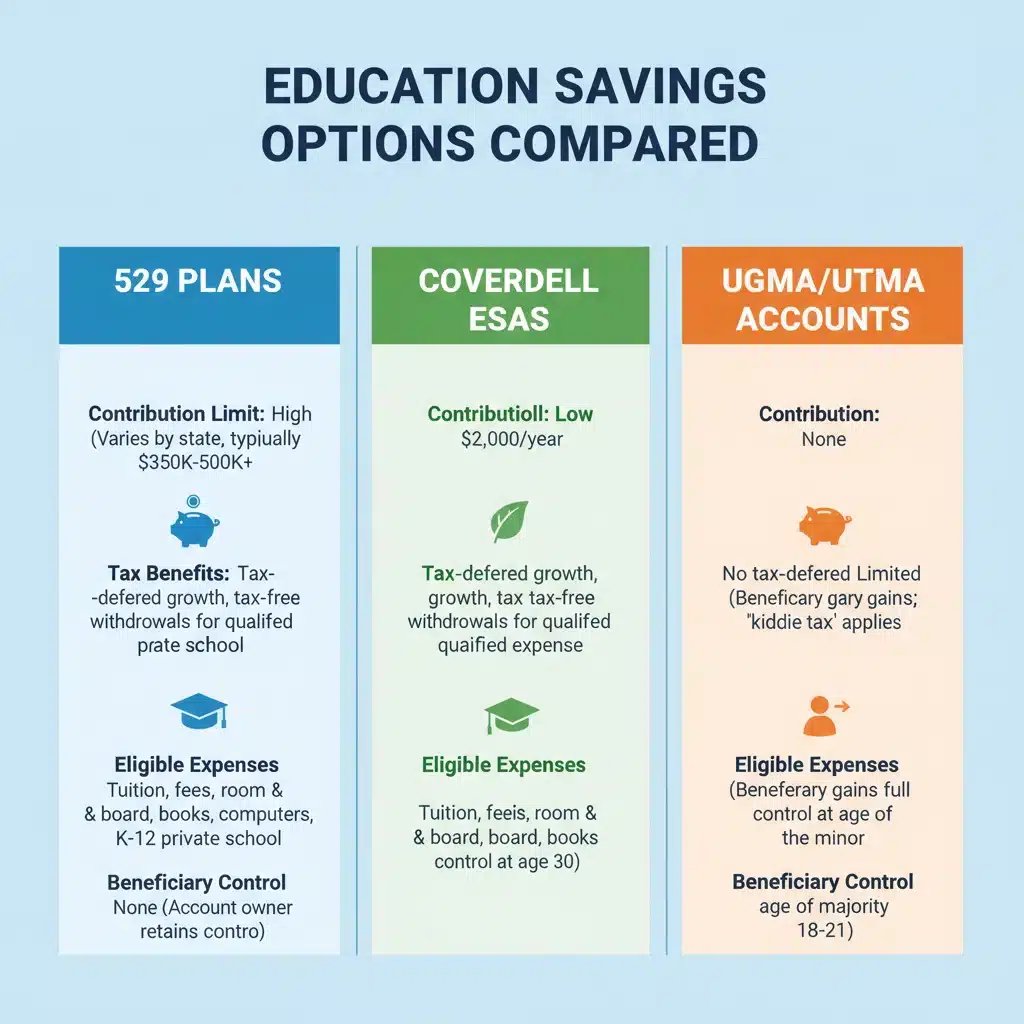
To help solidify your understanding and facilitate a direct comparison, let’s summarize the key differences between these three important education savings options.
Key Differentiators:
- Contribution Limits: 529 plans have very high lifetime limits, Coverdell ESAs are capped at $2,000 annually, and UGMA/UTMA accounts have no federal limits (though gift tax rules apply).
- Tax Benefits: 529 plans and Coverdell ESAs offer tax-free growth and withdrawals for qualified expenses. UGMA/UTMA accounts are taxed at the child’s rate (subject to kiddie tax rules) and withdrawals are not tax-free.
- Eligible Expenses: Coverdell ESAs offer the broadest definition, covering K-12 and higher education. 529 plans cover K-12 tuition and higher education. UGMA/UTMA funds can be used for any purpose benefiting the minor.
- Control: 529 plan owners maintain control. Coverdell ESA custodians maintain control until the beneficiary reaches age 18/21. UGMA/UTMA assets become fully controlled by the beneficiary at the age of majority.
- Impact on Financial Aid: UGMA/UTMA accounts have the most negative impact, followed by Coverdell ESAs (though less significant than UGMA/UTMA), and then parent-owned 529 plans, which have the least impact.
- Income Limitations: Only Coverdell ESAs have income limitations for contributors.
Which Education Savings Option is Best for Your Family in 2026?
The ‘best’ education savings option is highly personal and depends on your specific financial situation, goals, and risk tolerance. Here’s a guide to help you decide:
Choose a 529 Plan if:
- You want to save a substantial amount for college or K-12 tuition.
- You value tax-free growth and withdrawals for qualified education expenses.
- You want to maintain control over the funds until they are used for education.
- You are concerned about the impact on financial aid eligibility.
- You may benefit from a state income tax deduction or credit for contributions.
- You want flexibility to change beneficiaries if needed.
Consider a Coverdell ESA if:
- You want to save for K-12 expenses in addition to higher education.
- You want more control over your investment choices.
- Your income falls within the eligibility limits.
- You are looking for a smaller, supplemental savings vehicle due to the low contribution limit.
- You have a specific, short-term education savings goal.
Opt for an UGMA/UTMA Account if:
- You want complete flexibility in how the funds can be used by the minor (not just education).
- You want to gift assets to a minor and prefer broad investment options.
- You are comfortable with the child gaining full control of the assets at the age of majority.
- You have already maximized contributions to 529 plans and Coverdell ESAs.
- You are less concerned about potential negative impacts on financial aid.
Strategies for Maximizing Your Education Savings
Many families find that combining different education savings options can be the most effective strategy. For example, you might use a 529 plan for the bulk of college savings due to its high limits and tax advantages, and a Coverdell ESA for K-12 expenses or to supplement higher education costs with more investment control. UGMA/UTMA accounts could be used for other financial gifts to a minor that are not strictly for education.
Key Strategies to Consider:
- Start Early: The power of compound interest is your greatest ally. The sooner you start saving, the more time your investments have to grow.
- Automate Contributions: Set up automatic transfers from your checking or savings account into your chosen education savings options. This ensures consistency and makes saving a habit rather than an afterthought.
- Utilize Gift Tax Exclusions: Encourage grandparents and other family members to contribute directly to a 529 plan or Coverdell ESA, potentially using their annual gift tax exclusions to boost savings.
- Regularly Review and Adjust: Your financial situation and education costs can change. Periodically review your savings progress, investment performance, and adjust your strategy as needed.
- Understand Financial Aid Implications: Be aware of how each account type might affect your child’s eligibility for need-based financial aid. Generally, assets owned by parents (like 529 plans) have a lesser impact than assets owned by the student (like UGMA/UTMA).
The Role of Investment Choices Within Education Savings Options
The investment choices available within each education savings option play a critical role in the growth of your funds. Understanding these options is crucial for maximizing your savings potential.
Investment Options in 529 Plans:
Most 529 plans offer a selection of investment portfolios, typically categorized by:
- Age-Based Portfolios: These automatically adjust their asset allocation over time, becoming more conservative as the beneficiary approaches college age. They start with a higher allocation to stocks (growth) and gradually shift towards bonds and cash (preservation).
- Static Portfolios: These maintain a fixed asset allocation, allowing you to choose a portfolio that matches your risk tolerance (e.g., aggressive growth, moderate, conservative).
- Individual Fund Options: Some plans allow you to choose specific mutual funds or ETFs from a curated list.
When selecting a 529 plan, consider the diversity and quality of its investment options, as well as the associated fees. Lower fees can significantly impact your long-term returns.
Investment Options in Coverdell ESAs and UGMA/UTMA:
With Coverdell ESAs and UGMA/UTMA accounts, you typically have much broader investment flexibility. You can open these accounts with most brokerage firms and invest in a wide array of securities, including:
- Individual stocks and bonds
- Mutual funds
- Exchange-Traded Funds (ETFs)
- Certificates of Deposit (CDs)
This greater control can be appealing for investors who prefer to manage their own portfolios or work with a financial advisor to create a customized strategy. However, with greater control comes greater responsibility for investment selection and risk management.
Tax Implications Beyond Growth and Withdrawals
While tax-free growth and withdrawals are significant benefits, it’s also important to consider other tax implications associated with these education savings options.
Gift Tax Considerations:
Contributions to 529 plans, Coverdell ESAs, and UGMA/UTMA accounts are considered gifts. For 2024, individuals can gift up to $18,000 per recipient per year without incurring gift tax or using up their lifetime gift tax exclusion. Married couples can gift up to $36,000. As mentioned, 529 plans have a unique ‘super-funding’ option allowing five years’ worth of gifts at once.
The ‘Kiddie Tax’ Rule for UGMA/UTMA:
The ‘kiddie tax’ rule applies to unearned income (like interest, dividends, and capital gains) of children under age 18, and in some cases, full-time students under age 24. For 2024, the first $1,250 of a child’s unearned income is tax-free, the next $1,250 is taxed at the child’s rate, and any amount above $2,500 is taxed at the parent’s marginal tax rate. This can reduce the tax advantage of UGMA/UTMA accounts for larger balances.
Impact on Estate Planning:
Assets in 529 plans are generally removed from the account owner’s taxable estate, even though the owner retains control. This can be an attractive feature for estate planning. Assets in UGMA/UTMA accounts are considered the child’s assets and are also removed from the donor’s estate. Coverdell ESAs are also typically excluded from the contributor’s estate.
Navigating Potential Changes and Future Outlook for 2026
While the core rules for these education savings options are relatively stable, it’s important to remember that tax laws and financial aid regulations can change. Staying informed about potential legislative updates is crucial. For instance, recent years have seen expansions in what qualifies as an eligible expense for 529 plans (K-12 tuition, student loan repayment, apprenticeship programs). There’s always a possibility of further enhancements or modifications to these accounts.
For 2026, it’s advisable to consult with a qualified financial advisor who can provide personalized guidance based on the most current tax laws and your family’s unique circumstances. They can help you model different scenarios and choose the optimal combination of education savings options.

Conclusion: Empowering Your Family’s Educational Future
Saving for education is a marathon, not a sprint. By understanding the nuances of 529 Plans, Coverdell ESAs, and UGMA/UTMA accounts, you can build a robust strategy tailored to your family’s needs. Each of these education savings options offers distinct advantages and disadvantages, and the best approach often involves a thoughtful combination of them.
Whether your priority is maximizing tax benefits, maintaining control, or providing ultimate flexibility for your child, there’s an option, or a blend of options, that can help you achieve your goals. Don’t let the daunting cost of education deter you. With careful planning, consistent contributions, and smart investment choices within these powerful education savings options, you can significantly ease the financial burden and open doors to a brighter educational future for your loved ones. Start today, and empower the next generation with the gift of education.
Author