
Student Loan Deferment vs. Forbearance in 2026: Choosing the Right Pause for Your Payments
The landscape of student loan management can often feel like navigating a dense jungle, especially when faced with financial hardship. For many borrowers, the ability to temporarily pause payments can be a crucial lifeline. As we look towards 2026, understanding your options—specifically student loan deferment vs. forbearance—becomes paramount. These two terms are often used interchangeably, but they have distinct differences that can significantly impact your financial future. Making the wrong choice could lead to unexpected interest accrual, increased debt, and a longer repayment period. This comprehensive guide will delve deep into both options, helping you understand which path is best suited for your unique circumstances to effectively manage your student loan pause.
The economic environment is constantly shifting, and personal financial situations can change rapidly. Whether you’re facing unemployment, a medical emergency, or pursuing further education, knowing how to appropriately hit the ‘pause’ button on your student loans is essential. This article aims to demystify deferment and forbearance, providing you with the knowledge to make an informed decision for your student loan pause in 2026 and beyond. We’ll explore eligibility requirements, the impact on interest, the application process, and crucial considerations for both federal and private student loans. Our goal is to empower you to choose the most advantageous option, safeguarding your financial well-being while navigating your student loan obligations.
Understanding the Basics: What is a Student Loan Pause?
Before we dive into the nuances of deferment and forbearance, let’s establish what a student loan pause truly means. Essentially, it’s a temporary suspension of your regular monthly payments. This can be a godsend when you’re experiencing financial difficulty, allowing you to reallocate funds to more pressing needs, such as housing, food, or medical bills. However, it’s critical to remember that ‘pause’ doesn’t mean ‘forgiveness.’ While your payments stop, your loan obligations generally do not disappear. The key difference between deferment and forbearance lies in how interest accrues during this pause and, consequently, its impact on your total repayment amount.
The federal government and private lenders offer these options to prevent borrowers from defaulting on their loans. Defaulting has severe consequences, including damaged credit scores, wage garnishment, and even seizure of tax refunds. Therefore, utilizing a student loan pause, when appropriate, is a far better alternative than simply ceasing payments. But which option is right for you? That’s the question we aim to answer comprehensively, focusing on the implications for your student loan pause in 2026 and how to prepare for it.
Many borrowers often feel overwhelmed by the terminology and the sheer volume of information available. This is why a clear, concise, and detailed explanation of each option is so vital. We will break down the complexities into easily digestible segments, ensuring you have a solid foundation before making any decisions regarding your student loan pause. Keep in mind that while both options offer relief, their long-term financial implications can vary dramatically, making an informed choice absolutely essential.
Student Loan Deferment: A Closer Look at Pausing Payments
Student loan deferment is generally considered the more favorable option for pausing payments because, in many cases, the government pays the interest on certain types of federal loans during the deferment period. This means your loan balance does not grow while your payments are suspended, which is a significant advantage. Deferment is not automatically granted; you must meet specific eligibility criteria set by your loan servicer and federal regulations.
Eligibility for Deferment
Common reasons for qualifying for a student loan deferment include:
- In-School Deferment: If you are enrolled at least half-time at an eligible educational institution, your payments can be deferred. This is often automatic for federal loans.
- Unemployment Deferment: If you are unemployed or working less than 30 hours per week and actively seeking full-time employment, you may qualify. This is a crucial student loan pause option for those facing job loss.
- Economic Hardship Deferment: If you are experiencing financial difficulties, such as receiving public assistance or earning less than 150% of the poverty guideline for your family size, you might be eligible.
- Graduate Fellowship Deferment: If you are enrolled in an approved graduate fellowship program.
- Rehabilitation Training Deferment: If you are enrolled in an approved rehabilitation training program for individuals with disabilities.
- Military Service Deferment: If you are serving in the military during a war, national emergency, or other qualifying operation.
- Cancer Treatment Deferment: This deferment is specifically for borrowers undergoing cancer treatment and for the six months following the end of treatment.
It’s important to note that eligibility criteria can evolve, so it’s always best to check the latest guidelines from the U.S. Department of Education or your loan servicer for 2026. Private student loans typically have their own, often stricter, deferment policies, if they offer them at all.
Interest Accrual During Deferment
This is where deferment truly shines for federal student loans. For subsidized federal loans (Direct Subsidized Loans, FFEL Subsidized Loans, and Perkins Loans), the government pays the interest that accrues during your deferment period. This means your loan balance at the end of the deferment will be the same as it was at the beginning, preventing interest capitalization (when unpaid interest is added to your principal balance).
However, for unsubsidized federal loans (Direct Unsubsidized Loans, FFEL Unsubsidized Loans, PLUS Loans, and Direct Consolidation Loans comprised of unsubsidized loans), interest will continue to accrue during deferment. While you aren’t required to make payments, this accrued interest will be added to your principal balance when the deferment ends, increasing your total debt. Even in this scenario, deferment still allows you to pause payments without the immediate pressure of an increasing monthly bill.
For private student loans, interest almost always accrues during deferment. Some lenders may offer a temporary interest subsidy, but this is rare. Always confirm the specific terms with your private lender.
Applying for Deferment
To apply for a student loan deferment, you’ll typically need to contact your loan servicer. They will provide you with the necessary forms and inform you of the documentation required to prove your eligibility. Common documents include enrollment verification, unemployment benefit statements, or income documentation. It’s crucial to apply before you miss a payment to avoid delinquency or default. Planning ahead for your student loan pause is key to a smooth process.
Student Loan Forbearance: When Deferment Isn’t an Option
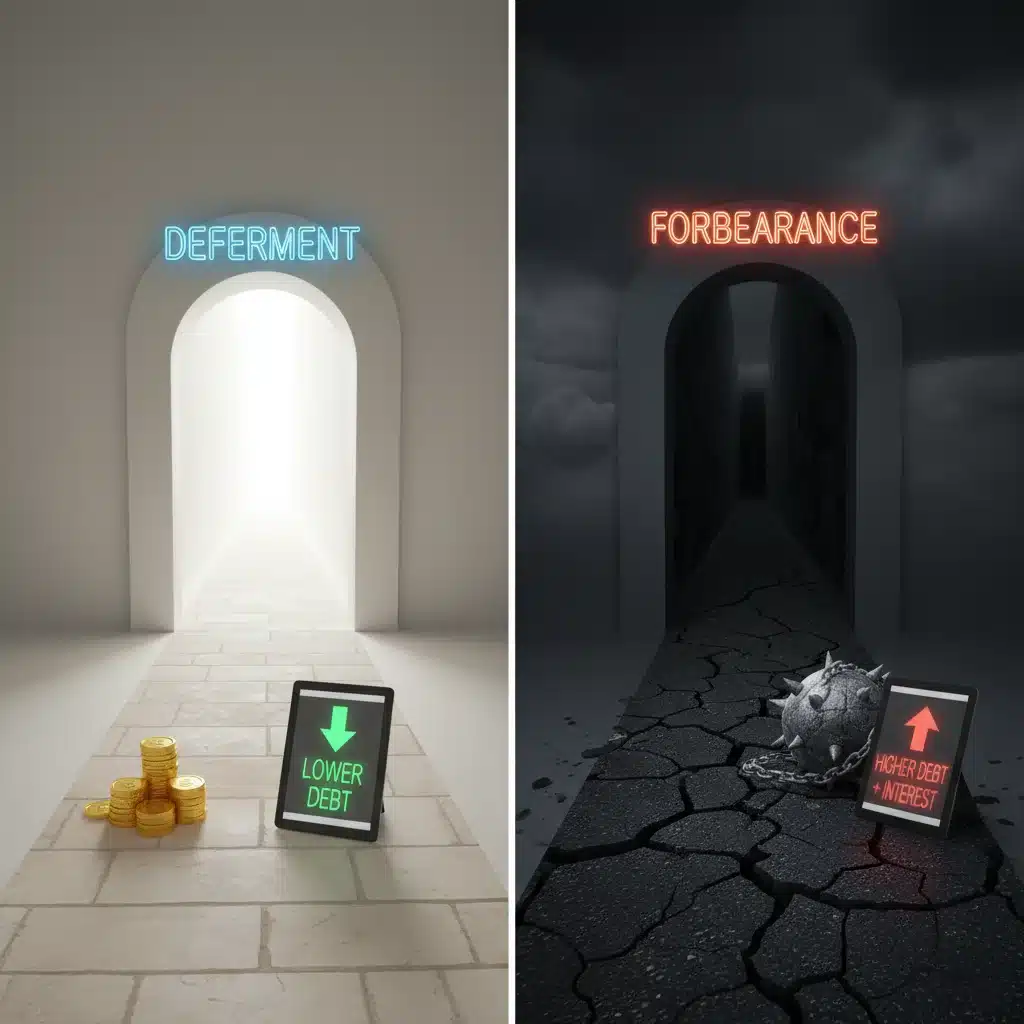
Student loan forbearance is another option for a temporary pause in payments, but it typically comes with a significant caveat: interest almost always accrues on all types of loans, both federal and private, during the forbearance period. This means your loan balance will likely be higher when your forbearance ends than when it began, due to the capitalized interest. While it offers immediate relief, it can be a more expensive option in the long run for your student loan pause.
Eligibility for Forbearance
Forbearance is generally easier to obtain than deferment because the eligibility criteria are broader. There are two main types:
- General Forbearance: This is granted at the discretion of your loan servicer for reasons such as financial difficulties, medical expenses, or changes in employment. You usually need to request this and explain your situation.
- Mandatory Forbearance: Your loan servicer is required to grant you forbearance in specific situations, such as:
- Serving in a medical or dental internship/residency.
- If your student loan payments are 20% or more of your gross monthly income, and you are serving in a national service position.
- If you are performing service that qualifies you for partial repayment of your loans under the Department of Defense Student Loan Repayment Program.
- If you are a member of the National Guard and have been activated by a governor, but you are not eligible for military deferment.
Similar to deferment, private lenders have their own forbearance policies, which can vary widely. Some may offer it for a limited time, while others may not offer it at all. Always check directly with your private loan servicer.
Interest Accrual During Forbearance
This is the critical distinction. During forbearance, interest accrues on all types of federal student loans (subsidized, unsubsidized, PLUS, and consolidation loans) and almost all private student loans. This accrued interest is then capitalized (added to your principal balance) at the end of the forbearance period. This increases your total loan amount and, consequently, the total interest you’ll pay over the life of the loan. This is a significant factor to consider when evaluating a student loan pause.
For example, if you have a $30,000 unsubsidized loan at 6% interest and enter forbearance for 12 months, approximately $1,800 in interest will accrue during that year. When the forbearance ends, your new principal balance will be $31,800. This higher principal means your future payments will include interest on this increased amount, costing you more over time. Understanding this impact is crucial for anyone considering a student loan pause.
Applying for Forbearance
To apply for forbearance, you’ll need to contact your loan servicer. They will provide the necessary forms and explain the documentation required. For general forbearance, you’ll likely need to describe your financial hardship. For mandatory forbearance, you’ll need to provide proof of your qualifying situation. As with deferment, it’s best to apply before you miss a payment to avoid negative consequences on your credit report.
Key Differences: Deferment vs. Forbearance for Your Student Loan Pause
The table below summarizes the core distinctions between student loan deferment and forbearance, which are vital for making an informed decision about your student loan pause in 2026.
| Feature | Deferment | Forbearance |
|---|---|---|
| Interest Accrual (Federal Subsidized Loans) | Government pays interest (no accrual for borrower) | Interest accrues for borrower |
| Interest Accrual (Federal Unsubsidized & PLUS Loans) | Interest accrues for borrower | Interest accrues for borrower |
| Interest Accrual (Private Loans) | Typically accrues for borrower (rare exceptions) | Almost always accrues for borrower |
| Interest Capitalization | Does not occur for subsidized loans; occurs for unsubsidized/PLUS if interest isn’t paid | Always occurs if interest isn’t paid during the period |
| Eligibility | Specific, strict criteria (e.g., in-school, unemployment, economic hardship) | Broader criteria, often at servicer’s discretion (general hardship) or mandatory situations |
| Impact on Loan Balance | Can remain the same (subsidized) or increase (unsubsidized/private) | Almost always increases due to interest capitalization |
| Long-Term Cost | Potentially lower, especially for subsidized loans | Generally higher due to capitalized interest |
The most significant takeaway is the interest accrual and capitalization. If you have federal subsidized loans and qualify for deferment, it is almost always the superior choice for a student loan pause. If you only have unsubsidized or private loans, both options will accrue interest, but deferment might still be preferable if it offers better terms or avoids certain fees that forbearance might entail. Always compare the specific details with your servicer.
Choosing the Right Pause for Your Student Loans in 2026
Deciding between deferment and forbearance requires careful consideration of your current financial situation, the type of loans you have, and your long-term repayment goals. Here’s a step-by-step approach to help you make the best decision for your student loan pause:
1. Understand Your Loan Types
First, identify whether your loans are federal or private, and if federal, whether they are subsidized or unsubsidized. This is the most crucial step, as it dictates how interest will be handled during a student loan pause. Log in to your loan servicer’s portal or the Federal Student Aid website (for federal loans) to get this information.
2. Assess Your Eligibility for Deferment
Review the eligibility criteria for deferment. Are you currently unemployed, enrolled in school, or experiencing severe economic hardship? If you qualify for a deferment, especially one where the government pays your interest (e.g., in-school deferment for subsidized loans), this should generally be your first choice for a student loan pause.
3. Consider the Duration of Your Hardship
How long do you anticipate needing to pause your payments? Deferments and forbearances typically have maximum time limits. For example, unemployment deferment is usually limited to three years. If your hardship is expected to be short-term, either option might work, but the interest impact is still a factor. For longer-term issues, you’ll need to plan carefully and understand the cumulative effect of interest accrual.
4. Calculate the Cost of Interest
If deferment isn’t an option where the government pays your interest, or if you have unsubsidized/private loans, calculate how much interest will accrue during the pause. Your loan servicer can help you with this. Knowing the exact financial impact (how much your loan balance will increase) can help you decide if a student loan pause is worth the cost, or if other alternatives might be better.
5. Explore Income-Driven Repayment (IDR) Plans
Before resorting to forbearance, especially for federal loans, investigate Income-Driven Repayment (IDR) plans. These plans adjust your monthly payment based on your income and family size. For some borrowers, payments can be as low as $0 per month, and during these periods, the government often subsidizes some or all of the accrued interest on subsidized loans. This can provide a more sustainable long-term solution than a temporary student loan pause through deferment or forbearance, as it counts towards eventual loan forgiveness after 20 or 25 years of payments.
6. Contact Your Loan Servicer
Once you have a clearer idea of your situation, contact your loan servicer. They are your primary resource for understanding your specific options, eligibility, and the application process. Be prepared to discuss your financial hardship and ask specific questions about interest accrual and capitalization for your particular loans. They can help you compare the real-world impact of a student loan pause on your total debt.
7. Exhaust Deferment Options First
As a general rule, always try to qualify for deferment before considering forbearance, especially if you have subsidized federal loans. The benefit of not having interest accrue is substantial.
Potential Pitfalls and Important Considerations for Your Student Loan Pause
While deferment and forbearance offer much-needed relief, they are not without their downsides. It’s crucial to be aware of these to avoid unexpected financial burdens.
Increased Total Cost of the Loan
As repeatedly mentioned, interest accrual, especially with capitalization, significantly increases the total amount you will repay over the life of your loan. A student loan pause, while helpful in the short term, can be costly in the long run.
Impact on Loan Forgiveness Programs
If you are pursuing Public Service Loan Forgiveness (PSLF) or income-driven repayment (IDR) forgiveness, periods of deferment or forbearance generally do not count as qualifying payments. There are exceptions, such as certain mandatory forbearances or specific deferments (like military deferment), but it’s vital to confirm this with your servicer. Relying on a student loan pause without understanding its impact on forgiveness can delay your progress towards loan discharge.
Limited Timeframes
Both deferment and forbearance are temporary. They have maximum time limits (e.g., three years for unemployment deferment, or typically 12 months at a time for general forbearance, with a cumulative limit). You cannot indefinitely pause your payments. Plan for when your student loan pause will end and how you will resume payments.
Private Loan Differences
Private lenders are not bound by the same federal regulations. Their deferment and forbearance options are usually more limited, have stricter eligibility, and almost always accrue interest. Always read the fine print of your private loan agreement and speak directly with your private loan servicer.
Credit Score Impact
If you properly apply and are granted a deferment or forbearance, it will not negatively impact your credit score. However, if you simply stop paying without approval, your loans will become delinquent, severely damaging your credit. A proper student loan pause is key to protecting your financial standing.

Alternatives to a Full Student Loan Pause
Before committing to a full student loan pause through deferment or forbearance, consider these alternatives that might offer more favorable terms or long-term benefits:
Income-Driven Repayment (IDR) Plans
As mentioned, IDR plans for federal student loans can significantly reduce your monthly payments, sometimes to $0, based on your income and family size. These payments count towards eventual loan forgiveness, and for subsidized loans, the government may cover some or all of the interest in certain situations. This is often a better long-term strategy than a temporary pause.
Changing Repayment Plans
For federal loans, you can switch between various repayment plans (e.g., Standard, Graduated, Extended) to find one that better fits your current budget. Some plans extend the repayment period, lowering your monthly payment, though increasing the total interest paid over time.
Refinancing (Private Loans Primarily)
If you have private student loans and a strong credit score (or a co-signer with one), refinancing could lead to a lower interest rate or a longer repayment term, reducing your monthly payments. However, refinancing federal loans into a private loan means losing access to federal benefits like IDR plans, deferment, and forbearance, so this decision should be made with extreme caution.
Making Interest-Only Payments
If you can afford to, making interest-only payments during a period of financial hardship (even during forbearance) can prevent interest capitalization and significantly reduce the total cost of your loan. This is a proactive measure that can save you money in the long run, even if you need a temporary student loan pause on principal payments.
Preparing for 2026 and Beyond
As we approach 2026, the economic environment and federal student loan policies may continue to evolve. Staying informed is your best defense against unexpected financial challenges. Here are some proactive steps:
- Monitor Official Sources: Regularly check the U.S. Department of Education’s Federal Student Aid website (studentaid.gov) for the latest updates on federal loan programs and policies.
- Maintain Communication with Your Servicer: Keep your contact information updated with your loan servicer and open all communications from them. They are your direct link to information about your specific loans and available options for a student loan pause.
- Build an Emergency Fund: If possible, start building an emergency fund. Even a small cushion can make a significant difference in covering payments during unexpected financial hardships, potentially avoiding the need for a student loan pause altogether.
- Review Your Budget Regularly: Understand where your money is going. A clear budget can help you identify areas where you might cut back to make loan payments, even if reduced, more manageable.
- Seek Financial Counseling: If you’re feeling overwhelmed, consider speaking with a non-profit credit counselor or financial advisor. They can offer personalized advice and help you create a repayment strategy.
Conclusion: Making an Informed Decision for Your Student Loan Pause
Navigating the complexities of student loan deferment vs. forbearance in 2026 requires a thorough understanding of their differences and implications. While both offer a temporary student loan pause, deferment is generally more advantageous for federal subsidized loans as the government covers interest during the pause. Forbearance, while easier to obtain, almost always results in interest accrual and capitalization, increasing your overall debt.
Your best course of action begins with understanding your specific loan types, assessing your eligibility for various programs, and carefully calculating the long-term financial impact of each choice. Always prioritize options that prevent interest capitalization, such as qualifying deferments or income-driven repayment plans, before resorting to general forbearance. By being proactive, informed, and communicative with your loan servicer, you can effectively manage your student loan obligations and make the best decision for your financial well-being, ensuring that your student loan pause serves as a true relief, not a hidden cost.
Remember, a temporary pause is a tool to help you through hardship, not a permanent solution. Plan for the end of your pause and explore sustainable repayment strategies to get back on track. Your financial future depends on these thoughtful decisions.