Student Loan Forgiveness 2026: A Comprehensive Guide to New Programs

Student loan debt continues to be a significant financial burden for millions of Americans, impacting their ability to save for the future, purchase homes, and achieve other financial milestones. As we look towards 2026, many borrowers are eagerly anticipating updates and new opportunities for student loan forgiveness. The landscape of federal student aid and debt relief programs is constantly evolving, making it crucial for borrowers to stay informed about the latest developments. Understanding the nuances of these programs, including eligibility requirements, application processes, and potential changes, is key to navigating your financial future successfully. This comprehensive guide will delve into what borrowers can expect regarding student loan forgiveness 2026, examining current programs, anticipated changes, and strategies to maximize your chances of debt relief.
The journey through student loan repayment can be long and challenging, but various forgiveness programs aim to alleviate some of that burden. From income-driven repayment plans that offer eventual forgiveness to specific programs for public servants and educators, there are multiple avenues to explore. However, these programs often come with complex rules and specific criteria that must be met. Our goal is to demystify these options and provide a clear roadmap for those seeking student loan forgiveness 2026. We will cover everything from the established Public Service Loan Forgiveness (PSLF) program to the nuances of Income-Driven Repayment (IDR) plans and any new initiatives that may emerge as we approach 2026. By the end of this article, you will have a clearer understanding of your options and how to prepare for potential relief.
The Current Landscape of Student Loan Forgiveness Programs
Before diving into what 2026 might hold, it’s essential to understand the existing framework of student loan forgiveness programs. These programs serve as the foundation upon which future changes will likely be built. Familiarity with these options is crucial for any borrower exploring student loan forgiveness 2026.
Public Service Loan Forgiveness (PSLF)
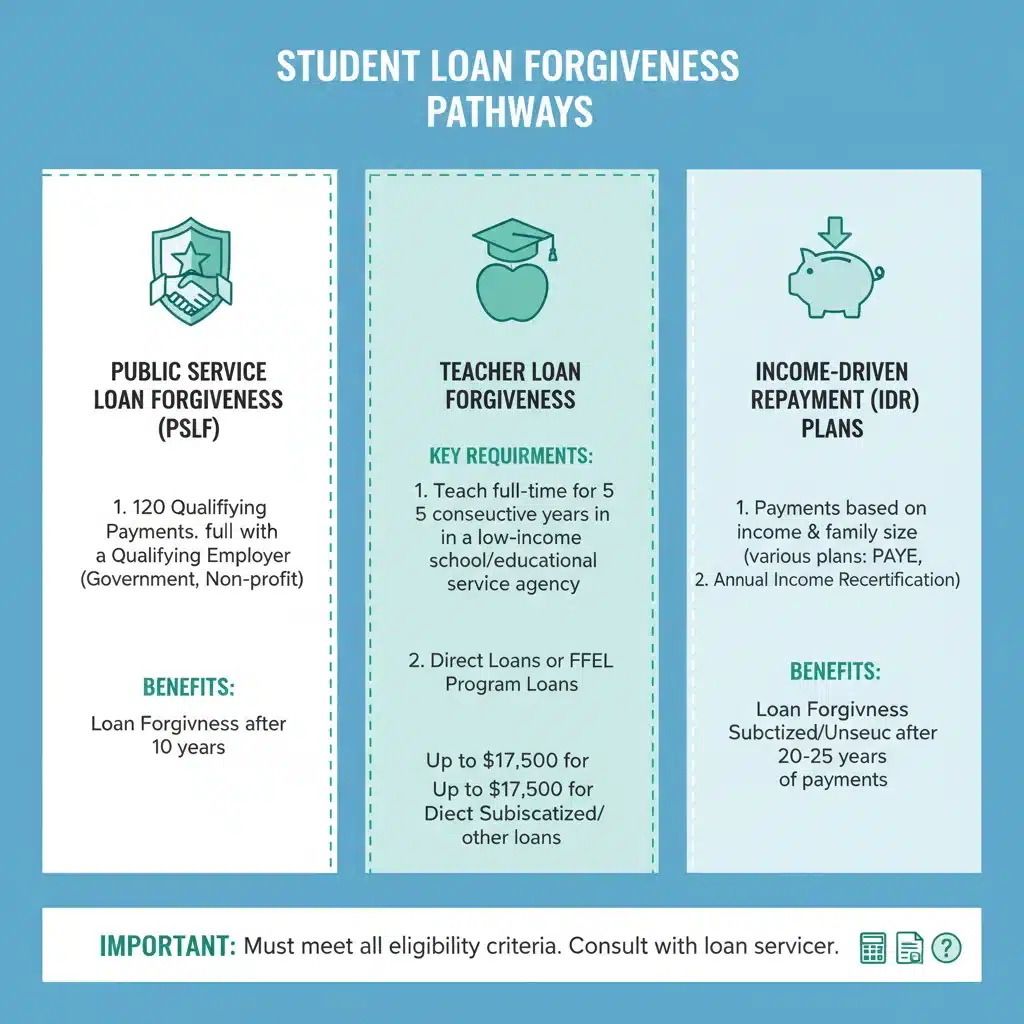
The Public Service Loan Forgiveness (PSLF) program remains one of the most significant avenues for federal student loan relief. Designed to encourage individuals to enter and remain in public service careers, PSLF offers forgiveness of the remaining balance on Direct Loans after 120 qualifying monthly payments have been made under a qualifying repayment plan while working full-time for a qualifying employer. Qualifying employers include government organizations (federal, state, local, or tribal) and not-for-profit organizations that are tax-exempt under Section 501(c)(3) of the Internal Revenue Code. It’s important to note that only Direct Loans are eligible for PSLF. If you have other types of federal loans, such as FFEL Program loans or Perkins Loans, you may need to consolidate them into a Direct Consolidation Loan to become eligible. The payments must also be made under an income-driven repayment plan to maximize the amount forgiven. Tracking your employment and payments meticulously is vital for PSLF, and using the PSLF Help Tool on the Federal Student Aid website is highly recommended to ensure you’re on the right track for student loan forgiveness 2026.
Income-Driven Repayment (IDR) Plans
Income-Driven Repayment (IDR) plans are a cornerstone of federal student loan management, offering lower monthly payments based on your income and family size. There are several IDR plans, including Revised Pay As You Earn (REPAYE), Pay As You Earn (PAYE), Income-Based Repayment (IBR), and Income-Contingent Repayment (ICR). A key feature of IDR plans is that any remaining loan balance is forgiven after 20 or 25 years of qualifying payments, depending on the specific plan and whether you have loans for graduate study. This long-term forgiveness can be a significant benefit, especially for those with high debt-to-income ratios. However, the forgiven amount under IDR plans may be considered taxable income by the IRS, unlike PSLF forgiveness. Borrowers should consider this potential tax liability when planning for student loan forgiveness 2026 through IDR. Regularly recertifying your income and family size annually is critical to ensure your payments remain accurate and you continue to qualify for the plan.
Teacher Loan Forgiveness
Teachers who serve for five consecutive complete academic years in a low-income school or educational service agency may be eligible for Teacher Loan Forgiveness. This program can forgive up to $17,500 for highly qualified math, science, or special education teachers, and up to $5,000 for other eligible teachers. This program is distinct from PSLF, and you cannot receive benefits from both programs for the same period of service. It’s crucial for educators to understand the specific requirements for qualifying schools and teaching subjects to determine their eligibility for this path to student loan forgiveness 2026. The U.S. Department of Education provides a directory of low-income schools to help teachers ascertain their eligibility.
Total and Permanent Disability (TPD) Discharge
Borrowers who are totally and permanently disabled may be eligible for a Total and Permanent Disability (TPD) discharge of their federal student loans. This discharge can be granted based on documentation from the Department of Veterans Affairs, the Social Security Administration, or a physician. If approved, the borrower’s federal student loans are discharged, and they are no longer required to make payments. This is a crucial relief option for those facing severe health challenges. There is typically a three-year post-discharge monitoring period during which borrowers must meet certain income and work requirements to maintain the discharge. Understanding these conditions is important for those considering TPD discharge as a path to student loan forgiveness 2026.
Borrower Defense to Repayment
The Borrower Defense to Repayment program offers relief to students who were misled by their schools or whose schools engaged in other misconduct in violation of state law. This can include misrepresentations about job placement rates, program accreditation, or the quality of instruction. If a borrower successfully proves their case, their federal student loans related to that school can be discharged. This program has seen significant changes and updates over the years, with varying eligibility criteria depending on when the loan was disbursed and when the misconduct occurred. Keeping up-to-date with the latest guidelines is essential for those pursuing this form of student loan forgiveness 2026.
Anticipated Changes and New Initiatives for Student Loan Forgiveness 2026
The landscape of student loan policy is dynamic, often influenced by political shifts, economic conditions, and ongoing advocacy efforts. While it’s impossible to predict the future with absolute certainty, several areas are likely to see continued discussion and potential changes that could impact student loan forgiveness 2026.
Potential for Broader Forgiveness Programs
There has been ongoing debate and advocacy for broader student loan forgiveness, potentially through executive action or legislative measures. While large-scale, across-the-board forgiveness has faced legal and political hurdles, discussions often revolve around targeted relief for specific groups of borrowers or mechanisms to simplify existing programs. Borrowers should pay close attention to policy discussions from the Department of Education and legislative bodies as 2026 approaches, as these could signal new opportunities for student loan forgiveness 2026. Any new programs would likely have specific eligibility criteria, such as income thresholds or debt levels, so staying informed is crucial.
Evolution of Income-Driven Repayment (IDR) Plans
The SAVE (Saving on a Valuable Education) Plan, introduced as a new IDR plan, represents a significant evolution in income-driven repayment. It offers lower monthly payments for many borrowers and has provisions for earlier forgiveness for those with smaller loan balances. As the SAVE Plan fully rolls out and its impact is assessed, there may be further adjustments or new iterations of IDR plans. These changes could make IDR plans even more accessible or provide more generous forgiveness terms, directly influencing the prospects for student loan forgiveness 2026. Understanding the SAVE Plan’s specifics, such as how discretionary income is calculated and the interest subsidy, is vital for current and future borrowers.
Simplification of PSLF and Other Programs
The PSLF program has historically been plagued by complexity and low approval rates, leading to calls for simplification. The Department of Education has already implemented temporary waivers to address some of these issues, making it easier for borrowers to qualify for past payments. It is possible that some of these simplifications could become permanent or that further streamlining efforts will be made to improve borrower access and success rates. Similar efforts could be made for other existing forgiveness programs. Any simplification would be a welcome development for borrowers seeking student loan forgiveness 2026, reducing administrative burdens and increasing clarity.
Impact of Economic Conditions
Economic conditions, such as inflation, interest rates, and employment levels, can influence student loan policy. In periods of economic strain, there might be increased pressure for relief measures, while periods of stability might see less urgency for new programs. Borrowers should monitor economic indicators and how they might shape policy decisions regarding student loan debt. These broader economic trends could indirectly affect the availability and terms of student loan forgiveness 2026.
Legislative Actions and Federal Budget
Ultimately, significant changes to student loan forgiveness programs often require legislative action and federal budgetary allocations. The political climate and the priorities of Congress and the White House will play a substantial role in determining what new programs or modifications to existing ones are enacted by 2026. Keeping an eye on proposed legislation and federal budget discussions is crucial for anticipating future changes in student loan forgiveness 2026.
Strategies to Prepare for Student Loan Forgiveness 2026
Regardless of what new programs or changes emerge, there are proactive steps borrowers can take now to position themselves for potential student loan forgiveness 2026.
Understand Your Loan Types
The first and most critical step is to know what type of federal student loans you have. Direct Loans are generally eligible for the widest range of forgiveness programs, including PSLF and all IDR plans. FFEL Program loans and Perkins Loans often require consolidation into a Direct Consolidation Loan to qualify for certain programs. You can find your federal loan information by logging into your account on StudentAid.gov. This foundational knowledge is essential for charting your path to student loan forgiveness 2026.
Enroll in the Right Repayment Plan
For most forgiveness programs, being on an income-driven repayment (IDR) plan is crucial. These plans not only make your monthly payments more manageable but also count towards the required payment periods for eventual forgiveness under PSLF or IDR forgiveness. Evaluate which IDR plan best suits your financial situation and future goals. The Loan Simulator tool on StudentAid.gov can help you compare different plans and estimate your payments and potential forgiveness. Choosing the optimal repayment plan is a key strategy for maximizing your chances for student loan forgiveness 2026.
Track Your Payments and Employment
For programs like PSLF, meticulous record-keeping is non-negotiable. Keep records of all your payments, employment history, and any correspondence with your loan servicer. For PSLF, submit the PSLF Form annually or whenever you change employers to ensure your payments are being counted correctly. This proactive approach can prevent issues down the line when you apply for student loan forgiveness 2026. Even for IDR forgiveness, having a clear record of your payment history can be beneficial.
Stay Informed and Monitor Updates
The world of student loan policy is constantly changing. Regularly check official sources like StudentAid.gov for the latest announcements, policy changes, and program updates. Subscribe to newsletters from the Department of Education or reputable financial aid organizations. Being informed will allow you to quickly adapt to any new programs or modifications that could impact your eligibility for student loan forgiveness 2026.
Utilize Official Resources
The Federal Student Aid website (StudentAid.gov) is your primary resource for all federal student loan information. It offers tools like the Loan Simulator, PSLF Help Tool, and detailed explanations of all repayment and forgiveness programs. Your loan servicer is also a valuable resource for specific questions about your account, but always cross-reference information with official Department of Education guidance. Relying on accurate, official information is paramount when planning for student loan forgiveness 2026.
Consider Consolidation Wisely
While consolidating federal loans can open doors to certain forgiveness programs (like making FFEL or Perkins loans eligible for PSLF), it can also reset your payment count for IDR forgiveness. Understand the implications of consolidation for your specific situation. If you have older loans that don’t qualify for certain programs, consolidation might be a good strategy, but always weigh the pros and cons. A well-timed consolidation could be beneficial for student loan forgiveness 2026, but a poorly timed one could set you back.

Seek Professional Advice if Needed
If your student loan situation is particularly complex, or if you’re unsure about the best path forward, consider consulting with a non-profit student loan counselor or a financial advisor specializing in student debt. They can provide personalized advice and help you navigate the intricacies of the programs to optimize your chances for student loan forgiveness 2026. Be wary of companies that charge high fees for services you can get for free from the Department of Education or your loan servicer.
Common Misconceptions About Student Loan Forgiveness
There are many myths and misunderstandings surrounding student loan forgiveness that can lead to confusion and missed opportunities. Dispelling these can help borrowers make informed decisions about student loan forgiveness 2026.
Myth: All Student Loans Are Eligible for Forgiveness
Reality: Generally, only federal student loans are eligible for forgiveness programs. Private student loans typically do not qualify for federal forgiveness programs, though some private lenders may offer their own hardship programs or refinancing options. It’s crucial to distinguish between federal and private loans when exploring forgiveness.
Myth: Forgiveness is Automatic
Reality: With very few exceptions (like some TPD discharges), student loan forgiveness is not automatic. Borrowers must actively apply for programs like PSLF, Teacher Loan Forgiveness, or request IDR forgiveness after meeting the payment requirements. Failing to apply means you won’t receive the benefit, even if you qualify.
Myth: My Loans Will Be Forgiven After X Years, No Matter What
Reality: Forgiveness under IDR plans requires consistent payments for 20 or 25 years, and PSLF requires 120 qualifying payments while working for an eligible employer. Simply having loans for a certain period does not automatically lead to forgiveness if the specific program requirements are not met.
Myth: Forgiven Debt is Always Tax-Free
Reality: This varies by program. PSLF is generally tax-free. However, forgiveness under income-driven repayment plans (IDR) can be considered taxable income by the IRS, unless Congress acts to make it tax-exempt. Borrowers should consult a tax professional to understand the potential tax implications of their specific forgiveness scenario, especially as they plan for student loan forgiveness 2026.
Myth: I Can’t Work While Receiving Forgiveness
Reality: Most forgiveness programs have no restrictions on working. In fact, PSLF requires full-time employment in public service. IDR plans adjust payments based on income, so working and earning more might increase your payment but doesn’t disqualify you from eventual forgiveness.
Conclusion: Navigating Student Loan Forgiveness 2026
The path to student loan forgiveness 2026 can seem daunting, but with careful planning, consistent effort, and staying informed, it is an achievable goal for many borrowers. The key is to understand the existing programs, anticipate potential changes, and proactively manage your loans. By knowing your loan types, enrolling in the appropriate repayment plans, diligently tracking your progress, and staying updated with official announcements, you can significantly improve your chances of securing debt relief.
As we move closer to 2026, the landscape of student loan forgiveness will undoubtedly continue to evolve. New policies may emerge, existing programs could be refined, and economic factors might shift the focus of federal aid. Your best defense is a good offense: be informed, be proactive, and don’t hesitate to utilize the wealth of resources available through the Department of Education and reputable financial aid advisors. The goal of alleviating student debt is a shared one, and by taking these steps, you can position yourself to take full advantage of any opportunities for student loan forgiveness 2026 that come your way. Your financial future depends on your engagement, so start preparing today.
Author