
Navigating the complexities of financial aid can often feel like deciphering a secret code. Among the many regulations designed to ensure responsible use of federal funds, the 150% Rule Financial Aid stands out as a particularly crucial one for students. As we approach the 2026 academic year, understanding this rule is more important than ever to safeguard your eligibility for federal grants, scholarships, and Student Loans. This comprehensive guide will demystify the 150% Rule, explain its implications for your Satisfactory Academic Progress (SAP), and provide actionable strategies to help you maintain your financial aid throughout your academic journey.
Many students focus primarily on FAFSA deadlines and award letters, often overlooking the ongoing requirements that dictate continued eligibility. The 150% Rule is not a one-time check; it’s a continuous assessment that can significantly impact your ability to finance your education. Ignoring it can lead to unexpected loss of financial aid, forcing students to find alternative funding or even put their studies on hold. Our goal here is to equip you with the knowledge to proactively manage your academic progress and secure your financial future in higher education.
What is the 150% Rule Financial Aid?
At its core, the 150% Rule Financial Aid is a component of Satisfactory Academic Progress (SAP) that limits the total number of credit hours for which a student can receive federal financial aid. Specifically, it states that you can receive federal financial aid for a maximum of 150% of the credits required to complete your degree or certificate program. This rule is in place to ensure that students are making reasonable progress towards their degree and are not accumulating excessive credits without graduating.
Let’s break down what this means. If your bachelor’s degree program typically requires 120 credit hours to graduate, the 150% Rule allows you to receive federal financial aid for up to 180 credit hours (120 credits * 150% = 180 credits). Once you exceed this 180-credit threshold, even if you haven’t yet graduated, you will generally lose your eligibility for federal financial aid. This includes Pell Grants, Federal Supplemental Educational Opportunity Grants (FSEOG), Federal Work-Study, and federal student loans.
The rule applies to all federal student aid programs under Title IV of the Higher Education Act. It’s not just about passing your classes; it’s about doing so within a reasonable timeframe and credit hour limit. This is a crucial distinction that often catches students off guard. It’s designed to encourage efficient academic planning and timely completion of degrees.
Understanding Satisfactory Academic Progress (SAP)
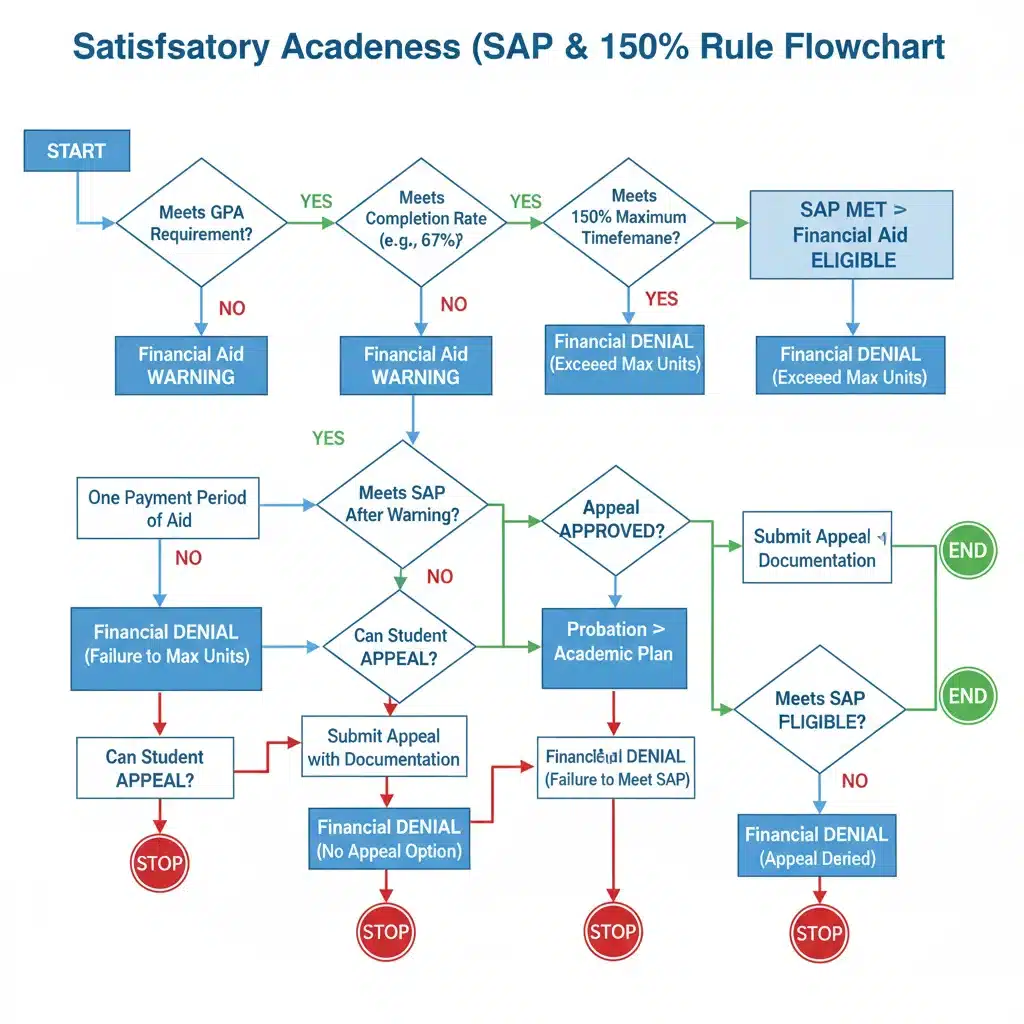
The 150% Rule is one of three main components of Satisfactory Academic Progress (SAP), which all students receiving federal financial aid must meet. The other two components are:
- Qualitative Measure (GPA Requirement): Students must maintain a minimum cumulative Grade Point Average (GPA), typically a 2.0 on a 4.0 scale, though this can vary by institution and program.
- Quantitative Measure (Completion Rate): Students must successfully complete a certain percentage of the credit hours they attempt, usually around 67%. This ensures that students are passing their courses and not just enrolling in them.
The 150% Rule Financial Aid falls under the quantitative measure, specifically addressing the maximum timeframe allowed for degree completion. All three components are evaluated periodically by your institution’s financial aid office, typically at the end of each academic year or payment period. Failure to meet any one of these SAP standards can result in the loss of financial aid eligibility.
Why Does the 150% Rule Exist?
The primary purpose of the 150% Rule is to promote fiscal responsibility and efficient use of federal financial aid funds. By setting a limit on the maximum timeframe, the government aims to:
- Encourage Timely Graduation: It motivates students to complete their degrees within a reasonable period, reducing the likelihood of prolonged enrollment without completion.
- Prevent Abuse of Funds: It helps prevent students from continuously enrolling in courses without making substantial progress, thereby conserving federal aid for those genuinely pursuing a degree.
- Ensure Program Integrity: It’s part of a broader framework to ensure that institutions and students are accountable for federal funds.
While it might seem restrictive to some, the rule is ultimately designed to help students stay on track and make the most of their educational investment. Understanding its intent can help you better strategize your academic path.
How the 150% Rule is Calculated for Your 2026 Financial Aid
Calculating your 150% Rule limit is straightforward, but it requires knowing the exact number of credits required for your specific degree program. This information is typically found in your academic catalog or by consulting your academic advisor.
Step-by-Step Calculation:
- Identify Program Credits: Determine the total number of credit hours officially required for your degree program. For example, a typical bachelor’s degree might require 120 credits, while an associate’s degree might require 60 credits.
- Calculate the 150% Limit: Multiply the program’s required credits by 1.5 (or 150%).
- Example for a 120-credit bachelor’s degree: 120 credits * 1.5 = 180 credits.
- Example for a 60-credit associate’s degree: 60 credits * 1.5 = 90 credits.
- Track Attempted Credits: Keep a running tally of all credit hours you have attempted. This is where many students make mistakes.
What Counts as “Attempted Credits”?
This is a critical point of confusion for many students. “Attempted credits” for the purpose of the 150% Rule Financial Aid often include:
- All credits you registered for: Whether you passed, failed, withdrew, or received an incomplete.
- Transfer credits: Credits you transferred from other institutions, even if you didn’t receive federal aid for them at the previous school.
- Remedial courses: Credits for developmental or remedial courses, though some institutions have specific policies on how these are counted.
- Repeated courses: If you retake a course, both attempts generally count towards your attempted credits, even if only one counts towards your GPA.
- Courses dropped after the add/drop period: These often count as attempted credits even if you don’t receive a grade.
It’s vital to understand your institution’s specific policy on what constitutes attempted credits, as there can be slight variations. Always consult your financial aid office or academic advisor for precise details related to your school.
Impact of Changing Majors or Programs
Changing majors or pursuing multiple degrees can significantly impact your 150% Rule calculation. Every credit hour you attempt, regardless of whether it applies to your new major, will likely count towards your maximum timeframe. If you change majors multiple times, you could quickly accumulate attempted credits that do not directly contribute to your eventual degree, pushing you closer to the 150% limit.
Similarly, if you already hold a bachelor’s degree and are pursuing a second bachelor’s or a graduate degree, the rules can become even more intricate. Generally, a new 150% timeframe is established for each new degree program, but prior credits may still be factored in depending on the institution and program structure. Always discuss such plans with your financial aid office beforehand.
For the 2026 academic year, institutions will continue to strictly enforce these guidelines. Proactive planning and regular check-ins with your academic and financial aid advisors are your best defense against unexpected aid loss.
Maintaining Eligibility: Strategies to Avoid Exceeding the 150% Rule
Falling afoul of the 150% Rule Financial Aid can be a significant setback. Fortunately, there are proactive steps you can take to manage your academic progress and ensure you stay within the limits. Strategic planning and regular monitoring are key.
1. Academic Planning and Advising
- Create a Clear Academic Plan: Work closely with your academic advisor from day one to map out a clear path to graduation. Understand exactly which courses are required and plan your schedule to avoid taking unnecessary credits.
- Regularly Review Your Degree Audit: Most institutions provide a degree audit system (sometimes called a degree progress report) that shows which courses you’ve completed, which are still needed, and how your attempted credits align with your degree requirements. Review this regularly to catch any deviations early.
- Be Cautious with Electives: While electives can enrich your education, taking too many that don’t contribute to your degree can quickly add to your attempted credit total. Choose electives wisely and ensure they fit into your overall academic plan.
2. Course Management and Performance
- Avoid Unnecessary Withdrawals (W): While sometimes unavoidable, each ‘W’ on your transcript typically counts as an attempted credit, even if you don’t earn credit for the course. Consider the implications before withdrawing.
- Limit Course Repeats: Repeating courses to improve a grade is sometimes necessary, but remember that both the original attempt and the repeated attempt often count towards your 150% limit. Strive to pass courses the first time.
- Stay Focused and Engaged: Good academic performance helps you pass courses the first time, reducing the need for repeats or withdrawals. Utilize academic support services like tutoring, writing centers, and study groups if you’re struggling.
3. Understanding Transfer Credits and Program Changes
- Evaluate Transfer Credits Carefully: Before transferring, understand how your new institution will apply your previous credits towards your degree and how they will count towards your 150% limit. Request a credit evaluation early in the transfer process.
- Plan Major Changes Strategically: If you are considering changing your major, do so as early as possible in your academic career. The later you switch, the more likely you are to accumulate excess credits that don’t count towards your new degree. Consult with advisors in both your current and prospective departments.
- Consider Minors and Double Majors: While academically enriching, pursuing minors or double majors can increase your total attempted credits. Ensure these pursuits align with your career goals and that you can complete them within your 150% timeframe.
4. Communicate with Your Financial Aid Office
This is perhaps the most critical strategy. Your financial aid office is your primary resource for understanding the 150% Rule Financial Aid as it applies specifically to your institution and your situation.
- Ask for Regular SAP Status Updates: Don’t wait until you’re in trouble. Ask your financial aid office to provide you with your current SAP status, including your attempted credits and how close you are to the 150% limit.
- Discuss Special Circumstances: If you have extenuating circumstances (e.g., medical issues, family emergencies) that are impacting your academic progress, discuss them with the financial aid office. They may have options or advice for you.
- Understand Appeal Processes: If you do lose financial aid due to the 150% Rule, your institution will have an appeal process. Knowing this process beforehand can save you time and stress if you ever need it.
- FAFSA for 2026: Ensure your FAFSA for the 2026-2027 academic year is submitted accurately and on time, even as you manage SAP.
By actively managing your academic path and staying informed, you can significantly reduce the risk of exceeding the 150% Rule and ensure your continued eligibility for federal financial aid for the 2026 academic year and beyond.
What Happens if You Exceed the 150% Rule?
Exceeding the 150% Rule Financial Aid limit means you will lose your eligibility for federal financial aid. This can be a significant blow, as it encompasses grants, federal loans, and work-study programs that many students rely on. The immediate consequence is that you will be responsible for covering the full cost of tuition, fees, and living expenses out-of-pocket, or finding alternative funding sources.
Loss of Federal Financial Aid
Once your attempted credits surpass the 150% threshold, your institution will notify you that you are no longer making Satisfactory Academic Progress (SAP) and that your federal financial aid eligibility has been suspended. This suspension is usually effective immediately for the next payment period.
It’s important to note that this doesn’t necessarily mean you’re expelled from your program or that you can’t continue your studies. It simply means that the federal government will no longer provide financial assistance for your education.
Options After Losing Aid
While losing federal aid is serious, it’s not always the end of the road. You typically have a few options:
- Appeal the Decision: Most institutions have an appeal process for students who have lost financial aid due to SAP issues, including the 150% Rule.
- Seek Private Loans: If your appeal is denied or you choose not to appeal, you might explore private student loans. However, these often have higher interest rates and less flexible repayment terms than federal loans, and may require a co-signer.
- Pay Out-of-Pocket: If feasible, you can pay for your remaining courses directly.
- Scholarships and Institutional Aid: While federal aid is out, you might still be eligible for institutional scholarships or state-specific aid programs that have different SAP requirements. Research these options thoroughly.
- Enroll Part-Time or Take a Break: Reducing your course load or taking a temporary break from studies might allow you to regroup, save money, and potentially re-evaluate your academic plan.
The Appeal Process
An appeal is your best recourse if you lose financial aid due to the 150% Rule. To successfully appeal, you’ll generally need to demonstrate:
- Extenuating Circumstances: You must explain what unforeseen and uncontrollable events contributed to your failure to meet SAP. This could include serious injury or illness, death of a relative, or other significant personal trauma. Simply changing your major or poor time management are typically not considered extenuating circumstances.
- How Circumstances Have Changed: You need to show that the circumstances that led to your academic difficulty have been resolved or are being managed effectively, so you can now succeed academically.
- An Academic Plan: You will likely need to submit an academic plan developed with your advisor, outlining the specific courses you need to complete your degree and a realistic timeline for doing so. This plan should demonstrate that you can graduate within a reasonable number of additional credit hours.
The appeal is typically submitted to the financial aid office, which then reviews it and makes a decision. If approved, you may be placed on financial aid probation, with specific conditions you must meet to continue receiving aid. It’s a second chance, but it comes with strict requirements.
Understanding these consequences and the available avenues for recourse is crucial for any student nearing their 150% limit. Proactive communication and diligent academic planning remain your best defense.

Common Misconceptions About the 150% Rule
Despite its critical importance, the 150% Rule Financial Aid is often misunderstood. Clarifying these common misconceptions can help students better navigate their academic and financial aid journey for 2026 and beyond.
Misconception 1: “Only Failed Classes Count Towards the Limit.”
Reality: As discussed earlier, almost all attempted credits count towards the 150% limit, regardless of the grade received. This includes courses you withdrew from (W), failed (F), or even passed if they don’t apply to your degree program. The focus is on the *attempt* to earn credits, not just successful completion.
Misconception 2: “If I change majors, the clock resets.”
Reality: This is a dangerous assumption. While a new academic plan might be developed for your new major, all previously attempted credits still count towards your overall 150% limit. Changing majors can quickly lead to exceeding the limit because you accumulate credits that don’t apply to your new degree. This is why early and careful planning is so important.
Misconception 3: “It only applies to federal grants, not loans.”
Reality: The 150% Rule applies to all federal student aid programs under Title IV of the Higher Education Act. This includes Federal Pell Grants, Federal Supplemental Educational Opportunity Grants (FSEOG), Federal Work-Study, and all federal student loans (Direct Subsidized, Direct Unsubsidized, and PLUS loans). Losing eligibility means losing access to all these crucial funding sources.
Misconception 4: “My school will warn me well in advance if I’m getting close to the limit.”
Reality: While many institutions do their best to inform students, the primary responsibility for tracking progress lies with the student. You should not solely rely on your school for warnings. Regularly checking your academic progress and consulting with your financial aid office proactively is your best defense. Notifications often come when you are already in danger or have exceeded the limit, leaving little time to react.
Misconception 5: “If I take time off, the attempted credits disappear.”
Reality: Taking a break from school does not erase your previously attempted credits from the 150% calculation. When you re-enroll, your attempted credit count picks up where it left off. The rule is based on your cumulative attempted credits across all enrollment periods and institutions.
Misconception 6: “AP/IB credits don’t count because I earned them before college.”
Reality: Advanced Placement (AP) or International Baccalaureate (IB) credits that are accepted by your institution and applied towards your degree often count as both attempted and earned credits for SAP purposes. While they give you a head start, they also contribute to your overall progress, meaning you might reach the 150% limit sooner if you then take many extra courses.
Understanding these distinctions is crucial for effective academic and financial planning. Don’t let these misconceptions lead to an unexpected loss of your 150% Rule Financial Aid eligibility. Always seek clarification from your financial aid office if you have any doubts.
Preparing for 2026: What Students Should Do Now
As the 2026 academic year approaches, proactive preparation is key to ensuring you remain compliant with the 150% Rule Financial Aid and other Satisfactory Academic Progress (SAP) requirements. Don’t wait until you receive a notification of aid suspension; take these steps now to secure your financial future in higher education.
1. Review Your Academic Transcript and Degree Audit
This is your most immediate and actionable step. Log into your student portal and access your unofficial transcript and degree audit (or degree progress report). Carefully review:
- Total Attempted Credits: Count every course you’ve registered for, including withdrawals, failures, and repeats.
- Total Earned Credits: See how many credits have actually counted towards your degree.
- Required Program Credits: Confirm the official number of credits needed for your specific degree program.
Compare your attempted credits against your program’s 150% limit. If you’re unsure how to interpret your transcript or degree audit, schedule an appointment with your academic advisor.
2. Consult with Your Academic Advisor
Your academic advisor is an invaluable resource. Discuss your current progress and future plans with them. Specifically, ask about:
- Remaining Courses: A clear list of all courses still required for your degree.
- Optimal Course Sequencing: How to take only the necessary courses in the most efficient order.
- Impact of Electives/Minors: If you’re considering electives or a minor, how they will affect your overall credit count.
- Graduation Timeline: A realistic timeline for completing your degree without accumulating excess credits.
Work with them to develop a concrete academic plan that minimizes wasted credits.
3. Visit Your Financial Aid Office
The financial aid office is the ultimate authority on how the 150% Rule Financial Aid is applied at your institution. Schedule a meeting with a financial aid counselor to:
- Get a Personalized SAP Status: Ask for a precise calculation of your attempted credits and how close you are to your 150% limit according to their records.
- Understand Institutional Policies: Clarify any specific institutional policies regarding transfer credits, repeated courses, remedial coursework, or withdrawals.
- Discuss Potential Issues: If you’re nearing the limit, discuss potential scenarios and what steps you can take. Inquire about the appeal process and what documentation would be needed if you ever had to appeal.
- FAFSA for 2026: Ensure your FAFSA for the 2026-2027 academic year is submitted accurately and on time, even as you manage SAP.
4. Consider Your Enrollment Load Carefully
While taking a full course load might seem like the fastest way to graduate, sometimes strategic under-loading can prevent you from accumulating unnecessary credits, especially if you are struggling academically or need to ensure you pass every course. Balance your desire for timely graduation with your ability to succeed in each course.
5. Document Everything
Keep a record of all communications with your academic and financial aid offices, including dates, names of individuals you spoke with, and summaries of discussions. Save copies of emails, academic plans, and any official notifications regarding your SAP status. This documentation can be invaluable if you ever need to appeal a financial aid decision.
By taking these proactive steps, you are not only ensuring compliance with the 150% Rule Financial Aid but also taking control of your educational journey. A well-informed student is an empowered student, capable of navigating the financial aid landscape successfully through 2026 and beyond.
Conclusion: Securing Your 2026 Financial Aid Future
The 150% Rule Financial Aid is a fundamental aspect of Satisfactory Academic Progress (SAP) that all students relying on federal funding must understand. It’s not merely a bureaucratic hurdle but a mechanism designed to encourage efficient progress toward degree completion and responsible use of taxpayer-funded educational assistance. As you plan for the 2026 academic year, grasping the nuances of this rule is paramount to securing your financial aid eligibility.
We’ve explored how the 150% Rule is calculated, the types of credits that contribute to your maximum timeframe, and the significant implications of exceeding this limit. From understanding that nearly all attempted credits count, regardless of the outcome, to recognizing that changing majors does not reset the clock, debunking common misconceptions is key to informed decision-making.
The most powerful tools at your disposal are proactive academic planning, diligent course management, and consistent communication with your academic and financial aid advisors. By creating a clear academic roadmap, carefully selecting courses, minimizing withdrawals and repeats, and regularly reviewing your progress, you can stay well within the 150% limit. Should unforeseen circumstances arise, remember that an appeal process exists, offering a potential lifeline if you can demonstrate extenuating circumstances and a viable plan for future success.
Don’t leave your financial aid to chance. Take the initiative now to review your academic standing, understand your institution’s specific SAP policies, and ensure every credit hour you attempt is a step closer to your degree, not a step closer to losing crucial financial support. Your educational future for 2026 and beyond depends on your vigilance and informed action. Empower yourself with knowledge, and you can confidently navigate the path to graduation with your financial aid intact.