Mastering Compound Interest: Your Path to Financial Freedom in 2026
In the vast landscape of personal finance, few concepts hold as much transformative power as compound interest. Often dubbed the eighth wonder of the world by Albert Einstein, its ability to generate wealth over time is nothing short of miraculous. For anyone serious about long-term savings growth and achieving financial freedom, understanding and harnessing the power of compound interest growth is not just beneficial; it’s absolutely essential. This comprehensive guide will demystify compound interest, explain its mechanics, and provide actionable strategies to make your money work harder for you, especially as we look towards 2026 and beyond.
Mastering Compound Interest: Your Path to Financial Freedom in 2026
What is Compound Interest? The Foundation of Wealth Accumulation
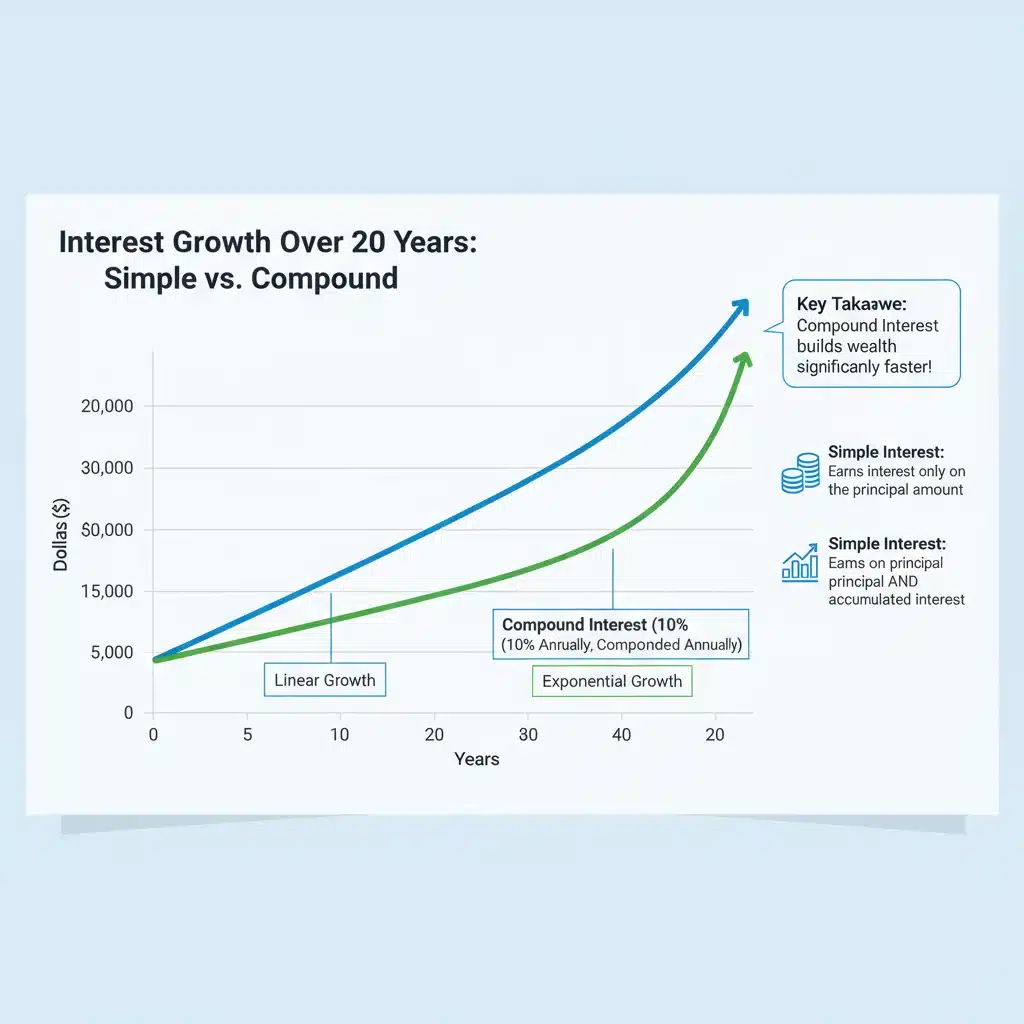
At its core, compound interest is the interest you earn on both the initial principal and the accumulated interest from previous periods. Unlike simple interest, which is calculated only on the principal amount, compound interest continually builds upon itself. This ‘interest on interest’ effect is what makes compound interest growth so powerful, leading to exponential increases in your investment over time.
Imagine you invest $1,000 at a 5% annual interest rate. With simple interest, you’d earn $50 each year, totaling $500 after 10 years. With compound interest, however, the $50 earned in the first year is added to your principal, meaning you earn interest on $1,050 in the second year, and so on. This seemingly small difference creates a snowball effect, where your money grows at an accelerating rate.
The Mechanics of Compound Interest: How Does it Really Work?
To truly appreciate compound interest growth, it’s crucial to understand the variables involved:
- Principal (P): The initial amount of money deposited or invested.
- Interest Rate (r): The annual rate at which your investment grows, expressed as a decimal.
- Number of Times Interest is Compounded Per Year (n): How often the interest is calculated and added to the principal (e.g., annually, semi-annually, quarterly, monthly, daily). The more frequently interest is compounded, the faster your money grows.
- Time (t): The number of years the money is invested or borrowed for.
The Compound Interest Formula
The most common formula for calculating compound interest is:
A = P (1 + r/n)^(nt)
Where:
- A = the future value of the investment/loan, including interest
- P = the principal investment amount (the initial deposit or loan amount)
- r = the annual interest rate (as a decimal)
- n = the number of times that interest is compounded per year
- t = the number of years the money is invested or borrowed for
Let’s use an example: You invest $10,000 at an annual interest rate of 6%, compounded monthly, for 10 years.
- P = $10,000
- r = 0.06
- n = 12 (compounded monthly)
- t = 10 years
A = 10,000 (1 + 0.06/12)^(12*10)
A = 10,000 (1 + 0.005)^(120)
A = 10,000 (1.005)^120
A ≈ 10,000 * 1.819396
A ≈ $18,193.97
In this scenario, your initial $10,000 would grow to approximately $18,193.97 over 10 years, with $8,193.97 being the interest earned through compound interest growth.
The Power of Time: Why Starting Early Matters
One of the most critical factors influencing compound interest growth is time. The longer your money has to compound, the more significant the returns. This is often illustrated by the ‘early bird’ versus ‘late bloomer’ example:
- Early Bird: Invests $5,000 per year for 10 years (total $50,000) starting at age 25, then stops contributing but lets the money grow until age 65.
- Late Bloomer: Invests $5,000 per year for 30 years (total $150,000) starting at age 35, until age 65.
Assuming an average annual return of 8%, the early bird, despite investing significantly less ($50,000 vs. $150,000), will likely end up with a larger sum at age 65 due to the extra decade of compounding. This highlights the immense advantage of starting your investments as early as possible to maximize compound interest growth.
Strategies for Maximizing Compound Interest Growth in 2026
Now that you understand the fundamentals, let’s explore practical strategies to supercharge your compound interest growth.
1. Start Early and Be Consistent
As discussed, time is your greatest ally. Begin investing as soon as you can, even if it’s a small amount. Consistency is key; regular contributions, even modest ones, will significantly boost your principal over time, providing more fuel for compound interest to work its magic. Automate your savings and investments to ensure you’re consistently contributing.
2. Maximize Contribution Amounts
The more you invest initially and consistently, the larger the base upon which interest can compound. Look for ways to increase your savings rate: cut unnecessary expenses, seek higher-paying jobs, or develop side hustles. Every extra dollar contributed early on has a magnified effect on your long-term compound interest growth.
3. Choose Investments with Higher (Realistic) Returns
While higher returns come with higher risk, selecting appropriate investment vehicles is crucial. Savings accounts offer minimal interest, while diversified portfolios of stocks, bonds, and mutual funds typically offer better returns over the long term, allowing for more substantial compound interest growth. Consult a financial advisor to align your investments with your risk tolerance and financial goals.
4. Understand Compounding Frequency
The more frequently interest is compounded, the better. Daily compounding will yield slightly more than monthly, which will yield more than quarterly, and so on. When comparing investment options, always check the compounding frequency. While the difference might seem small in the short term, it can add up significantly over decades, enhancing your compound interest growth.
5. Reinvest Your Earnings
For investments like dividends from stocks or interest from bonds, ensure you reinvest these earnings back into the original investment. This is the essence of compounding; turning your earnings into new principal that can also earn interest. Many brokerage accounts offer automatic dividend reinvestment plans, making this strategy effortless.
6. Minimize Fees and Taxes
Fees and taxes are silent killers of compound interest growth. High expense ratios on mutual funds or frequent trading commissions can significantly erode your returns. Opt for low-cost index funds or ETFs. Similarly, utilize tax-advantaged accounts like 401(k)s, IRAs, and HSAs, where your investments can grow tax-deferred or tax-free, allowing compound interest to work without interruption.
Real-World Applications of Compound Interest
Compound interest isn’t just a theoretical concept; it’s a practical tool used in various financial aspects.
Retirement Savings (401k, IRA)
These are prime examples of vehicles designed for compound interest growth. Contributions grow tax-deferred, meaning you don’t pay taxes on the gains until retirement, allowing your money to compound uninterrupted for decades. Maxing out these accounts is one of the most effective ways to leverage compounding for long-term wealth.
Investment Portfolios
Whether you’re investing in individual stocks, bonds, mutual funds, or ETFs, the goal is often to benefit from compound interest. As your investments appreciate and generate returns (dividends, interest, capital gains), reinvesting these returns helps accelerate your portfolio’s compound interest growth.
Education Savings (529 Plans)
Saving for a child’s education often involves 529 plans, which offer tax-advantaged growth. Contributions grow through compound interest, providing a substantial fund for future educational expenses.
Debt: The Dark Side of Compounding
While beneficial for investors, compound interest works against borrowers. High-interest debts like credit card balances accrue interest on the principal and previously unpaid interest, leading to rapid debt accumulation. Understanding this negative compounding effect underscores the importance of paying off high-interest debt quickly to prevent it from spiraling out of control.

Understanding the Future: Compound Interest Growth in 2026 and Beyond
As we move into 2026, the principles of compound interest remain timeless, but the financial landscape evolves. Economic conditions, inflation rates, and market volatility can all influence the actual returns on your investments. However, the underlying mathematical power of compound interest growth remains constant.
In an environment of fluctuating interest rates, it becomes even more crucial to:
- Stay Diversified: Don’t put all your eggs in one basket. A diversified portfolio can help mitigate risks and maintain steady compound interest growth even during market downturns.
- Review and Rebalance: Regularly review your portfolio to ensure it aligns with your risk tolerance and goals. Rebalancing helps maintain your desired asset allocation.
- Educate Yourself: Continuously learn about personal finance and investment strategies. The more informed you are, the better equipped you’ll be to make decisions that optimize your compound interest growth.
The year 2026 is not just a date; it’s an opportunity to recommit to your financial goals and leverage the enduring power of compound interest. Whether you’re planning for retirement, a down payment on a home, or simply building a robust emergency fund, compound interest will be your most loyal ally.
Common Misconceptions About Compound Interest
Despite its widespread recognition, several misconceptions about compound interest growth persist:
- It’s Only for the Wealthy: This is entirely false. Compound interest works for everyone, regardless of their starting capital. Even small, consistent contributions can lead to significant wealth over time.
- It’s a Get-Rich-Quick Scheme: Compound interest is powerful, but it requires patience. It’s a ‘get rich slow’ scheme, emphasizing consistent effort and long-term commitment rather than overnight success.
- Interest Rates Are Everything: While interest rates are important, time and compounding frequency often play a more significant role in the overall growth of your investment. A slightly lower interest rate over a much longer period can still outperform a higher rate over a shorter period.
- It’s Too Complicated: The basic concept is simple: interest on interest. While the formula can look daunting, many online calculators can do the heavy lifting for you, allowing you to focus on the strategic aspects of maximizing your compound interest growth.
Practical Steps to Kickstart Your Compound Interest Journey
Ready to put compound interest to work for you? Here are actionable steps:
- Set Clear Financial Goals: Define what you’re saving for (retirement, house, child’s education). Specific goals provide motivation and help you determine how much you need to save and invest.
- Create a Budget: Understand your income and expenses. Identify areas where you can cut back to free up more money for investing, thereby accelerating your compound interest growth.
- Build an Emergency Fund: Before investing heavily, ensure you have 3-6 months of living expenses saved in an easily accessible, high-yield savings account. This prevents you from needing to tap into your investments during unforeseen circumstances.
- Open an Investment Account: Choose a brokerage firm and open a suitable account (e.g., Roth IRA, Traditional IRA, 401(k), taxable brokerage account).
- Choose Your Investments Wisely: Start with low-cost index funds or ETFs that track broad market indexes. These offer diversification and typically good returns over the long term, perfect for fostering compound interest growth.
- Automate Your Contributions: Set up automatic transfers from your checking account to your investment account on a regular basis. This ensures consistency and takes the guesswork out of saving.
- Monitor and Adjust: Periodically review your investments and financial plan. Life changes, and your financial strategy should adapt accordingly.
The Psychological Aspect of Compound Interest
Beyond the numbers, there’s a significant psychological benefit to understanding and applying compound interest. It fosters patience, discipline, and a long-term perspective on money. Seeing your money grow, even slowly at first, can be incredibly motivating and reinforce positive financial habits. This long-term thinking is crucial for navigating market fluctuations and resisting the urge to make impulsive financial decisions that could derail your compound interest growth.
Moreover, the concept of compound interest encourages a mindset of delayed gratification. Instead of spending every dollar earned, you learn to appreciate the future value of money invested today. This shift in perspective is often what separates those who achieve significant wealth from those who struggle financially.
Conclusion: Embrace Compound Interest for a Secure Financial Future
Compound interest is not merely a financial concept; it’s a powerful engine for wealth creation and financial freedom. By understanding its mechanics, starting early, investing consistently, and making informed choices, you can harness its incredible power to achieve your long-term financial goals. As we look towards 2026 and beyond, the principles of compound interest growth will remain a cornerstone of sound financial planning. Don’t underestimate its potential; start today, be patient, and watch your money grow exponentially.
Embrace the journey of consistent saving and smart investing, and you’ll soon discover why compound interest truly is one of the most powerful forces in the financial universe. Your future self will thank you for mastering this essential financial principle.
Author