529 Plan Optimization 2026: Maximize Education Savings Tax-Advantaged

529 Plan Optimization for 2026: Strategies to Maximize Tax-Advantaged Education Savings
Planning for your child’s education is one of the most significant financial undertakings many families face. With college costs continuing to rise, leveraging every available tool to save effectively is paramount. Among these, the 529 plan stands out as a powerful, tax-advantaged savings vehicle. As we look towards 2026, understanding the nuances of 529 plan optimization becomes even more crucial. This comprehensive guide will delve into advanced strategies, recent changes, and expert tips to help you maximize your education savings and ensure a brighter future for your loved ones.
The landscape of education finance is ever-evolving. What worked last year might not be the most optimal approach next year. Therefore, staying informed about the latest regulations, investment opportunities, and strategic maneuvers is key to successful 529 plan optimization. We’ll explore everything from contribution strategies and investment choices to beneficiary changes and withdrawal considerations, all with an eye on maximizing your tax benefits and overall savings potential.
Understanding the Fundamentals of 529 Plans
Before diving into advanced 529 plan optimization, it’s essential to have a solid grasp of the basics. A 529 plan is a tax-advantaged savings plan designed to encourage saving for future education costs. Sponsored by states, state agencies, or educational institutions, these plans offer significant benefits, primarily at the federal level, and often at the state level as well.
Key Features of 529 Plans:
- Tax-Free Growth: Investments within a 529 plan grow tax-free.
- Tax-Free Withdrawals: Qualified withdrawals for eligible education expenses are tax-free.
- State Tax Benefits: Many states offer tax deductions or credits for contributions to their 529 plans, and sometimes even for contributions to out-of-state plans.
- Ownership and Control: The account owner retains control of the account, even after the beneficiary reaches adulthood.
- High Contribution Limits: Most plans have very high lifetime contribution limits, often exceeding $300,000 or even $500,000 per beneficiary.
- Flexibility: If the original beneficiary doesn’t use the funds, you can change the beneficiary to another eligible family member without penalty.
Types of 529 Plans:
- College Savings Plans: These are the most common type. They allow you to invest contributions in a variety of investment options, typically mutual funds or exchange-traded funds (ETFs). The value of your account will fluctuate based on the performance of these investments. This is where most of our 529 plan optimization strategies will focus.
- Prepaid Tuition Plans: These plans allow you to lock in tuition rates at eligible in-state public colleges and universities. Some private colleges also participate. These plans are less common and typically have more restrictions.
Strategic Contributions: Maximizing Your Input for 2026
The cornerstone of effective 529 plan optimization begins with how and when you contribute. Your contribution strategy can significantly impact the long-term growth of your education savings.
Front-Loading Contributions (Superfunding):
One of the most powerful strategies for 529 plan optimization is front-loading contributions, also known as superfunding. This allows you to contribute up to five years’ worth of the annual gift tax exclusion amount in a single year, without incurring gift tax. For 2026, assuming the current annual gift tax exclusion amount holds or increases slightly, this could mean a substantial initial contribution.
- Benefit: By contributing a large sum early, your money has more time to grow tax-free, leveraging the power of compounding.
- Consideration: While you avoid gift tax, you cannot make additional contributions for that beneficiary for the next four calendar years (or five years in total for the superfunded amount) without potentially triggering gift tax implications.
Maximizing State Tax Benefits:
Many states offer attractive tax incentives for 529 plan contributions. This is a crucial element of 529 plan optimization that is often overlooked.
- State Tax Deductions/Credits: Research your state’s specific rules. Some states offer a deduction for contributions to any 529 plan, while others only offer it for contributions to their own state’s plan.
- Contribution Timing: Be mindful of your state’s tax year deadlines for contributions to qualify for deductions or credits.
- Out-of-State Plans: Even if your state doesn’t offer a deduction for its own plan, or if you prefer an out-of-state plan due to better investment options or lower fees, the federal tax benefits still apply. Weigh the state tax benefit against the investment performance and fee structure of different plans.
Regular and Automated Contributions:
Consistency is key. Setting up automated contributions, even if they are smaller amounts, ensures a disciplined savings approach and takes advantage of dollar-cost averaging. This can smooth out market fluctuations over time.
Investment Strategies for 529 Plan Optimization in 2026
The investment choices within your 529 plan can significantly impact your account’s growth. Effective 529 plan optimization requires a thoughtful approach to investment selection and ongoing management.
Age-Based Portfolios:
Most 529 plans offer age-based portfolios, which automatically adjust their asset allocation as the beneficiary gets closer to college age. They typically start with a more aggressive allocation (more equities) and gradually shift to a more conservative one (more bonds and cash) as the beneficiary ages. This is a popular and often effective default option for many families.
Custom Portfolios:
For those comfortable with a more hands-on approach, many plans allow you to choose from a selection of individual mutual funds or ETFs. This allows for greater customization to align with your risk tolerance and investment philosophy. When considering custom portfolios for 529 plan optimization, pay close attention to:
- Expense Ratios: Lower expense ratios mean more of your money stays invested.
- Fund Performance: Review historical performance, but remember that past performance is not indicative of future results.
- Diversification: Ensure your chosen portfolio is well-diversified across different asset classes.
Monitoring and Rebalancing:
Even with age-based portfolios, it’s wise to periodically review your 529 plan’s performance and asset allocation. Market fluctuations can cause your portfolio to drift from its target allocation. Rebalancing, either manually or through an age-based plan’s automatic adjustments, ensures your risk level remains appropriate for your timeline. This proactive management is vital for sustained 529 plan optimization.
Qualified Expenses and Withdrawal Strategies
Understanding what constitutes a qualified education expense is critical to ensuring your withdrawals remain tax-free. Missteps here can lead to taxes and penalties, undermining your 529 plan optimization efforts.
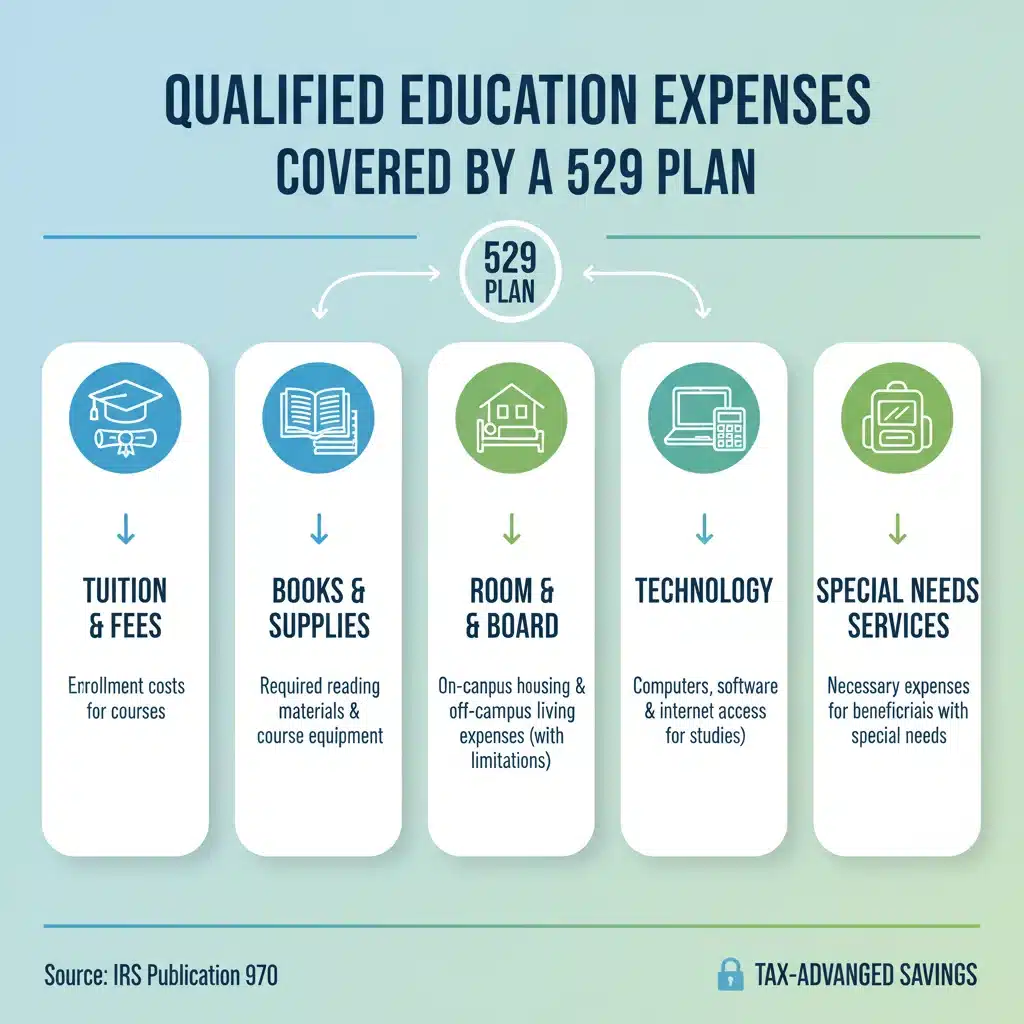
What are Qualified Education Expenses?
For withdrawals to be tax-free, they must be used for qualified education expenses, which generally include:
- Tuition and Fees: For enrollment or attendance at an eligible educational institution.
- Books, Supplies, and Equipment: Required for enrollment or attendance.
- Room and Board: For students enrolled at least half-time. This includes on-campus housing and off-campus housing costs up to the allowance determined by the institution for federal financial aid purposes.
- Computers and Related Equipment: Including internet access, software, and services, if used primarily by the beneficiary during enrollment.
- Special Needs Services: Expenses for a special needs beneficiary incurred in connection with enrollment or attendance.
- K-12 Tuition: Up to $10,000 per year per beneficiary for tuition expenses at a public, private, or religious elementary or secondary school.
- Apprenticeship Programs: Expenses for fees, books, supplies, and equipment required for participation in a registered apprenticeship program.
- Student Loan Repayment: Up to $10,000 (lifetime limit per beneficiary) for qualified student loan principal and interest.
Coordinating with Education Tax Credits:
Be strategic when claiming education tax credits (like the American Opportunity Tax Credit or Lifetime Learning Credit) and making 529 plan withdrawals. You cannot use 529 funds for expenses that are also used to claim a federal education tax credit in the same tax year. This requires careful planning to maximize both benefits and is a key aspect of 529 plan optimization.
Non-Qualified Withdrawals:
Withdrawals not used for qualified education expenses are subject to income tax on the earnings portion and a 10% federal penalty tax, with some exceptions (e.g., beneficiary receives a tax-free scholarship, attends a U.S. military academy, or becomes disabled).
Advanced 529 Plan Optimization Strategies for 2026
Beyond the basics, several advanced strategies can further enhance your 529 plan’s effectiveness.
Changing Beneficiaries:
If your initial beneficiary decides not to pursue higher education, or if there are leftover funds, you can change the beneficiary to another eligible family member without penalty. This includes siblings, cousins, nieces, nephews, parents, and even the account owner themselves. This flexibility is a significant advantage for 529 plan optimization.
Using 529 Funds for K-12 Education:
The Tax Cuts and Jobs Act of 2017 expanded the definition of qualified expenses to include up to $10,000 per year for K-12 tuition. This provides an additional layer of 529 plan optimization for families with children in private elementary or high schools.
The SECURE Act 2.0 and 529 to Roth IRA Rollovers:
One of the most significant changes impacting 529 plan optimization comes from the SECURE Act 2.0, enacted in late 2022. Starting in 2024, unused 529 plan funds can be rolled over to a Roth IRA for the beneficiary, subject to certain conditions:
- The 529 account must have been open for at least 15 years.
- The rollover amount is limited to the Roth IRA annual contribution limit for that year.
- A lifetime limit of $35,000 applies.
- Any contributions made to the 529 plan within the last five years (and their earnings) are not eligible for rollover.
This new provision offers an incredible safety net, addressing a common concern about overfunding a 529 plan. It transforms what might have been a potential penalty into a valuable retirement savings opportunity, significantly enhancing the appeal and flexibility of 529 plan optimization.
Grandparent-Owned 529 Plans:
Grandparents can also open 529 plans for their grandchildren. Historically, grandparent-owned 529s had a disadvantage for financial aid purposes, as distributions were counted as untaxed income to the student, reducing aid eligibility by up to 50%. However, FAFSA simplification (effective for the 2024-2025 aid year and beyond) has eliminated this issue. Grandparent-owned 529s will no longer impact federal financial aid eligibility, making them an excellent tool for multi-generational 529 plan optimization.
Choosing the Right 529 Plan for Your Needs
With nearly every state offering a 529 plan, choosing the right one can feel overwhelming. While your home state’s plan might offer tax benefits, it’s not always the best choice.
Factors to Consider:
- Investment Options: Look for a plan with a diverse range of high-quality, low-cost investment options.
- Fees: Compare administrative fees, underlying fund expense ratios, and any other charges. Lower fees mean more of your money working for you.
- State Tax Benefits: As discussed, evaluate if your state offers a compelling tax deduction or credit. If not, you might consider an out-of-state plan with better investment options.
- Performance: While past performance isn’t a guarantee, it can be one factor in evaluating the investment managers.
- Reputation and Stability: Research the plan’s sponsor and track record.
Websites like Savingforcollege.com and FinAid.org offer excellent comparison tools to help you research and select the best plan for your 529 plan optimization goals.
Impact of Financial Aid on 529 Plan Optimization
While 529 plans are excellent savings vehicles, it’s important to understand how they interact with financial aid eligibility. This understanding is key to holistic 529 plan optimization.
Parent-Owned 529 Plans:
For federal financial aid purposes (FAFSA), a 529 plan owned by a dependent student or their custodial parent is considered a parental asset. Parental assets are assessed at a maximum of 5.64% in the Expected Family Contribution (EFC) calculation. This is a relatively favorable treatment compared to student-owned assets, which are assessed at 20%.
Grandparent-Owned 529 Plans (Post-FAFSA Simplification):
As mentioned, FAFSA simplification has removed the negative impact of grandparent-owned 529 plans on federal financial aid eligibility. Distributions from these plans will no longer be reported as untaxed income on the FAFSA, making them a more attractive option for many families looking to optimize their overall financial strategy.
Other Considerations:
- Institutional Aid: While federal aid rules are standard, individual colleges may have their own methodologies for awarding institutional aid. Some private colleges might treat 529 plans differently.
- Withdrawal Timing: If you anticipate needing financial aid, strategic withdrawal timing can be important. For parent-owned 529s, it’s generally best to use the funds during the later years of college, as the asset value will have been counted in previous FAFSA applications.

Monitoring and Adjusting Your 529 Plan
529 plan optimization is not a set-it-and-forget-it endeavor. Regular monitoring and adjustments are essential to keep your plan on track.
Annual Review:
Make it a habit to review your 529 plan at least once a year. Consider the following:
- Investment Performance: How are your investments performing relative to your expectations and benchmarks?
- Beneficiary’s Age and Timeline: Is the asset allocation still appropriate given how close your beneficiary is to needing the funds?
- Contribution Amounts: Are your contributions keeping pace with your savings goals and projected college costs?
- Changes in State Law: Are there any new state tax benefits or rules that could impact your strategy?
- Changes in Federal Law: Stay updated on federal legislative changes, like the SECURE Act 2.0, that could affect 529 plans.
Adjusting Contributions:
Life circumstances change. You might need to increase or decrease your contributions based on income changes, new financial goals, or updated college cost projections. The flexibility of 529 plans allows for these adjustments without penalty.
Changing Investment Options:
Federal rules generally allow you to change your investment options within a 529 plan twice per calendar year, or if you change the beneficiary. This flexibility allows you to adapt to market conditions or changes in your risk tolerance, contributing to ongoing 529 plan optimization.
Common Pitfalls to Avoid in 529 Plan Management
Even with the best intentions, certain mistakes can hinder your 529 plan optimization efforts. Being aware of these pitfalls can help you steer clear of them.
1. Not Starting Early Enough:
The biggest enemy of savings is procrastination. The power of compound interest is most effective over long periods. Starting early, even with small contributions, can make a significant difference in the long run.
2. Being Too Conservative or Too Aggressive:
Finding the right balance in your investment strategy is crucial. Being too conservative, especially when the beneficiary is young, can lead to insufficient growth. Being too aggressive as college approaches can expose your savings to unnecessary market risk. Age-based portfolios are designed to mitigate this, but if you choose custom options, careful monitoring is needed.
3. Ignoring State Tax Benefits:
Failing to take advantage of state tax deductions or credits is leaving money on the table. Always research your state’s specific 529 plan incentives.
4. Not Understanding Qualified Expenses:
Making non-qualified withdrawals can result in taxes and penalties, negating much of the plan’s tax advantage. Always confirm an expense is qualified before making a withdrawal.
5. Forgetting to Review and Rebalance:
As discussed, a static investment approach can lead to suboptimal results. Regular reviews and rebalancing ensure your plan remains aligned with your goals and risk tolerance.
6. Overlooking the Roth IRA Rollover Option (Post-2023):
For those with older 529 plans and excess funds, the new Roth IRA rollover option is a game-changer. Ignoring this flexibility could mean missing out on a valuable retirement savings opportunity for the beneficiary.
Conclusion: The Future of 529 Plan Optimization
The 529 plan remains an indispensable tool for education savings, and with the strategic insights for 2026, its utility is only growing. From leveraging front-loading and state tax benefits to making informed investment choices and understanding the expanded qualified expenses, every aspect contributes to comprehensive 529 plan optimization.
The introduction of the 529 to Roth IRA rollover under the SECURE Act 2.0 significantly enhances the flexibility and appeal of these plans, addressing previous concerns about overfunding. Coupled with the FAFSA simplification regarding grandparent-owned plans, the future of 529 plans looks brighter than ever for families committed to funding higher education.
By diligently applying these strategies, regularly reviewing your plan, and staying informed about legislative changes, you can confidently navigate the complexities of education finance. Your commitment to proactive 529 plan optimization will not only maximize your tax-advantaged savings but also provide a solid financial foundation for your child’s educational journey and beyond.
Remember, while this guide provides extensive information, consulting with a qualified financial advisor can offer personalized guidance tailored to your specific financial situation and goals. They can help you craft the most effective 529 plan optimization strategy for your family, ensuring you make the most of this powerful savings vehicle.
Author