
College Savings Bonds 2026: Are They Still a Smart Choice?
Navigating the complex landscape of college financing can be daunting for any family. With tuition costs continuing to rise, finding the right savings vehicle is more critical than ever. For decades, college savings bonds were a popular choice, offering a seemingly straightforward way to put money aside for future education expenses. But as we look ahead to 2026 and beyond, a pertinent question arises: are college savings bonds still a viable and smart option for today’s families?
This comprehensive guide will delve deep into the world of college savings bonds, exploring their history, their current relevance, and how they stack up against more modern alternatives like 529 plans. We’ll examine the benefits, dissect the drawbacks, and provide you with the knowledge needed to make an informed decision about your family’s educational future. Understanding the nuances of each savings method is paramount to optimizing your college fund and ensuring your children have the best possible start.
What Are College Savings Bonds? A Historical Perspective
Before we can assess their current viability, it’s essential to understand what college savings bonds are and how they came to be. Historically, the term ‘college savings bonds’ often referred to U.S. Treasury Savings Bonds, specifically Series EE and Series I bonds, when used for educational purposes. These bonds offered a tax-advantaged way to save, as the interest earned could be tax-free if used to pay for qualified higher education expenses and if certain income limitations were met.
Series EE bonds, for instance, were purchased at half their face value and matured over time, guaranteeing a specific return if held for a certain period. Series I bonds, on the other hand, offered a variable interest rate tied to inflation, providing a hedge against rising costs. Both types of bonds were popular due to their safety, backed by the full faith and credit of the U.S. government, and their relatively simple structure.
However, the landscape of financial products has evolved significantly. The accessibility and features of these traditional bonds have changed, leading many to question their competitive edge in today’s market. While they still exist, their role as a primary college savings strategy has diminished compared to newer, more flexible options.
The Mechanics of College Savings Bonds Today
While the heyday of physical savings bonds might be behind us, U.S. Treasury Series EE and Series I bonds are still available electronically through TreasuryDirect.gov. They continue to offer certain benefits, particularly for those who prioritize safety and simplicity. Let’s break down how they work in the context of college savings for 2026 families.
Series EE Bonds: The Fixed-Rate Option
Series EE bonds are purchased at face value and earn a fixed interest rate for 20 years. After 20 years, they will double in value, effectively giving them a guaranteed 3.5% annual return over that period if held to maturity. While this might seem appealing, the actual annual interest rate can be quite low in the interim. The real advantage comes from the tax exclusion for qualified education expenses. To qualify, the bond owner must be at least 24 years old when the bond is issued, and the bond must be redeemed in the same year the education expenses are paid. Income limits also apply, which can be a significant hurdle for many families.
Series I Bonds: The Inflation-Adjusted Option
Series I bonds offer a different appeal: their interest rate adjusts semi-annually based on inflation. This makes them an attractive option in periods of high inflation, as they protect your purchasing power. Like EE bonds, their interest can be tax-free if used for qualified education expenses, subject to the same income limitations and ownership rules. The beauty of I bonds lies in their ability to keep pace with rising costs, a crucial factor when considering the ever-increasing price of college tuition.
Key Considerations for Using Bonds for College
When considering college savings bonds, several factors come into play:
- Tax Exclusion: The primary draw is the potential for tax-free interest if used for qualified education expenses. However, the income limits can be restrictive. For 2023, for example, the modified adjusted gross income (MAGI) phase-out ranges were quite specific, meaning higher-income families might not qualify for the full exclusion. These limits are adjusted annually.
- Safety and Guarantee: Being backed by the U.S. government, these bonds are among the safest investments available. There’s no risk of losing your principal.
- Liquidity: Bonds cannot be redeemed within the first year of purchase. If redeemed between one and five years, you forfeit the last three months of interest. This makes them less liquid than some other savings options.
- Purchase Limits: There are annual purchase limits for both EE and I bonds, typically $10,000 per person per calendar year for each series.
- Safety and Security: As government-backed securities, they carry virtually no risk of default. Your principal is safe, making them an excellent choice for risk-averse investors.
- Tax Benefits: The interest earned can be entirely tax-free at the federal level if used for qualified higher education expenses and if you meet the income requirements. State and local taxes are always exempt. This is a significant perk if you qualify.
- Simplicity: They are relatively easy to purchase and understand, especially compared to more complex investment vehicles.
- Inflation Protection (I Bonds): Series I bonds offer a valuable hedge against inflation, ensuring your savings maintain their purchasing power, which is critical given the rising cost of education.
- No Fees: Unlike many managed investment accounts, there are no annual maintenance fees or commissions associated with buying or holding savings bonds.
- Income Limitations for Tax Exemption: This is arguably the biggest drawback. Many middle-to-high-income families may exceed the MAGI limits, rendering the federal tax exclusion unavailable and significantly reducing their appeal.
- Lower Potential Returns: Especially for EE bonds, the fixed interest rates might not keep pace with the aggressive growth needed to combat college tuition inflation, which often outpaces general inflation. Other investment vehicles may offer higher potential returns over the long term.
- Purchase Limits: The annual $10,000 per person limit for each bond series can restrict how much you can contribute, making it challenging to fund a substantial portion of college costs solely through bonds.
- Lack of Flexibility: Bonds must be held for at least one year. Early redemption (before five years) results in a penalty of the last three months’ interest. There’s also less flexibility in how the funds can be used compared to, say, a 529 plan, which covers a broader range of educational expenses.
- Impact on Financial Aid: Like other savings, bonds are considered assets when calculating financial aid eligibility. While generally treated more favorably than assets held directly by the student, they still contribute to the Expected Family Contribution (EFC).
- Electronic Only: While convenient for some, the electronic-only format via TreasuryDirect might be a barrier for others who prefer traditional paper statements or more user-friendly interfaces.
- Tax Advantages: Contributions to 529 plans grow tax-deferred, and qualified withdrawals for education expenses are entirely tax-free at the federal level. Many states also offer a state income tax deduction or credit for contributions. This is a significant advantage over bonds, especially for higher-income families who may not qualify for the bond interest exclusion.
- Investment Variety: Unlike bonds, 529 plans offer a range of investment options, from conservative money market funds to aggressive stock portfolios. This allows families to tailor their investment strategy to their risk tolerance and time horizon, potentially achieving higher returns than bonds.
- Higher Contribution Limits: 529 plans typically have very high aggregate contribution limits (often hundreds of thousands of dollars), allowing families to save substantially more than the annual limits on savings bonds.
- Broader Qualified Expenses: 529 plans cover a wider array of qualified education expenses, including tuition, fees, room and board, books, supplies, and even certain K-12 tuition expenses (up to $10,000 per year per beneficiary) and student loan repayments (up to $10,000 lifetime per beneficiary). Bonds are generally limited to tuition and fees.
- Flexibility: While not as liquid as a regular savings account, 529 plans offer more flexibility than bonds. You can change beneficiaries within the same family, and if the original beneficiary doesn’t attend college, the funds can be used for another family member.
- Impact on Financial Aid: Assets held in a 529 plan are generally treated favorably in financial aid calculations, typically assessed at a maximum rate of 5.64% of their value, and are considered parental assets (if owned by a parent) which have less impact than student-owned assets.
- Custodial Accounts (UGMA/UTMA): These accounts allow you to save for a minor, but the assets are considered the child’s, which can negatively impact financial aid eligibility. Funds can be used for anything that benefits the child, not just education, which offers flexibility but less control once the child reaches the age of majority.
- Coverdell Education Savings Accounts (ESAs): Similar to 529 plans with tax-free growth and withdrawals for qualified education expenses, but with much lower annual contribution limits ($2,000) and income restrictions for contributors. They offer more investment flexibility than 529 plans.
- Roth IRAs: While primarily retirement vehicles, Roth IRAs can be a flexible option. Contributions can be withdrawn tax-free and penalty-free at any time. Earnings can also be withdrawn tax-free and penalty-free if used for qualified education expenses, provided the account has been open for at least five years. However, prioritizing retirement savings is generally recommended.
- 529 Plans: For the bulk of your savings, leveraging their tax advantages and investment growth potential.
- Series I Bonds: As a conservative component, particularly for inflation protection or for funds you’ll need in the shorter term.
- Roth IRAs: As a flexible back-up, keeping in mind their primary purpose is retirement.
- Taxable Brokerage Accounts: For additional savings once other tax-advantaged options are maxed out.
While these bonds offer stability, their yield might not always be competitive with other investment vehicles, especially for those who don’t qualify for the tax exclusion or who need more aggressive growth to keep pace with tuition inflation.
The Pros and Cons of College Savings Bonds for 2026
To determine if college savings bonds are a good fit for your 2026 college plan, it’s crucial to weigh their advantages against their disadvantages.
Advantages of College Savings Bonds:
Disadvantages of College Savings Bonds:
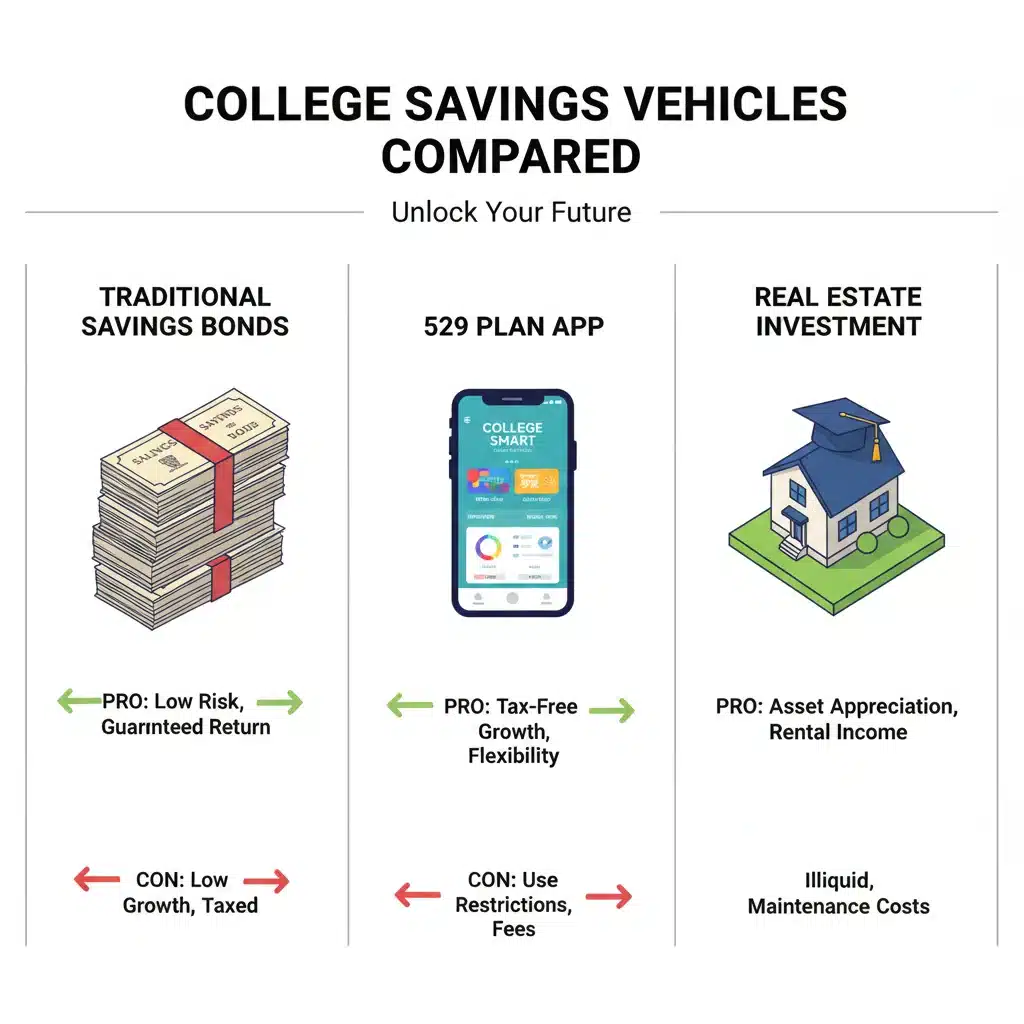
Comparing College Savings Bonds to Modern Alternatives
The financial landscape for college savings has diversified significantly. While college savings bonds still hold a place, it’s crucial to compare them with more contemporary and often more flexible alternatives. The most prominent of these are 529 plans, but other options also exist.
529 Plans: The Dominant Player
529 plans are state-sponsored investment plans designed specifically for education savings. They come in two main forms: prepaid tuition plans and education savings plans.
The main downside of 529 plans is that non-qualified withdrawals are subject to income tax and a 10% penalty on the earnings. Also, investment returns are not guaranteed, unlike with savings bonds.
Other Alternatives:
For most families planning for college in 2026, 529 plans offer a compelling combination of tax benefits, investment flexibility, and high contribution limits that often make them a superior choice to college savings bonds as a primary college savings vehicle.
When Might College Savings Bonds Still Be a Good Option?
Despite the rise of 529 plans and other investment vehicles, there are still specific scenarios where college savings bonds, particularly Series I bonds, might be a valuable component of a broader college savings strategy for 2026 families.
For the Risk-Averse Investor:
If capital preservation and guaranteed returns (for EE bonds) or inflation protection (for I bonds) are your top priorities, and you are highly risk-averse, savings bonds offer unparalleled safety. They are immune to market fluctuations, providing peace of mind that your principal will not diminish.
Families with Lower to Moderate Incomes:
For families who anticipate their income will fall within the MAGI limits for the education tax exclusion when their child attends college, the tax-free interest can make savings bonds a very attractive, simple, and secure option. It’s crucial to project future income carefully to determine eligibility.
As a Complement to Other Savings:
Savings bonds don’t have to be your sole college savings vehicle. They can serve as a conservative component of a diversified portfolio, especially as college approaches and you want to de-risk some of your savings. For instance, you might use 529 plans for aggressive growth in the early years and then allocate a portion of your savings to I bonds as the college start date nears, locking in inflation-protected value.
For Short-Term Savings Goals:
If you’re saving for a shorter-term educational expense, perhaps for a college student who is already in high school, and you want to avoid market volatility, I bonds can be a good choice due to their inflation protection and relative liquidity after one year.
Gift-Giving:
Savings bonds, particularly paper bonds (which are no longer issued but still exist), have historically been popular gifts. While new bonds are electronic, they can still be purchased as gifts. This might not be a primary savings strategy but can be a thoughtful way for grandparents or other relatives to contribute to a child’s education.
It’s important to remember that the maximum annual purchase limits ($10,000 per person per series) mean that bonds alone are unlikely to cover the entire cost of a college education. They are best considered as part of a multi-faceted approach to funding higher education.
Strategic Planning for College in 2026 and Beyond
Effective college savings goes beyond choosing a single product; it involves a holistic strategy tailored to your family’s unique financial situation, risk tolerance, and educational goals. For families eyeing college in 2026, time is of the essence, but there’s still ample opportunity to optimize your savings.
Diversification is Key:
Just as with any investment portfolio, diversification is crucial for college savings. Relying solely on one type of savings vehicle might expose you to unnecessary risks or limit your potential returns. A diversified approach might include:
Understand Your Risk Tolerance and Time Horizon:
With college potentially just a few years away for 2026 families, your investment strategy should reflect a decreasing risk tolerance. Early on, more aggressive investments in a 529 plan might be appropriate. As college approaches, gradually shifting to more conservative investments, including potentially college savings bonds or money market funds within your 529, can help protect your accumulated savings from market downturns.
Consider the Impact on Financial Aid:
Every dollar saved for college can potentially impact financial aid eligibility. Assets held in a child’s name (like UGMA/UTMA accounts or bonds owned directly by the child) are assessed more heavily than parental assets (like 529 plans or bonds owned by a parent). Understanding the Expected Family Contribution (EFC) and how different assets are treated is vital for maximizing aid opportunities.
Regularly Review and Adjust Your Plan:
Life circumstances change, as do college costs and financial aid rules. It’s important to review your college savings plan annually, or whenever there’s a significant life event (e.g., birth of another child, job change, market shift). Adjust your contributions, investment allocations, and overall strategy as needed to stay on track.
Seek Professional Advice:
Navigating college financing can be complex. Consulting a qualified financial advisor specializing in education planning can provide personalized guidance. They can help you assess your current situation, project future costs, and recommend the most suitable combination of savings vehicles for your family’s goals.

The Future of College Savings: Beyond 2026
The landscape of college savings is continuously evolving. As we look beyond 2026, new legislation, economic conditions, and educational trends will undoubtedly shape the best approaches to funding higher education. While college savings bonds may continue to play a niche role, the emphasis remains on flexible, tax-advantaged accounts that can adapt to changing needs.
One area of ongoing discussion is the potential for further enhancements to 529 plans, such as expanded eligible expenses or increased state-level incentives. Additionally, the role of federal student aid programs, grants, and scholarships will always be a critical component of the overall college funding picture. Staying informed about these developments is crucial for long-term planning.
Technology will also continue to influence how families save and plan. User-friendly platforms, AI-powered financial advice, and integrated planning tools are becoming more prevalent, making it easier for families to manage their college funds effectively. The key will be to leverage these tools and resources to create a robust and adaptable savings strategy.
Conclusion: Making an Informed Decision for Your Family
So, are college savings bonds still a viable option for 2026 families? The answer is nuanced: while they offer undeniable safety and specific tax benefits for certain income brackets, they are generally not the most robust or flexible primary savings vehicle compared to modern alternatives like 529 plans.
For most families, 529 plans will likely offer a more advantageous combination of tax benefits, investment growth potential, and flexibility in covering a broader range of educational expenses. However, savings bonds, particularly Series I bonds, can still serve a valuable role as a conservative component of a diversified portfolio, especially for risk-averse savers or those who qualify for the tax-free interest exclusion.
Ultimately, the best approach involves a careful evaluation of your family’s financial situation, income levels, risk tolerance, and time horizon. Don’t put all your eggs in one basket. By understanding the pros and cons of college savings bonds and comparing them thoughtfully with other options, you can craft a comprehensive and effective strategy that helps you confidently meet the rising costs of higher education for your children in 2026 and beyond.
Start planning today, explore all your options, and consider seeking advice from a financial professional to ensure your college savings strategy is as strong and efficient as possible.