Child Tax Credit 2026: Maximizing Benefits for Families with Multiple Children

Child Tax Credit 2026: Understanding the Latest Enhancements for Families with 2+ Children
For millions of families across the United States, the Child Tax Credit (CTC) has been a crucial lifeline, offering significant financial relief and support for raising children. As we look ahead to Child Tax Credit 2026, there’s growing anticipation and discussion around potential enhancements, particularly for households with two or more children. This comprehensive guide aims to demystify the upcoming changes, help you understand how to maximize your benefits, and provide a clear roadmap for navigating the evolving landscape of family tax credits. The future of the CTC holds promising prospects for many, and being well-informed is the first step toward securing your family’s financial well-being.
The importance of the Child Tax Credit cannot be overstated. It represents a tangible commitment to supporting families, alleviating the financial burden of childcare, education, healthcare, and everyday necessities. For families with multiple children, these expenses multiply, making the CTC an even more vital component of their annual budget. The discussions surrounding Child Tax Credit 2026 are centered on making this credit even more impactful, ensuring it reaches those who need it most and provides a more substantial boost to household incomes. By understanding the nuances of these potential changes, families can better plan their finances and take full advantage of the support available.
The Evolution of the Child Tax Credit: A Brief History Leading to Child Tax Credit 2026
To fully appreciate the significance of Child Tax Credit 2026, it’s helpful to briefly review its history and evolution. Introduced in 1997 as a $400 non-refundable credit per child, the CTC has undergone several transformations, reflecting changing economic realities and policy priorities. Its primary goal has always been to reduce child poverty and support middle-class families. Over the years, the credit amount has increased, and its accessibility has expanded, making it a cornerstone of family-focused legislation.
One of the most significant expansions occurred with the American Rescue Plan Act of 2021, which temporarily increased the credit to $3,600 for children under six and $3,000 for children aged six to seventeen. Crucially, it also made the credit fully refundable for that year, meaning even families with little to no tax liability could receive the full amount. This temporary expansion had a profound impact, significantly reducing child poverty rates and providing much-needed relief during a challenging economic period. While these enhanced provisions largely reverted in 2022, the positive impact of the fully refundable and increased credit sparked widespread calls for similar, more permanent reforms.
The discussions surrounding Child Tax Credit 2026 are largely influenced by the success and lessons learned from the 2021 expansion. Policymakers are exploring ways to strike a balance between providing substantial financial support to families and ensuring fiscal responsibility. The focus remains on making the credit more equitable and effective, particularly for larger families who often face higher cumulative expenses. Understanding this historical context provides a foundation for grasping the potential direction and impact of the upcoming changes, highlighting the continuous effort to refine and optimize this vital family benefit. The ongoing debate emphasizes the credit’s role as a dynamic policy tool, continually adapted to meet the evolving needs of American families.
Key Proposed Enhancements for Child Tax Credit 2026 for Families with 2+ Children
As we approach Child Tax Credit 2026, several key proposals are on the table, aiming to significantly enhance the credit, especially for families with two or more children. While specifics are still being debated in Congress, the general direction points towards making the credit more generous and accessible. These proposed changes are a response to ongoing economic pressures and the recognition that raising multiple children presents unique financial challenges.
Increased Credit Amount per Child
One of the most anticipated enhancements for Child Tax Credit 2026 is an increase in the maximum credit amount per child. While the current maximum stands at $2,000 per qualifying child, proposals suggest raising this figure, potentially back to the $3,000 or $3,600 levels seen in 2021, or even higher, particularly for younger children. For families with two or more children, this increase would be compounded, leading to a much more substantial total credit. For example, if the credit increased to $3,000, a family with two children could receive $6,000, a significant boost compared to the current $4,000. This direct financial injection can help cover rising costs of living, from groceries and utilities to school supplies and extracurricular activities.
Enhanced Refundability and Lower Income Thresholds
A critical aspect of the 2021 expansion was its full refundability, meaning that even families with no federal income tax liability could receive the full credit amount. This provision was particularly beneficial for low-income families. For Child Tax Credit 2026, there’s a strong push to make the credit fully or more substantially refundable on a permanent basis. This would ensure that the credit truly benefits all eligible families, regardless of their income level or tax burden, rather than primarily serving as a tax reduction for those with higher incomes. Additionally, proposals include lowering the income threshold at which families can begin to claim the credit, expanding its reach to more vulnerable households and ensuring that the credit starts phasing in at a lower earnings level, offering immediate relief to families struggling to make ends meet.
Inflation Adjustment and Annual Indexing
Another significant proposed change for Child Tax Credit 2026 is the introduction of inflation adjustment or annual indexing. Currently, the CTC amount is not automatically adjusted for inflation, meaning its real value diminishes over time as the cost of living increases. By indexing the credit to inflation, its purchasing power would be maintained year after year, providing more stable and predictable support for families. This long-term adjustment would be particularly beneficial for families with multiple children, as it ensures the credit remains relevant and impactful in an ever-changing economic landscape. This forward-thinking approach would safeguard the credit’s effectiveness for future generations.
Specific Provisions for Families with Multiple Children
While many enhancements would benefit all eligible families, there are specific discussions around additional provisions for families with two or more children within the framework of Child Tax Credit 2026. These could include higher phase-out thresholds for larger families, allowing them to earn more before their credit begins to diminish, or even a slightly higher credit amount for a third or subsequent child. The rationale behind these considerations is the recognition that the financial strain on families grows exponentially with each additional child. Tailoring the credit to directly address the unique needs of larger families would make the CTC an even more powerful tool for economic stability and child well-being. These targeted measures aim to provide proportional support, acknowledging the increased financial demands on bigger households.
These proposed enhancements for Child Tax Credit 2026 represent a significant step towards creating a more robust and equitable support system for American families. By increasing the credit amount, expanding refundability, indexing for inflation, and considering specific provisions for larger families, the CTC could become an even more powerful instrument in reducing child poverty and fostering economic security for millions. Staying informed about these potential changes is crucial for families planning their financial futures.
Who Qualifies for Child Tax Credit 2026? Eligibility Criteria Explained
Understanding the eligibility criteria for the Child Tax Credit 2026 is paramount for families seeking to claim this vital benefit. While the core requirements are expected to remain similar to previous years, any new legislation could introduce subtle but important changes. Generally, several conditions must be met for both the child and the taxpayer to qualify.
Child Eligibility Requirements
For a child to be considered a ‘qualifying child’ for the Child Tax Credit 2026, they must meet several criteria:
- Age Test: The child must be under the age of 17 at the end of the tax year (i.e., 16 or younger). This is a consistent requirement that defines who is considered a ‘child’ for this credit.
- Relationship Test: The child must be your son, daughter, stepchild, foster child, brother, sister, half-brother, half-sister, stepbrother, stepsister, or a descendant of any of them (e.g., a grandchild). This broad definition ensures that various family structures are covered.
- Residency Test: The child must have lived with you for more than half of the tax year. There are exceptions for temporary absences due to special circumstances like illness, education, or military service.
- Support Test: The child must not have provided more than half of their own support for the year. This ensures that the credit is for dependents who are primarily supported by the taxpayer.
- Joint Return Test: The child cannot file a joint return for the year (unless filed only to claim a refund of withheld income tax or estimated tax paid).
- Citizenship Test: The child must be a U.S. citizen, U.S. national, or U.S. resident alien. This is a fundamental requirement for all dependents claimed on U.S. tax returns.
Taxpayer Eligibility Requirements
In addition to the child’s qualifications, the taxpayer claiming the Child Tax Credit 2026 must also meet certain criteria, primarily related to their income:
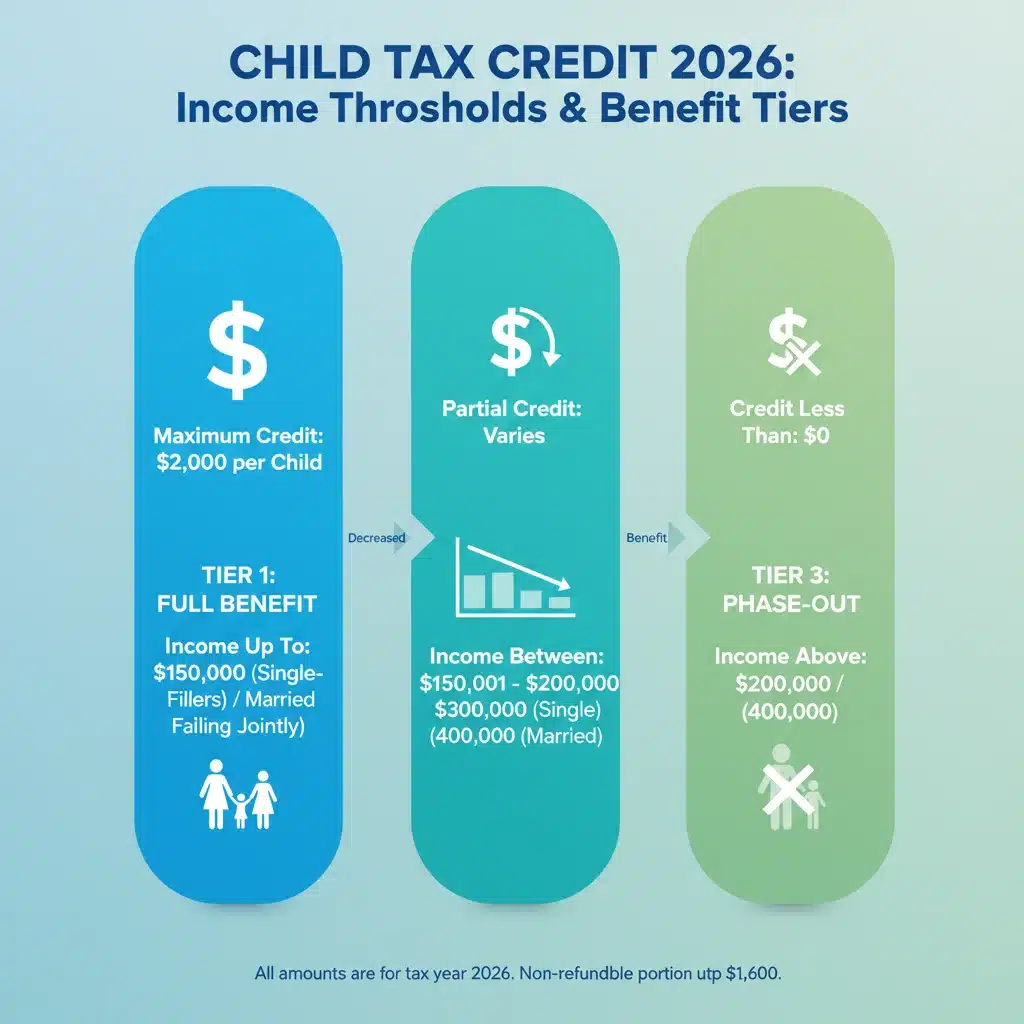
- Adjusted Gross Income (AGI) Limits: The credit begins to phase out for higher-income taxpayers. While the exact thresholds for 2026 are subject to legislative changes, historically, the phase-out typically begins at $400,000 for married couples filing jointly and $200,000 for all other filers. Any new legislation for Child Tax Credit 2026 might adjust these thresholds, potentially raising them to allow more families to qualify for the full credit, especially those with multiple children who have higher overall expenses.
- Social Security Number (SSN): Both the taxpayer and the qualifying child must have a valid Social Security Number (SSN) issued by the Social Security Administration. This is a strict requirement for claiming the credit.
Special Considerations for Families with 2+ Children
For families with two or more children, the primary benefit of qualifying for the Child Tax Credit 2026 is the multiplication of the credit amount. If the maximum credit is $X per child, a family with two children could receive $2X, a family with three children $3X, and so on. This cumulative effect makes the CTC particularly impactful for larger households. While there aren’t typically separate eligibility rules solely based on the number of children, any proposed enhancements for 2026 might introduce nuances, such as higher income phase-out thresholds specifically for larger families, or even a slightly higher credit amount for subsequent children, acknowledging the increased financial demands. It’s crucial for these families to ensure every qualifying child meets all the criteria to maximize their total credit.
Staying updated on the precise eligibility requirements as new legislation unfolds will be crucial. The IRS website and reputable tax professionals will be the best sources for the most current and accurate information regarding Child Tax Credit 2026. Proactive understanding of these rules ensures that eligible families can effectively plan and claim the maximum benefits available to them.
Calculating Your Potential Child Tax Credit 2026 Benefits
Estimating your potential benefits from the Child Tax Credit 2026 requires understanding the proposed changes and applying them to your specific family situation. While the exact figures are subject to legislative finalization, we can outline a general approach to calculation based on current discussions and historical precedents. This estimation is particularly important for families with two or more children, as the cumulative impact of the credit can be substantial.
Step 1: Determine the Maximum Credit Amount per Child
The first step is to ascertain the maximum credit amount per qualifying child for Child Tax Credit 2026. As discussed, this is likely to be higher than the current $2,000. Let’s assume for illustrative purposes that the credit is set at $3,000 per child, with potentially $3,600 for children under six, similar to the 2021 expansion. Your calculation will begin with these figures.
Step 2: Identify Your Number of Qualifying Children
Count the number of children in your household who meet all the eligibility criteria (age, relationship, residency, support, etc.) for the Child Tax Credit 2026. For a family with, say, three qualifying children, two aged 8 and one aged 4, under our illustrative scenario, you would have two children qualifying for the $3,000 credit and one for the $3,600 credit.
Step 3: Calculate Your Gross Credit Amount
Multiply the maximum credit amount by the number of qualifying children. Using our example: (2 children x $3,000) + (1 child x $3,600) = $6,000 + $3,600 = $9,600. This is your gross credit amount before any income phase-outs or refundability considerations. For families with multiple children, this step immediately highlights the significant financial support the credit can provide.
Step 4: Consider Your Adjusted Gross Income (AGI) and Phase-Outs
This is where your income comes into play. The Child Tax Credit 2026, like previous iterations, will likely have income thresholds above which the credit begins to phase out. For every $1,000 (or other specified increment) your AGI exceeds the threshold, your credit amount will be reduced by a certain percentage, typically $50. For example, if the phase-out starts at $200,000 for single filers and $400,000 for married filing jointly, and your AGI is $205,000 (single), your credit might be reduced by $250 (5 x $50). It’s crucial to note that proposed enhancements for 2026 might include higher phase-out thresholds, particularly for families with multiple children, allowing more of the gross credit to be retained by higher-earning families.
Step 5: Account for Refundability
The refundability aspect of the Child Tax Credit 2026 is critical, especially for lower-income families. If the credit is fully refundable, you will receive the full credit amount, even if it exceeds your tax liability. If it’s partially refundable, there might be a limit to the refundable portion, often tied to earned income. For instance, if the credit is $9,600 and your tax liability is $5,000, and the credit is fully refundable, you would receive the $5,000 as a reduction in your taxes and an additional $4,600 as a refund. If it’s not fully refundable, you might only reduce your tax liability to zero and not receive the remaining $4,600 as a refund, or only a portion of it. The push for 2026 is towards greater refundability to ensure the credit benefits all families, including those with little to no tax burden.
Example Calculation for a Family with 2+ Children
Let’s consider a married couple filing jointly with an AGI of $150,000, and three qualifying children (ages 4, 8, and 10).
- Assume Child Tax Credit 2026 rates are $3,600 for children under 6 and $3,000 for children 6-17.
- Qualifying Children: One child under 6 ($3,600), two children 6-17 (2 x $3,000 = $6,000).
- Gross Credit: $3,600 + $6,000 = $9,600.
- Assume phase-out for married filing jointly starts at $400,000. Since their AGI is $150,000, they are well below this threshold, so no phase-out applies.
- Assume full refundability for Child Tax Credit 2026.
- Result: This family would be eligible for the full $9,600 credit. If their tax liability is less than $9,600, they would receive the difference as a refund.
It is important to use the most up-to-date figures once the legislation for Child Tax Credit 2026 is finalized. Consulting with a tax professional or utilizing reliable tax software will provide the most accurate calculation for your specific circumstances. The goal is to ensure you claim every dollar your family is entitled to under the new provisions.
Navigating the Changes: What Families Should Do Now
While Child Tax Credit 2026 is still some time away, proactive planning can significantly benefit families, especially those with two or more children. Staying informed and taking certain steps now can ensure you’re well-prepared to maximize your benefits when the time comes. The legislative process can be complex, but your readiness doesn’t have to be.
Stay Informed Through Official Sources
The most crucial step is to continuously monitor official sources for updates regarding Child Tax Credit 2026. The Internal Revenue Service (IRS) website, congressional updates, and reputable financial news outlets will provide the most accurate information. Avoid relying on speculative news or unofficial channels. Subscribing to newsletters from tax advocacy groups or the IRS can also keep you abreast of developments. Understanding the final legislation is key to accurate planning.
Organize Your Records
Good record-keeping is always essential for tax purposes, and it will be particularly important for claiming the Child Tax Credit 2026. Start gathering and organizing documents related to your children, such as:
- Social Security cards for all family members.
- Birth certificates for children.
- Proof of residency for children (e.g., school records, medical bills addressed to the child at your home).
- Income statements (W-2s, 1099s) and other relevant financial documents.
- Records of any child support or alimony payments, as these can affect who claims a child.
Having these documents readily available will streamline the tax filing process and help confirm your eligibility for the credit. For families with multiple children, ensuring each child’s documentation is in order is critical to claiming the full potential benefit.
Review Your Income and Tax Situation
As the Child Tax Credit 2026 will likely have income thresholds, it’s a good idea to review your current and projected Adjusted Gross Income (AGI). Understand how your income might affect your eligibility for the full credit or if you might be subject to phase-outs. If you anticipate significant changes in income, you might consider consulting a financial advisor to strategize. This foresight can help you understand your potential credit amount and plan accordingly.
Consult with a Tax Professional
For complex family situations or if you have specific questions about how Child Tax Credit 2026 might apply to you, consulting with a qualified tax professional is highly recommended. They can provide personalized advice, help you understand the nuances of the new legislation, and ensure you claim all eligible credits and deductions. A professional can also help you navigate any changes in refundability or earned income requirements, which are often the most complex aspects of the CTC for many families.

Consider Advance Payments (If Applicable)
While the 2021 advance payments were a temporary measure, there’s always a possibility that similar provisions could be included in future legislation for Child Tax Credit 2026. If advance payments are reintroduced, understand how they work and whether they are beneficial for your family. While they provide immediate financial relief, they also mean receiving less at tax time. Weigh the pros and cons based on your household’s cash flow needs and overall financial strategy.
Educate Yourself on Financial Planning for Families
Beyond the immediate tax benefits, understanding how the Child Tax Credit 2026 fits into your broader financial plan is crucial. Consider how these potential funds can be used to achieve your family’s financial goals, whether it’s saving for college, reducing debt, or building an emergency fund. The credit is a tool; how you wield it can significantly impact your family’s long-term financial health. For families with multiple children, this often means allocating funds across various needs and future plans.
By taking these proactive steps, families can approach Child Tax Credit 2026 with confidence, ensuring they are prepared to leverage any enhancements to secure their financial stability and support their children’s well-being. The more prepared you are, the better positioned you’ll be to take full advantage of these important governmental supports.
Impact of Child Tax Credit 2026 on Family Budgets and the Economy
The potential enhancements to the Child Tax Credit 2026, especially for families with two or more children, are expected to have a profound impact on both individual family budgets and the broader economy. These changes are not merely about tax adjustments; they represent a significant investment in human capital and economic stability.
Direct Financial Relief for Families
For families, particularly those with multiple children, the increased credit amount and enhanced refundability for Child Tax Credit 2026 translate directly into more disposable income. This relief can be channeled into various essential areas: covering rising costs of childcare, which is often one of the largest expenses for working parents; purchasing healthier food options; affording necessary medical care; or investing in educational resources and extracurricular activities that enrich children’s lives. For lower-income families, the fully refundable portion can mean the difference between struggling to meet basic needs and achieving a greater degree of financial stability. This direct injection of funds helps alleviate the day-to-day financial pressures that many households face, allowing parents to focus more on their children’s development and less on constant financial strain.
Reduction in Child Poverty
One of the most significant anticipated impacts of an expanded Child Tax Credit 2026 is a substantial reduction in child poverty. The 2021 expansion, with its full refundability, demonstrated a remarkable drop in child poverty rates. Reinstating and potentially enhancing these provisions for 2026 could lift millions of children out of poverty or near-poverty conditions. This is particularly true for larger families where the cumulative credit can significantly boost household income above poverty thresholds. Reducing child poverty has long-term societal benefits, including improved health outcomes, better educational attainment, and increased economic mobility for future generations.
Stimulation of Local Economies
When families receive more disposable income through the Child Tax Credit 2026, a significant portion of that money is typically spent on goods and services within their local communities. This increased consumer spending stimulates local economies, supporting small businesses, creating jobs, and fostering economic growth. From local grocery stores to childcare providers and clothing retailers, various sectors benefit from the increased purchasing power of families. This economic ripple effect extends throughout the economy, demonstrating that investments in families are also investments in broader economic prosperity.
Improved Child Well-being and Development
Beyond the immediate financial aspects, the Child Tax Credit 2026 has the potential to improve child well-being and development. When families have fewer financial worries, they can provide a more stable and enriching environment for their children. This can lead to better academic performance, improved physical and mental health, and greater opportunities for social and emotional development. Access to better nutrition, early childhood education, and safe living conditions, all supported by the credit, lay a stronger foundation for children’s long-term success. For families with multiple children, where resources are often stretched thin, this support becomes even more critical in ensuring equitable opportunities for all siblings.
Long-Term Economic Benefits
The long-term economic benefits of a robust Child Tax Credit 2026 are substantial. Investing in children today yields returns in the future through a more educated, healthier, and productive workforce. Children who grow up with fewer financial constraints are more likely to achieve higher levels of education, earn more as adults, and contribute more to the tax base. This creates a virtuous cycle where present investments lead to future economic strength and reduced reliance on social safety nets. The credit is thus not just a handout but a strategic investment in the nation’s future prosperity.
In conclusion, the prospective enhancements to the Child Tax Credit 2026 are poised to deliver substantial benefits to American families, particularly those managing the costs of raising two or more children. These changes promise not only immediate financial relief but also significant positive impacts on child poverty, local economies, and the long-term well-being of the nation. As discussions continue, understanding these potential effects underscores the importance of this critical piece of family-focused legislation.
Addressing Common Questions About Child Tax Credit 2026
As the discussion around Child Tax Credit 2026 gains momentum, many families, especially those with two or more children, have common questions. Here, we address some of the most frequently asked queries to provide clarity and help you prepare.
Will the Child Tax Credit be Fully Refundable in 2026?
One of the most significant questions revolves around refundability. While the expanded credit in 2021 was fully refundable, the current standard CTC is only partially refundable. There is strong bipartisan support and ongoing legislative debate to make the Child Tax Credit 2026 fully or more substantially refundable again. This would mean that even families with little to no federal tax liability could receive the full credit amount, which is crucial for low-income households. The outcome of these negotiations will determine the extent of refundability. Families should monitor legislative updates closely for the final decision on this critical aspect.
How Will the Credit Amount for Multiple Children Be Calculated?
Assuming the proposed enhancements for Child Tax Credit 2026 pass, the credit will likely be calculated on a per-child basis. This means if the maximum credit is set at, for example, $3,000 per child, a family with two qualifying children could receive $6,000, and a family with three children could receive $9,000, and so on. There might also be differentiated amounts based on the child’s age (e.g., higher for younger children, as seen in 2021). The key takeaway for families with multiple children is that the total credit will be the sum of the individual credits for each eligible child, potentially making it a very substantial benefit.
Are There Income Limits for Child Tax Credit 2026?
Yes, it is highly probable that the Child Tax Credit 2026 will retain income limits, above which the credit begins to phase out. Historically, these limits have been $200,000 for single filers and $400,000 for married couples filing jointly. However, discussions for 2026 include potential adjustments to these thresholds, possibly raising them to allow more middle and upper-middle-income families to qualify for the full or a larger portion of the credit, especially those with multiple dependents. Families should be aware that their Adjusted Gross Income (AGI) will play a role in determining their final credit amount.
Do I Need a Social Security Number for My Child to Claim the Credit?
Absolutely. To claim the Child Tax Credit 2026, every qualifying child must have a valid Social Security Number (SSN) issued by the Social Security Administration. An Individual Taxpayer Identification Number (ITIN) is not sufficient for the CTC, although it may be for other tax credits. It’s essential to ensure all your children have an SSN well in advance of tax filing season to avoid delays in processing your claim.
Will There Be Advance Payments Like in 2021?
The advance monthly payments of the Child Tax Credit in 2021 were a temporary measure under the American Rescue Plan. While these were popular and provided immediate relief, there is currently no guarantee that similar advance payments will be part of the Child Tax Credit 2026 legislation. The decision to reintroduce advance payments would depend on congressional negotiations and economic conditions. Families should plan as if the credit will be received as a lump sum upon filing their tax return, unless specific legislation for advance payments is passed and announced by the IRS.
What if My Child Turns 17 During 2026?
For the Child Tax Credit 2026, a child must be under the age of 17 at the end of the tax year. This means if your child turns 17 on or before December 31, 2026, they would not qualify for the CTC for that tax year. This is a strict age cutoff that has been consistent in previous versions of the credit. Families with children nearing this age threshold should be particularly mindful of this rule.
How Can I Prepare for Child Tax Credit 2026 Now?
The best way to prepare for Child Tax Credit 2026 is to stay informed through official IRS channels and reputable news sources, keep meticulous records of all your family’s financial and personal documents (especially children’s SSNs and proof of residency), and consider consulting with a tax professional. Understanding your current income situation and how it might interact with potential income thresholds will also be beneficial. Proactive preparation ensures you can smoothly claim the maximum benefits available to your family.
By staying informed and organized, families can confidently approach the changes expected with Child Tax Credit 2026 and effectively utilize this important financial support to enhance their well-being.
Conclusion: Securing Your Family’s Future with Child Tax Credit 2026
The discussions and potential enhancements surrounding Child Tax Credit 2026 represent a critical juncture for American families, particularly those with two or more children. This credit has consistently proven to be a powerful tool in alleviating financial burdens, reducing child poverty, and fostering economic stability. As we’ve explored, the anticipated changes aim to make the credit even more impactful, more accessible, and more responsive to the real-world financial challenges faced by households raising multiple children.
From potential increases in the per-child credit amount to enhanced refundability and consideration for inflation adjustments, the future of the CTC appears bright for many. These modifications are not merely technical adjustments to tax law; they are foundational investments in the well-being of our youngest citizens and the long-term prosperity of the nation. For families navigating the rising costs of childcare, education, healthcare, and daily living, a more generous and equitable Child Tax Credit 2026 could provide the essential breathing room needed to thrive.
The importance of proactive engagement cannot be overstated. By staying informed through official sources like the IRS, meticulously organizing your financial and personal records, and understanding the eligibility criteria, you position your family to fully benefit from the upcoming changes. Consulting with a tax professional can offer personalized guidance, ensuring that every qualifying child is accounted for and every eligible dollar is claimed. This diligent preparation ensures that when Child Tax Credit 2026 officially rolls out, your family is ready to maximize its potential.
Ultimately, the enhanced Child Tax Credit 2026 is more than just a tax break; it is a testament to the societal value placed on supporting families and nurturing the next generation. For families with two or more children, who often bear a disproportionate share of financial responsibilities, these enhancements offer a renewed sense of security and opportunity. By understanding and leveraging these provisions, families can build a stronger financial foundation, invest in their children’s futures, and contribute to a more robust and equitable society for everyone. Embrace the opportunity to learn, plan, and secure the benefits your family deserves as we look forward to the positive impact of the Child Tax Credit in 2026.