Navigating 2026 FAFSA Changes: Maximize Your Student Aid

Anúncios
Navigating the 2026 FAFSA Changes: Maximizing Your Federal Student Aid by 15%
Understanding the intricacies of financial aid can often feel like deciphering a complex code, especially when significant reforms are on the horizon. For students and families planning for college in the 2026-2027 academic year and beyond, a thorough grasp of the 2026 FAFSA Changes is not just beneficial—it’s absolutely critical. These upcoming modifications are poised to reshape how federal student aid is calculated and distributed, potentially altering your eligibility and the amount of financial assistance you receive. Our aim with this comprehensive guide is to empower you with the knowledge to navigate these changes effectively, helping you strategically maximize your federal student aid by as much as 15%.
Anúncios
The Free Application for Federal Student Aid (FAFSA) is the gateway to billions of dollars in federal grants, scholarships, work-study programs, and low-interest loans. Historically, the FAFSA has undergone periodic adjustments, but the changes slated for the 2026-2027 award year represent some of the most substantial reforms in decades. These are not minor tweaks; they involve fundamental shifts in terminology, calculation methodologies, and the overall student aid process. Being proactive and informed about the 2026 FAFSA Changes can make a tangible difference in your college funding strategy.
This article will delve deep into what these changes entail, how they might impact different family financial situations, and, most importantly, provide actionable strategies to optimize your application. We’ll explore the new terminology, discuss the revised aid eligibility formulas, and offer expert advice on how to prepare well in advance. Whether you’re a prospective student, a parent, or a high school counselor, this guide is designed to be your go-to resource for understanding and leveraging the upcoming FAFSA reforms. Let’s embark on this journey to demystify the 2026 FAFSA Changes and ensure you’re in the best possible position to secure the financial aid you deserve.
Anúncios
Understanding the Core of the 2026 FAFSA Changes: The FAFSA Simplification Act
The driving force behind the forthcoming modifications is the FAFSA Simplification Act, a legislative effort designed to streamline the application process and expand eligibility for federal student aid. While the act officially took effect for the 2024-2025 FAFSA cycle with some initial adjustments, the full scope of its impact, particularly regarding new calculation methodologies, will become evident for the 2026-2027 award year. This act aims to make the application more accessible and transparent for millions of students, but it also introduces new complexities that require careful attention.
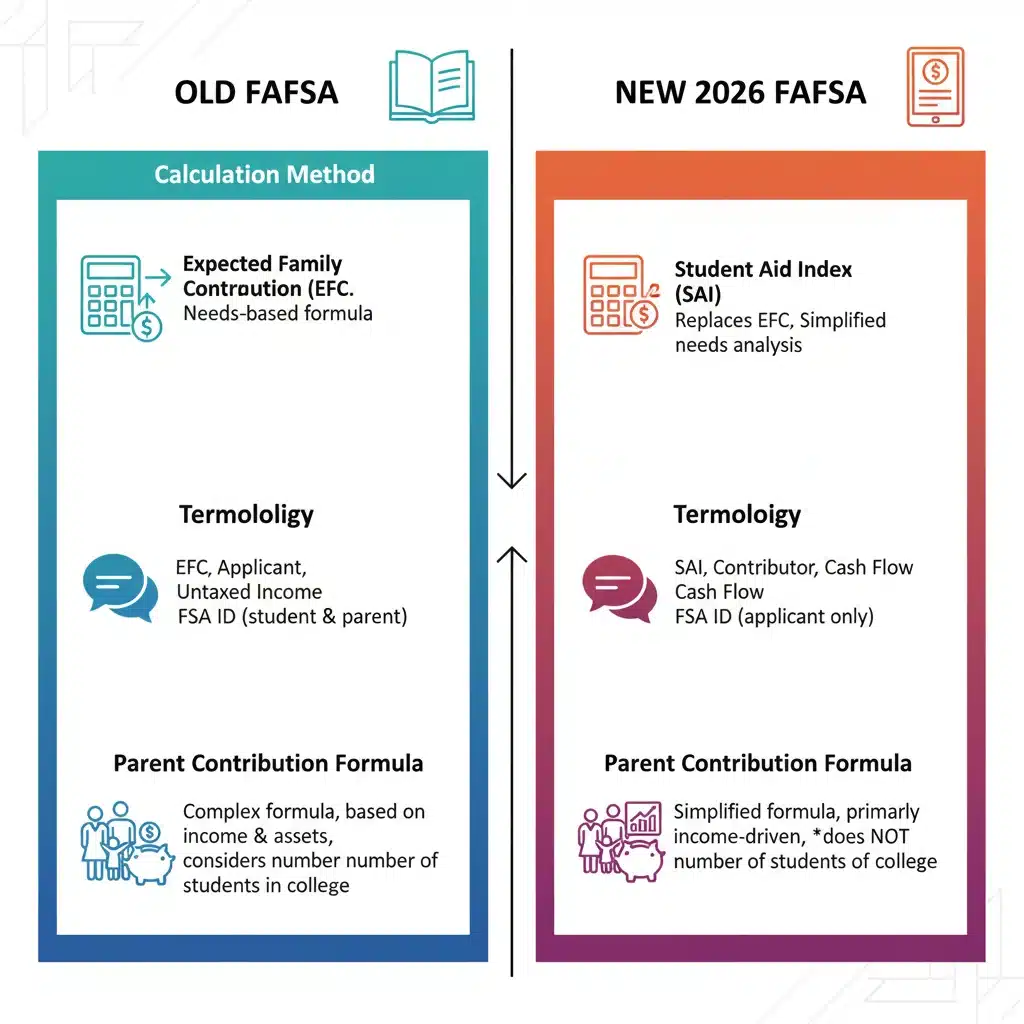
One of the most significant aspects of the 2026 FAFSA Changes is the replacement of the Expected Family Contribution (EFC) with the Student Aid Index (SAI). The EFC, a familiar term for generations of college-bound students, was often a source of confusion, as it rarely represented the actual amount a family was expected to pay. The SAI is intended to be a more accurate reflection of a student’s financial need and, crucially, can be a negative number, indicating a higher level of financial need than previously possible. This shift fundamentally alters how a student’s eligibility for need-based aid is determined.
Another pivotal change involves the number of family members attending college. Under the old EFC formula, having multiple children simultaneously enrolled in college significantly reduced the EFC for each student. However, with the introduction of the SAI, this benefit is eliminated. The SAI will no longer divide by the number of children in college, which could potentially impact families with multiple dependents pursuing higher education. This specific adjustment is one of the most talked-about aspects of the 2026 FAFSA Changes and necessitates re-evaluation of financial planning for such families.
Furthermore, the FAFSA Simplification Act modifies how income and assets are assessed. For instance, the treatment of small business and farm net worth has been adjusted. Previously, these assets were often excluded for certain families. The new rules may include them in the asset calculation, potentially increasing a family’s SAI. This detail is particularly important for entrepreneurial families or those with agricultural holdings. Understanding these nuances is key to accurately completing the FAFSA and maximizing aid.
Beyond these major shifts, the act also simplifies the process for Pell Grant eligibility, making it easier for more students from low-income backgrounds to qualify. It expands the federal student aid eligibility to incarcerated individuals and simplifies questions on the application itself. The goal is to reduce barriers and increase access to federal funding. However, with simplification comes the need for precision in understanding how each change affects your unique financial circumstances. The 2026 FAFSA Changes are designed to be more equitable, but their impact will vary widely.
Key Terminology Changes: EFC to SAI and Beyond
The lexicon of federal student aid is evolving, and familiarizing yourself with the new terminology is essential for navigating the 2026 FAFSA Changes. As mentioned, the most significant shift is from Expected Family Contribution (EFC) to Student Aid Index (SAI). Let’s break down what this means in practical terms:
- Expected Family Contribution (EFC): The old metric. It was an index number used by financial aid offices to determine how much financial aid a student would receive. It was calculated based on income, assets, and family size, among other factors. Many found the term misleading, as it rarely reflected what a family actually paid.
- Student Aid Index (SAI): The new metric. The SAI is also an index number, but it’s designed to be a more accurate and transparent measure of a student’s ability to pay for college. A key difference is that the SAI can be a negative number, down to -1500. A negative SAI indicates a higher level of financial need, potentially leading to more grant aid. This is a crucial element of the 2026 FAFSA Changes, as it directly impacts eligibility for need-based aid.
Beyond EFC and SAI, other terms are being updated or clarified:
- Contributor: This new term refers to anyone required to provide information on the FAFSA. This typically includes the student, their parents (if dependent), and the student’s spouse (if applicable). Understanding who is considered a contributor is vital for ensuring all necessary financial information is provided.
- Pell Grant Eligibility: The new FAFSA simplifies the process for determining Pell Grant eligibility. Instead of relying solely on the SAI, eligibility will also be determined by federal poverty levels and family size. This change is expected to expand Pell Grant access to more students from low-income backgrounds, a significant positive outcome of the 2026 FAFSA Changes.
- Asset Protection Allowance: This allowance, which shields a portion of a family’s assets from being counted in the aid calculation, has been adjusted. While the specifics can be complex, generally, a larger allowance means more assets are protected, potentially lowering the SAI.
These terminology changes are more than just semantics; they reflect fundamental shifts in how financial need is assessed and how aid is distributed. Familiarizing yourself with these new terms now will prevent confusion and ensure a smoother application process when the 2026 FAFSA Changes fully take hold.
Impact on Different Family Structures and Financial Situations
The 2026 FAFSA Changes will not affect all families equally. The impact will vary significantly depending on income levels, asset holdings, and family structure. Understanding these differential impacts is crucial for strategic planning.
Families with Multiple Children in College
As previously noted, one of the most impactful changes for many families is the elimination of the ‘number in college’ factor in the SAI calculation. Under the old EFC formula, if you had two children in college simultaneously, the EFC for each student would be roughly halved. This substantial benefit will no longer exist with the SAI. For these families, the immediate consequence could be a significant increase in their out-of-pocket costs or a reduction in need-based aid. It’s imperative for families with multiple college-bound students to re-evaluate their savings and funding strategies well before the 2026 FAFSA Changes fully implement.
Single-Parent Households and Divorced Parents
The FAFSA Simplification Act also modifies how information is gathered from divorced or separated parents. Previously, the parent who provided the most financial support was responsible for completing the FAFSA. Under the new rules, the parent who provides the greater portion of the student’s financial support will still be the primary contributor, but the definition might be more clearly tied to where the student lived for the majority of the 12 months prior to filing the FAFSA. This clarification aims to reduce confusion but requires careful attention to custody arrangements and financial contributions. For single-parent households, the core calculation remains largely similar, focusing on the available income and assets of the household.
Low-Income Families
The 2026 FAFSA Changes are generally expected to benefit low-income families. The expanded Pell Grant eligibility, tied to federal poverty levels and family size, means more students will qualify for this foundational grant. The ability for the SAI to be a negative number also provides a clearer indicator of extreme financial need, which can lead to increased institutional aid in some cases. Families who previously struggled to meet educational costs may find themselves eligible for more substantial federal assistance under the new framework.
Families with Small Businesses or Farms
The treatment of small business and farm net worth is another critical area. Historically, these assets were often excluded from the EFC calculation for certain family sizes. With the 2026 FAFSA Changes, the net worth of a small business or farm (where the family owns more than 50% and it has fewer than 100 full-time equivalent employees) will now be included as an asset. This could significantly increase the calculated SAI for these families, potentially reducing their eligibility for need-based aid. It’s vital for these families to consult with financial advisors to understand the implications and explore potential strategies to mitigate the impact.
High-Income Families
For high-income families, the direct impact of the 2026 FAFSA Changes might be less pronounced in terms of federal grant eligibility, as they typically don’t qualify for need-based federal grants. However, changes to the asset calculation and the elimination of the ‘number in college’ benefit could still affect their eligibility for federal loans or institutional aid at some colleges. Understanding the SAI calculation is still important, even if federal grants are not the primary goal.
Strategies to Maximize Your Federal Student Aid Under the New Rules
Given the significant 2026 FAFSA Changes, a proactive and informed approach is essential for maximizing your federal student aid. Here are actionable strategies to help you secure up to 15% more in financial assistance:
1. Understand Your New Student Aid Index (SAI)
The first step is to familiarize yourself thoroughly with how the SAI is calculated. Unlike the EFC, the SAI can be negative, indicating higher need. Review the official FAFSA guidance and use online SAI calculators (when they become available for the 2026 cycle) to get an estimate of your potential SAI. Understanding this baseline will inform all other strategies. Pay close attention to how your specific income and assets are weighed under the new formula, especially concerning the inclusion of small business/farm net worth.
2. Strategic Management of Income and Assets
Financial planning should begin well before you file the FAFSA. The FAFSA uses tax information from two years prior (the ‘prior-prior year’). For the 2026-2027 FAFSA, this means your 2024 tax information will be used. This gives you a window of opportunity to make strategic adjustments:
- Income Optimization: If possible, try to reduce your adjusted gross income (AGI) in the prior-prior year. Contributions to tax-deferred retirement accounts (like 401(k)s or IRAs) can lower your AGI, which in turn can reduce your SAI. Consider if any major income events (bonuses, stock options) can be strategically timed outside the prior-prior year.
- Asset Allocation: Understand which assets count towards the SAI. Assets held in qualified retirement plans (401(k)s, IRAs) are generally excluded. However, non-retirement investment accounts (brokerage accounts, mutual funds), savings accounts, and certain real estate (beyond your primary residence) are typically included. If you have significant liquid assets, consider shifting them into excluded accounts, if appropriate for your overall financial goals. This is particularly important for families with small businesses or farms, as their net worth will now be included.
- 529 Plans: Assets in 529 college savings plans owned by a dependent student or parent are counted as parental assets, which are assessed at a lower rate than student assets. This remains a beneficial strategy. However, if a 529 plan is owned by a grandparent or other non-parent, distributions from it will count as untaxed student income in the year they are disbursed, which can significantly increase the SAI for the following year. Consider transferring ownership to the parent or student prior to disbursement, or using these funds in later years when their impact on aid might be less critical.
3. Prepare for the Loss of ‘Number in College’ Benefit
For families with multiple children attending college simultaneously, the elimination of the ‘number in college’ benefit is a major change. This means each student’s SAI will be calculated independently without a reduction for siblings. To mitigate this:
- Re-evaluate Savings: If you were relying on this benefit, reassess your college savings plans. You may need to increase contributions or explore additional funding sources.
- Seek Institutional Aid: While federal aid calculations are changing, many institutions offer their own need-based or merit-based aid. Research colleges known for generous institutional aid for families with multiple students.
- Consider Payment Plans: Many colleges offer interest-free monthly payment plans, which can help manage the increased out-of-pocket costs.
4. Pay Attention to Dependency Status
A student’s dependency status significantly impacts who must provide financial information. Most undergraduate students are considered dependent. However, if a student meets certain criteria (e.g., married, graduate student, veteran, orphan, ward of the court, or has legal dependents), they may be considered independent. Independent students only provide their own financial information (and that of a spouse, if applicable), which can result in a lower SAI if the student’s income and assets are minimal. While you cannot manipulate dependency status, understanding the rules ensures you apply correctly.
5. File Early and Accurately
Even with simplification, accuracy is paramount. Errors can delay your application and impact your aid eligibility. Always double-check all information before submitting. Filing as early as possible after the FAFSA opens (typically October 1st for the following academic year) is crucial. Some aid, especially state and institutional grants, is awarded on a first-come, first-served basis, so an early submission can increase your chances of securing limited funds.
6. Appeal for Special Circumstances
The 2026 FAFSA Changes do not eliminate the ability to appeal for special circumstances. If your family experiences a significant financial change after filing the FAFSA (e.g., job loss, medical expenses, divorce, death of a parent), contact the financial aid office at each college. They have the authority to make professional judgments and adjust your SAI to better reflect your current financial situation.
The Broader Landscape: Beyond Federal Aid
While understanding the 2026 FAFSA Changes is crucial for federal aid, it’s important to remember that federal aid is just one piece of the college funding puzzle. To truly maximize your overall financial assistance, you must also look at other sources:
Institutional Aid and CSS Profile
Many private colleges and some public universities use their own institutional aid formulas, often requiring the CSS Profile in addition to the FAFSA. The CSS Profile is generally more comprehensive, delving deeper into family assets and income. The 2026 FAFSA Changes will not directly alter the CSS Profile, but colleges may adjust their own aid policies in response to the federal reforms. Always check each college’s specific requirements.
Scholarships and Grants
Don’t overlook the vast world of scholarships and grants from private organizations, foundations, and local community groups. These funds do not need to be repaid and are often awarded based on merit, specific talents, ethnicity, field of study, or unique personal circumstances, rather than solely on financial need. Start your scholarship search early and apply to as many as you qualify for. Websites like Fastweb, Scholarship.com, and specific college scholarship portals are excellent resources.
State Aid Programs
Most states offer their own financial aid programs, often requiring the FAFSA for eligibility. Be aware of your state’s specific deadlines and requirements, as they can differ from federal deadlines. State aid can be a significant source of funding, especially for in-state public universities.
Work-Study Programs
Federal Work-Study is a need-based program that allows students to earn money to help pay for educational expenses through part-time jobs, often on campus. The amount of work-study eligibility is determined by your FAFSA results. While it doesn’t reduce your upfront costs, it provides valuable income and often relevant work experience.
Education Tax Credits and Deductions
Don’t forget about federal education tax credits and deductions, such as the American Opportunity Tax Credit and the Lifetime Learning Credit. While not direct aid, these can significantly reduce your overall cost of education by lowering your tax liability. Consult with a tax professional to understand your eligibility.
Preparing for the Future: A Timeline for Success
Proactive preparation is your best defense against unexpected financial aid outcomes stemming from the 2026 FAFSA Changes. Here’s a general timeline to help you stay on track:
- High School Freshman/Sophomore Year: Focus on academic excellence and extracurricular activities. Begin conversations about college costs and financial aid with your family. Start researching different types of colleges and their typical aid packages.
- High School Junior Year: Begin researching scholarship opportunities. Attend financial aid workshops if available. Families should start reviewing their financial situation with the 2026 FAFSA Changes in mind, particularly regarding income and asset management for the ‘prior-prior year’ (which would be your sophomore year’s tax information for the 2026-2027 FAFSA).
- High School Senior Year (Fall): The 2026-2027 FAFSA will typically open on October 1, 2025. File the FAFSA as soon as possible after it opens. Complete the CSS Profile if required by your colleges. Continue applying for scholarships.
- High School Senior Year (Spring): Review financial aid offers from colleges carefully. Compare packages and understand the mix of grants, scholarships, and loans. Appeal aid decisions if your financial circumstances have changed or if you believe there’s been an error.
This timeline is a general guide, and specific actions may vary based on your individual circumstances. The key is to start early and remain informed about the 2026 FAFSA Changes as more detailed guidance becomes available from the Department of Education.
Conclusion: Empowering Your College Journey with Informed Decisions
The 2026 FAFSA Changes represent a significant overhaul of the federal student aid system, designed to simplify the application process and expand access to financial assistance. While these reforms aim for greater equity and transparency, they also introduce new complexities that require careful attention from students and families. From the transition of EFC to SAI to the elimination of the ‘number in college’ benefit, each change has the potential to impact your eligibility and the amount of aid you receive.
By understanding these changes, implementing strategic financial planning, and proactively managing your income and assets, you can position yourself to maximize your federal student aid. Our goal is to equip you with the knowledge and strategies to potentially increase your financial assistance by 15% or more, making your college education more affordable and accessible.
Remember, the journey to securing financial aid is an ongoing process that benefits from early planning, diligent research, and accurate application. Stay informed, ask questions, and utilize all available resources. With a clear understanding of the 2026 FAFSA Changes, you can confidently navigate the path to higher education and achieve your academic dreams.
Author