PSLF in 2026: Guide to 120 Qualifying Payments

Understanding Public Service Loan Forgiveness (PSLF) in 2026 involves navigating specific eligibility criteria, income-driven repayment plans, and meticulously tracking 120 qualifying payments to achieve student loan discharge.
Are you dedicated to public service but burdened by student loan debt? The Public Service Loan Forgiveness (PSLF) program offers a path to financial freedom. This guide will walk you through Exploring Public Service Loan Forgiveness (PSLF) in 2026: A Step-by-Step Guide to 120 Qualifying Payments, ensuring you understand the nuances and requirements to successfully achieve loan forgiveness.
Understanding the PSLF Program Landscape in 2026
The Public Service Loan Forgiveness (PSLF) program has undergone significant changes since its inception, and understanding its current landscape in 2026 is crucial for anyone seeking to benefit. This program is designed to encourage individuals to enter and remain in full-time public service employment, offering forgiveness of the remaining balance on federal direct loans after 120 qualifying payments.
It’s important to recognize that PSLF is not a ‘one-size-fits-all’ solution. Eligibility hinges on several factors, including the type of loans you hold, your repayment plan, and your employer. Staying informed about any potential legislative updates or policy shifts is essential, as the program continues to evolve to meet the needs of public servants while maintaining its integrity.
What Defines a Qualifying Employer?
For PSLF purposes, a qualifying employer is generally a government organization at any level (federal, state, local, or tribal), or a not-for-profit organization that is tax-exempt under Section 501(c)(3) of the Internal Revenue Code. Other not-for-profit organizations that provide certain public services may also qualify, even if they are not 501(c)(3) organizations.
- Government organizations: Includes public schools, colleges, universities, and federal, state, and local agencies.
- 501(c)(3) non-profits: Most charities, foundations, and non-profit hospitals.
- Other non-profits: Organizations providing public health, public safety, emergency management, or public education services.
It’s vital to have your employer certified through the Employment Certification Form (ECF) regularly, ideally annually or whenever you change employers. This proactive step helps ensure that your employment history is accurately recorded and that you are on track toward your 120 qualifying payments.
The PSLF program in 2026 remains a cornerstone for supporting individuals dedicated to public service. By understanding the core tenets of qualifying employment and the types of loans applicable, borrowers can lay a solid foundation for pursuing loan forgiveness. Continuous vigilance regarding program rules and proactive engagement with the loan servicer are key to a successful PSLF journey.
Eligibility Requirements: Who Qualifies for PSLF?
Navigating the eligibility requirements for PSLF can feel complex, but understanding them thoroughly is the first step toward successful loan forgiveness. In 2026, the core criteria remain consistent, focusing on your loan type, employment, and repayment plan. Meeting these requirements precisely ensures that your payments count towards the coveted 120.
Many individuals mistakenly believe that simply working in public service guarantees forgiveness, but the reality is more nuanced. Both your loans and your employment must align with specific federal guidelines. Without this alignment, even years of dedicated service may not lead to PSLF.
Direct Loans are Essential
Only federal Direct Loans are eligible for PSLF. If you have other types of federal loans, such as FFEL Program loans or Perkins Loans, you must consolidate them into a Direct Consolidation Loan to make them eligible. This consolidation must happen before you make any payments that you intend to count towards PSLF.
- Direct Subsidized Loans
- Direct Unsubsidized Loans
- Direct PLUS Loans
- Direct Consolidation Loans
It’s critical to note that private student loans are never eligible for PSLF. If you have a mix of federal and private loans, only your eligible federal loans can be considered for forgiveness under this program.
Beyond loan type, your employment status is paramount. You must be employed full-time by a qualifying employer. Full-time is generally defined as working at least 30 hours per week. This can be for one qualifying employer or a combination of part-time jobs with multiple qualifying employers, as long as the combined hours meet the 30-hour threshold.
Finally, your repayment plan must be an income-driven repayment (IDR) plan. These plans calculate your monthly payment based on your income and family size, making them affordable for public servants. Only payments made under an IDR plan or the 10-year Standard Repayment Plan count toward the 120 qualifying payments. However, since the 10-year Standard Repayment Plan fully repays your loan by the time you make 120 payments, there would be no balance left to forgive. Therefore, an IDR plan is almost always necessary to benefit from PSLF.
In summary, eligibility for PSLF in 2026 requires careful attention to the type of federal loans you hold, consistent full-time employment with a qualifying organization, and enrollment in an appropriate income-driven repayment plan. Meeting all these conditions consistently over time is the bedrock of a successful PSLF application.
Understanding Qualifying Payments and the 120-Payment Goal
The core of the PSLF program revolves around making 120 qualifying monthly payments. This is not just any payment; it must meet specific criteria to be counted towards your forgiveness goal. Understanding these criteria is paramount for anyone aiming to successfully achieve loan forgiveness by 2026 and beyond.
Many borrowers mistakenly believe that once they are in public service, every payment automatically counts. However, strict rules govern what constitutes a qualifying payment, and overlooking even one detail can delay your journey to forgiveness.
What Makes a Payment “Qualifying”?
For a payment to be considered qualifying for PSLF, it must meet several conditions simultaneously. Each payment must be made:
- After October 1, 2007.
- While you are employed full-time by a qualifying employer.
- Under a qualifying repayment plan (primarily an Income-Driven Repayment plan).
- For the full amount due as shown on your bill.
- No later than 15 days after your due date.
Payments made before your loans enter an eligible repayment plan, or while you are not employed by a qualifying employer, will not count. Similarly, payments made while your loans are in deferment, forbearance, or grace periods typically do not count, unless specific waivers or temporary changes allow them to.
It’s crucial to diligently track your payments and employment. The Employment Certification Form (ECF) is your primary tool for this. Submitting it annually, or whenever you change employers, allows your loan servicer to track your progress and notify you of any issues. This proactive approach helps prevent surprises when you finally apply for forgiveness.
Furthermore, ensure you are not making extra payments or paying more than your scheduled amount with the intention of accelerating forgiveness. While paying more than required can reduce your overall debt, for PSLF, only the regularly scheduled monthly payments under an IDR plan count towards the 120. Overpaying might lead to your loan being considered ‘paid ahead,’ which could prevent subsequent payments from counting until your ‘paid ahead’ status is exhausted.
The 120-payment goal, equivalent to 10 years of qualifying payments, requires unwavering consistency and adherence to program rules. By meticulously ensuring each payment meets the outlined criteria and regularly certifying your employment, you can steadily progress towards achieving Public Service Loan Forgiveness.
Navigating Income-Driven Repayment (IDR) Plans
Income-Driven Repayment (IDR) plans are a cornerstone of the PSLF program, making monthly student loan payments affordable for public servants. These plans adjust your monthly payment amount based on your income and family size, ensuring that your payments are manageable while you pursue loan forgiveness.
Choosing the right IDR plan is critical, as not all plans are equally beneficial for every borrower. Understanding the different options and how they impact your path to 120 qualifying payments can significantly streamline your PSLF journey.
Key IDR Plans for PSLF
Several IDR plans are available, and most are eligible for PSLF. The most common ones include:
- Revised Pay As You Earn (REPAYE)
- Pay As You Earn (PAYE)
- Income-Based Repayment (IBR)
- Income-Contingent Repayment (ICR)
Each plan has slightly different terms regarding how your discretionary income is calculated, the percentage of income you pay, and the maximum repayment period. For PSLF, the primary goal is to keep your monthly payments as low as possible while still making qualifying payments, maximizing the amount forgiven at the end of the 120 payments.
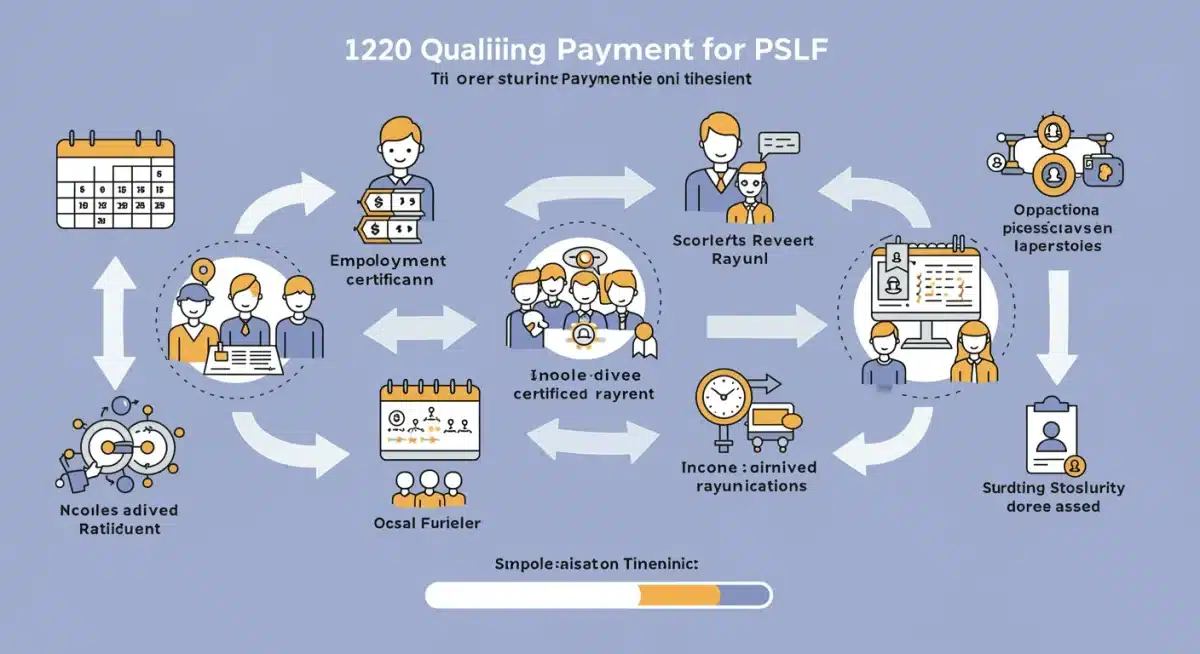
It’s crucial to recertify your income and family size annually. Failure to do so can result in your payments reverting to the higher 10-year Standard Repayment amount, or even capitalization of interest, which can increase your total loan balance and potentially cause payments to not qualify. Your loan servicer will typically send reminders, but it is ultimately your responsibility to ensure timely recertification.
Regularly reviewing your IDR plan is also a good practice. Life circumstances change, and an IDR plan that was optimal a few years ago might not be the best fit today. For instance, if your income decreases, you might qualify for a lower payment under a different IDR plan. Conversely, if your income significantly increases, your payments might rise, but you’ll still be on track for PSLF as long as you’re in a qualifying plan.
In essence, mastering IDR plans means more than just enrolling; it involves continuous management. By selecting the most advantageous plan for your financial situation and diligently recertifying your information each year, you ensure that every payment contributes effectively towards your 120-payment goal for PSLF.
The Importance of Employment Certification
Employment certification is arguably the most critical administrative component of the Public Service Loan Forgiveness (PSLF) program. It is the official process by which the Department of Education verifies that your employment meets the program’s requirements, directly impacting whether your payments are counted towards the 120-payment goal.
Many PSLF program applicants encounter issues due to neglected or improperly completed employment certification. Without this verification, even if you are making qualifying payments, those payments may not be officially recognized, leading to significant delays or even rejection of your forgiveness application.
How to Certify Your Employment
The process of certifying your employment involves submitting the PSLF & Temporary Expanded PSLF (TEPSLF) Certification & Application (ECF) Form. This form requires information about your employer and your employment dates, which must be certified by an authorized official at your workplace.
- Download the latest ECF form from the Federal Student Aid website.
- Complete your section of the form accurately.
- Have an authorized official from your employer complete and sign their section.
- Submit the completed form to MOHELA, the PSLF servicer.
It is strongly recommended to submit an ECF annually, or whenever you change employers. This practice helps ensure that your employment history is consistently updated and that your payments are being accurately tracked. Regular submission also allows you to catch any discrepancies early, rather than discovering them after years of payments.
Upon submission and processing of your ECF, MOHELA will review your employment and payment history. They will then notify you of the number of qualifying payments you have made. If there are any issues, such as an employer not qualifying or payments not meeting the criteria, you will be informed, giving you the opportunity to address them promptly.
Maintaining meticulous records of your submitted ECFs and all correspondence with your loan servicer is also crucial. This documentation serves as your personal proof of compliance and can be invaluable if any disputes arise regarding your eligibility or payment count. The employment certification process is your primary safeguard on the path to PSLF, making its consistent and accurate completion essential for success.
Applying for Forgiveness and What to Expect in 2026
After diligently making 120 qualifying payments over at least 10 years, the final step in the PSLF journey is to apply for forgiveness. While the path to 120 payments requires significant effort, the application process itself is relatively straightforward, provided you have maintained accurate records and consistently certified your employment.
It’s important to approach this stage with a clear understanding of the steps involved and what to expect in terms of processing times and potential outcomes. Being prepared can alleviate stress and ensure a smooth transition to loan forgiveness.
The Forgiveness Application Process
Once you believe you have made 120 qualifying payments, you will need to submit the PSLF & Temporary Expanded PSLF (TEPSLF) Certification & Application (ECF) Form. This is the same form used for employment certification, but when you submit it after 120 payments, it serves as your official application for forgiveness.
- Verify your payment count: Before applying, ensure your loan servicer (MOHELA) shows 120 or more qualifying payments.
- Submit the final ECF: Indicate on the form that you are applying for forgiveness, not just certifying employment.
- Continue making payments: Do not stop making payments until you receive confirmation that your loans have been forgiven. If you overpay, you will be reimbursed.
After submitting your application, MOHELA will review your entire payment and employment history. This review can take several weeks or even months, depending on the volume of applications and the complexity of your case. During this period, it’s essential to remain patient and respond promptly to any requests for additional information from your servicer.
If your application is approved, you will receive notification that your eligible federal student loans have been forgiven. The remaining balance, including any accrued interest, will be discharged, and you will no longer be required to make payments on those loans. It’s important to note that the forgiven amount under PSLF is federal income tax-free.
In the event your application is denied, MOHELA will provide a reason for the denial. This might include issues with qualifying employment, non-qualifying payments, or incorrect loan types. Understanding the reason for denial allows you to address the issues, potentially appeal the decision, or reapply once you meet the necessary criteria. The application for forgiveness is the culmination of years of dedication, and with proper preparation, it can lead to the life-changing outcome of student loan debt relief.
Common Pitfalls and How to Avoid Them
While the Public Service Loan Forgiveness (PSLF) program offers an incredible opportunity for debt relief, it’s also notorious for its stringent requirements and the common pitfalls that can derail a borrower’s progress. Being aware of these potential issues in 2026 is key to successfully navigating the program and achieving forgiveness.
Many public servants have faced setbacks due to misunderstandings or administrative errors. Proactive measures and a thorough understanding of the program’s nuances can help you avoid these common traps.
Avoiding Key Mistakes
One of the most frequent errors is having the wrong type of loan. Only Direct Loans qualify for PSLF. Borrowers with FFEL Program loans or Perkins Loans must consolidate them into a Direct Consolidation Loan. Failure to do so means none of your payments will count, regardless of your employment or repayment plan.
- Not consolidating ineligible loans: Consolidate FFEL or Perkins loans into Direct Loans early.
- Incorrect repayment plan: Ensure you are on an Income-Driven Repayment (IDR) plan. Payments on the Standard 10-year plan will not leave a balance to forgive.
- Missing annual employment certification: Certify your employment regularly (annually or with every job change) to track progress and correct issues promptly.
Another significant pitfall involves employment status. You must be employed full-time by a qualifying employer. This means working at least 30 hours per week. If you transition to part-time work or move to a non-qualifying employer, payments made during those periods will not count. Always verify your employer’s eligibility, even if you believe they qualify.
Furthermore, administrative errors by loan servicers or employers can occur. This underscores the importance of maintaining detailed records. Keep copies of all submitted forms, payment confirmations, and correspondence with your loan servicer. Regularly check your payment count on the MOHELA website and address any discrepancies immediately.
Finally, falling out of good standing with your loan payments can be detrimental. Payments must be made on time and for the full amount due. Defaulting on your loans or entering extended periods of deferment or forbearance (unless specifically allowed by certain waivers) will pause your progress towards the 120 payments. Understanding and meticulously adhering to these requirements will significantly increase your chances of successfully obtaining PSLF in 2026.
Maximizing Your Chances for PSLF Success in 2026
Achieving Public Service Loan Forgiveness (PSLF) in 2026 is a significant accomplishment that requires consistent effort and strategic planning. Beyond merely meeting the basic requirements, there are several best practices you can adopt to maximize your chances of success and ensure a smooth journey toward loan forgiveness.
The key lies in proactive management of your loans, employment, and communication with your loan servicer. By taking charge of these elements, you can significantly reduce the risk of unforeseen obstacles.
Best Practices for PSLF Borrowers
One of the most crucial steps is to regularly communicate with your loan servicer, MOHELA. They are the official servicer for PSLF, and maintaining open lines of communication can help clarify any doubts and resolve issues quickly. Don’t hesitate to call them with questions about your payment count, employer eligibility, or repayment plan.
- Annual Employment Certification: Submit your ECF every year, even if your employer hasn’t changed. This keeps your records updated and helps track qualifying payments.
- Keep Detailed Records: Maintain a personal file with copies of all ECFs, payment confirmations, and correspondence. This acts as a backup in case of discrepancies.
- Monitor Your Payment Count: Regularly check your qualifying payment count on the MOHELA website. If you notice any discrepancies, address them immediately.
Another vital practice is to re-evaluate your income-driven repayment (IDR) plan annually. Your income and family size can change, potentially affecting your monthly payment. Ensuring you are on the most advantageous IDR plan means you’re paying what you can afford while maximizing the amount that will be forgiven.
Stay informed about any changes to the PSLF program. While the core structure is expected to remain stable in 2026, policy adjustments or temporary waivers can occur. Following official Department of Education announcements and reputable financial news sources will keep you updated on any developments that might affect your eligibility or payment count.
Finally, consider seeking professional advice if you feel overwhelmed or have complex circumstances. A student loan expert or financial advisor specializing in PSLF can provide personalized guidance, helping you navigate the intricacies of the program and ensuring you are on the most efficient path to forgiveness. By adopting these proactive strategies, you can confidently work towards achieving PSLF and the financial relief it offers.
| Key Aspect | Brief Description |
|---|---|
| Loan Eligibility | Only Federal Direct Loans qualify; consolidate other federal loans if necessary. Private loans are ineligible. |
| Qualifying Employment | Full-time work for government (federal, state, local, tribal) or 501(c)(3) non-profit organizations. |
| Qualifying Payments | 120 on-time, full payments under an Income-Driven Repayment (IDR) plan after Oct 1, 2007, while employed. |
| Certification & Application | Submit Employment Certification Form (ECF) annually and the final ECF as your forgiveness application. |
Frequently Asked Questions About PSLF in 2026
Only Federal Direct Loans are eligible for PSLF. If you have other federal loans like FFEL Program loans or Perkins Loans, you must consolidate them into a Direct Consolidation Loan to make them eligible. Private student loans are never eligible for forgiveness under this program.
A qualifying employer is any government organization (federal, state, local, tribal) or a 501(c)(3) non-profit organization. Other non-profits providing specific public services may also qualify. The best way to confirm is to submit an Employment Certification Form (ECF) to MOHELA.
A qualifying payment is made on time, for the full amount due, under an Income-Driven Repayment (IDR) plan, while employed full-time by a qualifying employer, and after October 1, 2007. Payments made during deferment or forbearance typically do not count.
While not strictly mandatory, it is highly recommended to submit an ECF annually or whenever you change employers. This ensures your employment history is accurately tracked and allows you to resolve any potential issues early, preventing delays in forgiveness.
If you leave qualifying public service employment, your payments will no longer count towards PSLF. You can resume counting payments if you return to qualifying public service employment in the future. The 120 payments do not need to be consecutive.
Conclusion
The Public Service Loan Forgiveness (PSLF) program offers a transformative opportunity for dedicated public servants to achieve financial freedom from student loan debt. By diligently understanding and adhering to the guidelines for eligible loans, qualifying employment, and income-driven repayment plans, borrowers can successfully navigate the path to 120 qualifying payments. Proactive employment certification, meticulous record-keeping, and staying informed about program updates are paramount to maximizing your chances of success. While the journey requires commitment over a decade, the reward of loan forgiveness makes PSLF an invaluable program for those committed to serving their communities.