Federal Reserve Rate Hike: Mortgage Rates Up 0.25% in Spring 2026

The Federal Reserve’s recent 0.25% interest rate hike in Spring 2026 has directly influenced mortgage rates, leading to increased borrowing costs for both new homebuyers and those looking to refinance, impacting the broader housing market.
In a significant development for the nation’s economy, Breaking News: Federal Reserve’s Latest Interest Rate Hike Impacts Mortgage Rates by 0.25% in Spring 2026, signaling a shift that will resonate across the housing market. This adjustment, while seemingly small, carries substantial weight for prospective homeowners and those considering refinancing.
Understanding the Federal Reserve’s Decision
The Federal Reserve, often referred to as the Fed, plays a crucial role in shaping the economic landscape of the United States. Its primary objective is to maintain price stability and maximize employment, and one of its most powerful tools for achieving these goals is adjusting the federal funds rate.
The recent 0.25% increase in the federal funds rate was a decision carefully weighed by the Federal Open Market Committee (FOMC). This committee meets regularly to assess economic conditions and determine the appropriate monetary policy. The hike in Spring 2026 reflects the Fed’s ongoing efforts to curb inflation, which has remained a concern despite previous measures. By making borrowing more expensive, the Fed aims to cool down economic activity, thereby reducing demand and, consequently, prices.
The Mechanism of Rate Hikes
When the Federal Reserve raises the federal funds rate, it directly influences the cost of borrowing for banks. This, in turn, impacts the rates banks charge their customers for various loans, including mortgages. The ripple effect is complex but generally follows a predictable pattern:
- Increased Cost for Banks: Banks pay more to borrow from each other overnight.
- Higher Prime Rate: The prime rate, a benchmark for many consumer loans, typically rises in tandem.
- Broader Lending Rate Adjustments: Other lending rates, including those for mortgages, auto loans, and credit cards, tend to increase.
This latest adjustment is a clear signal from the Fed that it remains committed to its inflation targets, even if it means tightening financial conditions further. Understanding this fundamental mechanism is key to grasping the broader implications for mortgage rates and the housing market.
Direct Impact on Mortgage Rates
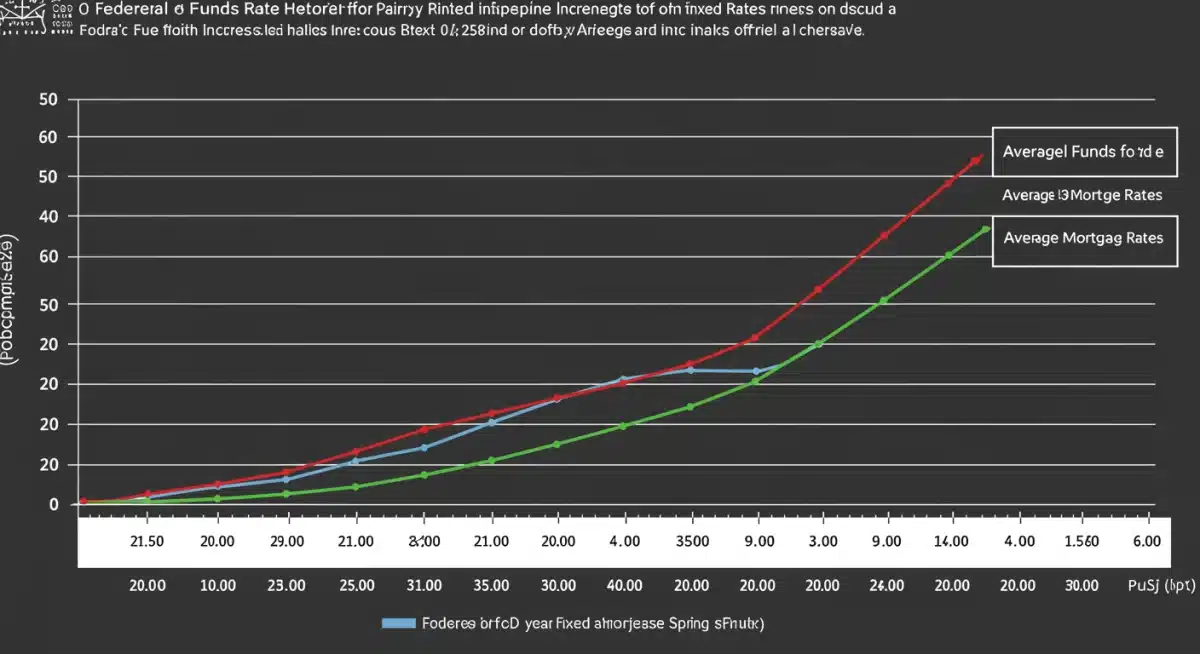
The announcement of the Federal Reserve’s 0.25% interest rate hike has sent ripples directly through the mortgage market. While the federal funds rate doesn’t directly dictate mortgage rates, it significantly influences them, particularly for adjustable-rate mortgages and, indirectly, fixed-rate mortgages through market expectations.
For prospective homebuyers, this means that the cost of borrowing to purchase a home has just become more expensive. A 0.25% increase on a substantial loan amount can translate into a noticeable difference in monthly payments over the life of a 30-year mortgage. This immediate financial impact could cause some potential buyers to reconsider their budgets or delay their homeownership plans.
How Fixed and Adjustable Rates React
Fixed-rate mortgages, which are most common, tend to track the yield on U.S. Treasury bonds, especially the 10-year Treasury. When the Fed raises rates, it often signals a stronger economy or higher inflation expectations, which can push Treasury yields up, subsequently increasing fixed mortgage rates. Adjustable-rate mortgages (ARMs), on the other hand, are more directly tied to short-term interest rate benchmarks, which are highly sensitive to the federal funds rate.
- Fixed-Rate Mortgages: Expect a gradual but firm upward trend as bond yields react.
- Adjustable-Rate Mortgages: Likely to see more immediate and direct increases in their rates once their adjustment period arrives.
- Refinancing Opportunities: Homeowners looking to refinance may find less favorable terms now compared to a few months ago.
The market’s reaction to this hike is critical. Lenders often price in anticipated Fed actions, so some of the increase may have already been factored in, but a definitive hike tends to solidify the higher rate environment. This makes careful financial planning even more essential for anyone engaging with the housing market.
Analyzing the Housing Market Response
The housing market is a complex ecosystem, and a Federal Reserve interest rate hike of 0.25% can trigger a cascade of reactions. This latest increase in Spring 2026 is expected to exert further downward pressure on buyer demand and potentially slow the pace of home sales across the United States.
When mortgage rates rise, the pool of eligible buyers shrinks. Affordability becomes a greater concern, especially in already expensive markets. This could lead to a cooling-off period, where bidding wars become less common and homes may stay on the market for longer. Sellers might need to adjust their price expectations to meet the new market realities.
Regional Variations and Inventory Levels
The impact will not be uniform across all regions. Areas with high demand and limited inventory might experience a milder slowdown, while markets that were already showing signs of weakening could see a more pronounced correction. Additionally, the availability of homes for sale, or inventory, plays a significant role in how the market responds.
- High-Demand Areas: May experience a slower but still competitive market.
- Lower-Demand Areas: Could see prices stabilize or even decline as buyers pull back.
- Inventory Impact: Increased rates might discourage some potential sellers, further impacting inventory levels.
Real estate agents and industry analysts will be closely monitoring these trends to identify emerging patterns. The overall sentiment in the market, from both buyers and sellers, will also be a key factor in how quickly and significantly these changes take hold.
Strategies for Homebuyers and Homeowners
With the Federal Reserve’s recent 0.25% interest rate hike, both prospective homebuyers and current homeowners need to re-evaluate their financial strategies. Adapting to this new interest rate environment is crucial for making informed decisions and securing the best possible financial outcomes in Spring 2026.
For those looking to purchase a home, it’s more important than ever to get pre-approved for a mortgage early in the process. This locks in an interest rate for a certain period, protecting you from potential further increases. Additionally, revisiting your budget to account for higher monthly payments is essential. Exploring different loan options, such as adjustable-rate mortgages if you plan to move within a few years, might be beneficial, though they come with their own risks.
Navigating the New Rate Landscape
Current homeowners, especially those with adjustable-rate mortgages, should review their loan terms to understand when their rates might adjust and by how much. Even those with fixed rates might consider strategies to build equity faster, such as making extra principal payments, to reduce the overall interest paid over the life of the loan.
- For Buyers: Secure pre-approval, re-evaluate budgets, and consider loan types carefully.
- For Homeowners: Review ARM terms, consider extra principal payments, and monitor market conditions for future opportunities.
- Financial Advising: Consulting with a financial advisor can provide personalized guidance based on individual circumstances.
Staying informed about market trends and understanding how these rate changes affect your personal finances will empower you to make prudent decisions in a dynamic economic climate. Proactive planning is the best defense against rising borrowing costs.
Broader Economic Implications of the Hike
While the immediate focus of a Federal Reserve interest rate hike is often on mortgage rates and the housing market, its implications stretch far wider across the broader U.S. economy. The 0.25% increase in Spring 2026 is a deliberate move to manage inflation, and its effects will be felt in various sectors.
Higher interest rates generally lead to a slowdown in consumer spending and business investment. When borrowing costs increase, companies may postpone expansion plans or reduce hiring, which can impact job growth. Consumers might also shy away from taking out loans for large purchases, further dampening economic activity. This is the Fed’s intended consequence: to cool an overheated economy.
Inflation Control and Market Confidence
The Fed’s commitment to controlling inflation is paramount. Persistent high inflation erodes purchasing power and creates economic uncertainty, which can be more detrimental in the long run. By acting decisively, even with modest rate hikes, the Fed aims to anchor inflation expectations and restore confidence in the economy’s stability.
- Consumer Spending: Expect a potential slowdown as borrowing becomes more expensive.
- Business Investment: Companies may reconsider expansion plans due to higher capital costs.
- Inflation Outlook: The hike is intended to reinforce the Fed’s resolve to bring inflation down to its target.
However, there’s a delicate balance to strike. Too aggressive an approach risks pushing the economy into a recession, while too passive an approach allows inflation to become entrenched. The Fed’s latest action is a carefully calculated step within this complex economic balancing act.
Future Outlook and Expert Predictions
The Federal Reserve’s 0.25% interest rate hike in Spring 2026 sets the stage for what could be a continued period of economic adjustments. Predicting the exact trajectory of interest rates and their full impact on mortgage rates and the housing market is challenging, but experts are offering various perspectives on the future outlook.
Many analysts suggest that the Fed will remain data-dependent, meaning future rate decisions will hinge on incoming economic indicators such as inflation reports, employment figures, and GDP growth. If inflation proves more stubborn than anticipated, further modest hikes could be on the horizon. Conversely, if economic activity slows too sharply, the Fed might pause or even reverse its course.
Key Factors to Monitor
Several critical factors will influence the market in the coming months. Global economic conditions, geopolitical events, and domestic policy changes can all play a role in shaping the Fed’s decisions and the broader financial landscape. Keeping an eye on these indicators will provide valuable insights into potential future trends.
- Inflation Data: Continued monitoring of CPI and PCE inflation reports.
- Employment Figures: Strength of the labor market will influence Fed policy.
- Global Economic Trends: International developments can impact domestic monetary policy.
While the immediate impact of this hike is clear, the long-term effects will depend on a confluence of macroeconomic forces. Staying informed through reputable financial news sources and consulting with experts will be crucial for navigating the evolving economic environment in the coming years.
| Key Point | Brief Description |
|---|---|
| Fed Rate Hike | Federal Reserve increased interest rates by 0.25% in Spring 2026 to combat inflation. |
| Mortgage Impact | Directly affects both fixed and adjustable mortgage rates, increasing borrowing costs. |
| Housing Market | Expected to cool buyer demand and potentially slow home sales, with regional variations. |
| Economic Outlook | Aims to control inflation, potentially leading to slower consumer spending and business investment. |
Frequently asked questions about interest rate hikes
The federal funds rate is the target interest rate set by the Federal Reserve for overnight borrowing between banks. It’s crucial because it serves as a benchmark for many other interest rates in the economy, including those for mortgages, car loans, and credit cards, influencing overall borrowing costs and economic activity.
A 0.25% hike, while seemingly small, can increase your monthly mortgage payment, especially on large loan amounts. For a $300,000 mortgage, it might add around $40-50 per month. Over the life of a 30-year loan, this accumulates significantly, making homeownership slightly more expensive for new borrowers or those with adjustable-rate mortgages.
While a 0.25% rate hike will likely cool the housing market by reducing buyer affordability and demand, it’s generally not expected to cause a crash. Instead, it aims for a more balanced market with potentially slower price appreciation or slight price corrections in some areas, rather than a steep decline.
If you’re planning to buy a home, it’s advisable to get pre-approved for a mortgage as soon as possible to lock in a rate. Re-evaluate your budget to account for potentially higher monthly payments. Work with a knowledgeable real estate agent and lender to explore all your financing options and understand market conditions.
For current homeowners with fixed-rate mortgages, the immediate impact is minimal. However, those with adjustable-rate mortgages (ARMs) will likely see their payments increase when their adjustment period arrives. It also affects the value of their home equity and potential refinancing options, making it less attractive to refinance at higher rates.
Conclusion
The Federal Reserve’s recent 0.25% interest rate hike in Spring 2026 marks a significant moment for the U.S. economy, particularly for the housing and mortgage markets. This strategic move, aimed at combating persistent inflation, will undoubtedly lead to higher borrowing costs for both prospective homeowners and those looking to refinance. While the immediate impact on monthly mortgage payments will be felt, the broader implications include a potential cooling of the housing market, a slowdown in consumer spending, and a re-evaluation of business investment strategies. Navigating this evolving economic landscape requires careful financial planning, staying informed about market trends, and potentially seeking expert advice to make the most informed decisions for your personal financial future.