Market Watch: Experts Predict 10% Stock Market Volatility in Early 2025
Experts forecast a significant 10% stock market volatility in early 2025, primarily influenced by escalating geopolitical shifts that could reshape investor strategies and economic landscapes.
The financial world is bracing for potential turbulence. Recent analyses and expert consensus suggest a notable stock market volatility of around 10% in early 2025, largely attributed to evolving geopolitical landscapes. This forecast prompts investors and economic observers to consider the multifaceted implications of global political shifts on market stability.
Understanding the Geopolitical Drivers of Market Volatility
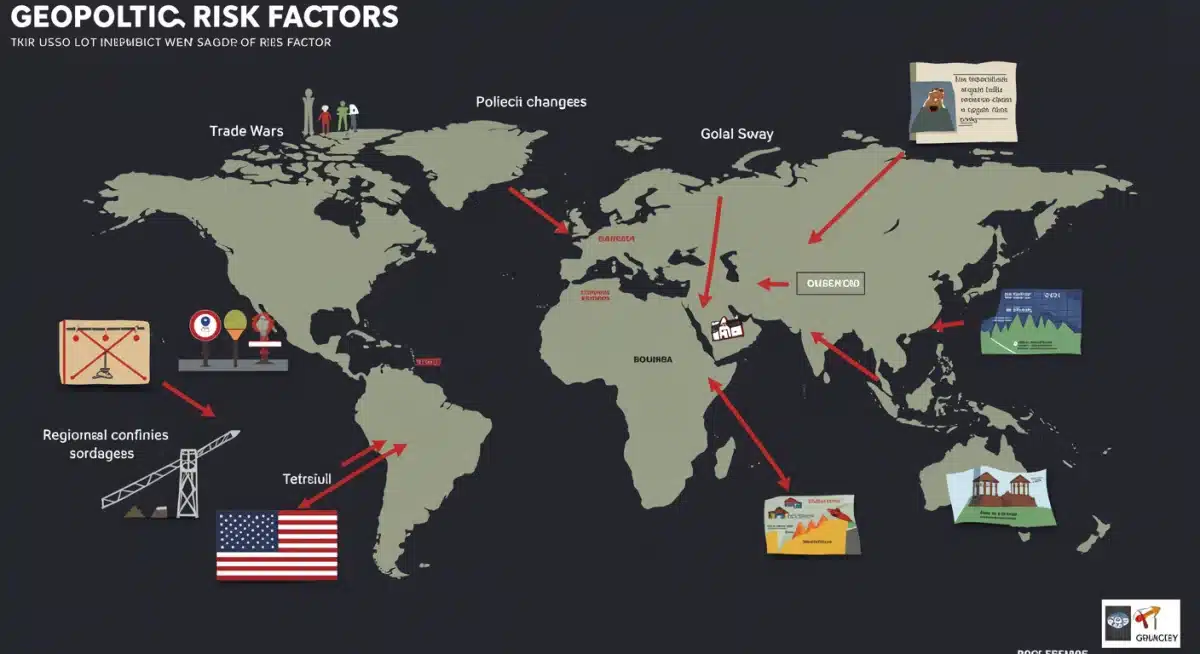
Geopolitical events have always been significant determinants of market behavior, but their influence appears to be intensifying as we approach 2025. The interconnectedness of global economies means that conflicts, trade disputes, and political instability in one region can send ripples across the entire financial system.
Several key geopolitical factors are currently under scrutiny. These include ongoing conflicts, shifts in global alliances, and the increasing competition for critical resources. Each of these elements contributes to an environment of uncertainty that can directly impact investor confidence and corporate earnings.
Regional Conflicts and Their Economic Fallout
Persistent regional conflicts, particularly in energy-rich areas or major trade routes, pose a direct threat to global supply chains and commodity prices. Interruptions can lead to inflation, higher production costs, and reduced consumer spending power. Investors often react to such instability by moving towards safer assets, leading to equity market declines.
- Disruptions in oil and gas supplies can cause energy price spikes.
- Conflicts can close vital shipping lanes, delaying goods and increasing transport costs.
- Humanitarian crises stemming from conflicts can strain international aid budgets and resources.
- Increased defense spending in response to threats can divert funds from economic development.
The economic fallout from these conflicts is rarely contained within national borders. Global supply chains mean that a localized event can quickly become a worldwide economic concern, affecting everything from manufacturing output to consumer goods prices. This interconnectedness amplifies the potential for volatility in financial markets.
The Role of Trade Tensions and Economic Nationalism
The rise of economic nationalism and protectionist policies continues to be a significant concern for global markets. Tariffs, trade barriers, and restrictions on technology transfer can disrupt established trade relationships and reduce overall economic efficiency. These measures often lead to retaliatory actions, creating a cycle of uncertainty.
Governments increasingly prioritize domestic industries and national security, sometimes at the expense of global cooperation. While intended to safeguard national interests, these policies can fragment global markets and create inefficiencies. Companies operating across borders face increased regulatory hurdles and unpredictable operating environments.
Impact on Multinational Corporations
Multinational corporations are particularly vulnerable to trade tensions. Their complex supply chains and global customer bases mean that they are directly exposed to the effects of tariffs and trade restrictions. This can lead to reduced profitability, difficulty in forecasting earnings, and a reluctance to invest in new projects.
- Increased costs due to tariffs on imported components.
- Reduced access to key markets for exports.
- Uncertainty in long-term investment planning.
- Pressure to reshore production, potentially increasing operational expenses.
The shifting landscape of international trade forces businesses to constantly adapt their strategies. This dynamic environment, while fostering innovation in some areas, also introduces significant risks that can contribute to overall market instability. Investors typically react to such uncertainty by demanding higher risk premiums, which can depress stock valuations.
Central Bank Policies and Inflationary Pressures
In response to geopolitical events and their economic consequences, central banks worldwide are navigating a delicate balance between controlling inflation and supporting economic growth. Geopolitical disruptions can exacerbate inflationary pressures, forcing central banks to consider more aggressive monetary policies, which can impact market liquidity and investor sentiment.
The interplay between geopolitical events, inflation, and central bank reactions creates a complex feedback loop. For instance, supply chain disruptions caused by conflicts can lead to higher prices, prompting central banks to raise interest rates. Higher rates, in turn, can slow economic activity and make borrowing more expensive for businesses and consumers.
Monetary Policy Responses to Geopolitical Shocks
Central banks often face a dilemma: tighten monetary policy to curb inflation, risking a recession, or maintain accommodative policies to support growth, risking entrenched inflation. Geopolitical shocks make this decision even more challenging, as they introduce external variables that are difficult to control through domestic monetary tools.
- Interest rate hikes can increase borrowing costs for companies and consumers.
- Quantitative tightening can reduce market liquidity.
- Uncertainty about future policy directions can deter investment.
- Currency fluctuations can impact international trade and corporate earnings.
The market’s reaction to central bank announcements is often pronounced, as these decisions directly influence the cost of capital and the overall economic outlook. Investors closely monitor central bank communications for clues about future policy paths, and any perceived hawkishness in response to geopolitical events can trigger significant market movements.
Technological Competition and Cybersecurity Risks
The global race for technological supremacy is another significant geopolitical factor influencing market stability. Competition in critical sectors like artificial intelligence, semiconductors, and quantum computing can lead to nationalistic policies, export controls, and increased cybersecurity threats. These dynamics can create winners and losers among companies and nations.
Governments are increasingly viewing technological leadership as a matter of national security and economic prosperity. This has led to substantial investments in domestic research and development, but also to restrictions on technology transfers and heightened scrutiny of foreign investments in sensitive sectors. The resulting fragmentation of global tech markets can impact profitability and innovation.
Cybersecurity as a Geopolitical Weapon
As digital infrastructure becomes more critical, cybersecurity risks are escalating. State-sponsored cyberattacks targeting financial institutions, critical infrastructure, or major corporations can cause widespread disruption, erode trust, and trigger significant market sell-offs. The potential for such attacks adds another layer of uncertainty for investors.
- Disruption of financial markets through direct cyberattacks.
- Theft of intellectual property impacting corporate value.
- Damage to reputation and consumer trust in affected companies.
- Increased costs for cybersecurity defenses across industries.
The constant threat of cyber warfare means that companies and governments must continuously invest in robust security measures. However, no system is entirely impervious, and a major cyberattack could have profound and immediate effects on market confidence and stability. This digital battleground is an increasingly important component of geopolitical risk.
Investor Strategies Amidst Anticipated Volatility
Given the expert predictions of increased stock market volatility in early 2025, investors need to adopt strategic approaches to protect their portfolios and potentially capitalize on opportunities. Diversification, hedging, and a focus on resilient assets are key components of navigating uncertain market conditions.
A well-thought-out investment strategy in a volatile environment emphasizes risk management and long-term objectives over short-term gains. Understanding the specific geopolitical risks and their potential impact on different sectors can help investors make more informed decisions about asset allocation.
Building a Resilient Portfolio
Diversification across different asset classes, geographies, and sectors remains a cornerstone of risk management. Investing in a mix of stocks, bonds, commodities, and alternative assets can help cushion the impact of downturns in any single market. Furthermore, considering investments in sectors historically less sensitive to geopolitical shocks, such as utilities or consumer staples, can add stability.
- Diversify across global markets to reduce regional risk concentration.
- Consider defensive sectors that tend to perform better during economic downturns.
- Allocate a portion of the portfolio to safe-haven assets like gold or certain government bonds.
- Regularly rebalance the portfolio to maintain desired risk exposure.
Beyond diversification, investors might explore hedging strategies using options or futures to mitigate potential losses. Maintaining a cash reserve also provides flexibility to capitalize on market dips when attractive opportunities arise. The emphasis should be on strategic positioning rather than reactive trading.
Long-Term Economic Outlook and Adaptation
While short-term volatility is anticipated, understanding the long-term economic implications of geopolitical shifts is crucial for sustainable investing. Global economic structures are continuously adapting to new political realities, and investors who recognize these evolving trends are better positioned for future growth.
The global economy is remarkably resilient, often finding new pathways for trade and innovation even amidst significant challenges. However, the nature of these adaptations can vary, leading to shifts in economic power and the emergence of new market leaders. Staying informed about these macro trends is vital for long-term success.
Emerging Opportunities and Sectoral Shifts
Geopolitical shifts, while creating risks, also open new avenues for investment. For example, increased focus on national security can boost defense and cybersecurity sectors. The push for energy independence can accelerate investments in renewable energy and domestic resource extraction. Identifying these emerging trends early can provide significant advantages.
- Increased investment in renewable energy technologies.
- Growth in domestic manufacturing and supply chain resilience.
- Expansion of cybersecurity and defense industries.
- Development of new trade routes and economic partnerships.
Ultimately, the ability to adapt to a changing global landscape will define investment success in the coming years. This involves not only mitigating risks but also actively seeking out and capitalizing on the opportunities that arise from geopolitical realignments and technological advancements. A forward-looking perspective, combined with robust risk management, is essential.
| Key Factor | Impact on Markets |
|---|---|
| Geopolitical Conflicts | Disrupt supply chains, raise commodity prices, reduce investor confidence. |
| Trade Tensions | Increase costs for businesses, fragment global markets, impact corporate earnings. |
| Central Bank Policies | Influence interest rates, liquidity, and overall economic growth prospects. |
| Technological Competition | Creates market fragmentation, cybersecurity risks, and shifts in industry leadership. |
Frequently Asked Questions About 2025 Market Volatility
The predicted volatility is primarily driven by escalating geopolitical shifts, including regional conflicts, intensified trade tensions, and the global competition for technological supremacy. These factors create significant uncertainty, impacting investor confidence and corporate outlooks globally.
Geopolitical conflicts disrupt global supply chains, leading to commodity price spikes and increased inflation. This instability often causes investors to shift towards safer assets, leading to declines in equity markets and broader economic uncertainty.
To navigate anticipated volatility, investors should focus on diversification across asset classes and geographies, consider defensive sectors, and potentially use hedging strategies. Maintaining a cash reserve for opportunistic buying during market dips is also advisable.
Central bank policies, particularly interest rate decisions, can both exacerbate and mitigate volatility. Aggressive tightening to combat inflation, often spurred by geopolitical events, can slow economic growth and increase market uncertainty, while careful management aims to stabilize.
Yes, geopolitical shifts can create new investment opportunities. Sectors like defense, cybersecurity, renewable energy, and domestic manufacturing often see increased investment as nations prioritize security and self-sufficiency. Identifying these long-term trends is key for strategic investors.
Conclusion
The forecast of 10% stock market volatility in early 2025, largely driven by complex geopolitical shifts, underscores the necessity for investors to remain vigilant and adaptable. Understanding the intricate connections between global politics, economic policies, and market reactions is paramount. By adopting well-informed strategies, including diversification and a forward-looking perspective, investors can better navigate the anticipated turbulence and identify potential opportunities amidst the changing global landscape, ensuring resilience in their financial endeavors.