The 2026 U.S. National Debt: Understanding its $35 Trillion Impact on Future Generations

The United States, a global economic powerhouse, continually navigates complex fiscal challenges. Among the most pressing is the ever-growing national debt, a figure that continues to climb with each passing year. Projections indicate a staggering milestone on the horizon: the U.S. national debt is expected to reach an unprecedented $35 trillion by 2026. This colossal sum is not merely an abstract number; it represents a profound financial obligation with far-reaching consequences, particularly for future generations. Understanding the intricacies of this debt, its origins, its potential ramifications, and the pathways to address it, is crucial for policymakers, economists, and every citizen.
The concept of national debt can often seem daunting and abstract, but its implications are very real. It influences everything from interest rates and inflation to government services and international relations. As the US national debt approaches the $35 trillion mark, the urgency to comprehend its scale and impact intensifies. This article aims to demystify the national debt, shedding light on the factors contributing to its rapid growth and exploring the critical challenges and opportunities it presents for the American future. We will delve into how this debt could shape the economic landscape for those inheriting it, examining the potential burdens and the strategies that might mitigate them.
The Anatomy of the U.S. National Debt: How Did We Get Here?
To grasp the magnitude of a $35 trillion debt, it’s essential to understand its foundational components and the historical trajectory that has led to its current state. The U.S. national debt is essentially the accumulation of past government budget deficits. A budget deficit occurs when government spending exceeds its revenue in a given fiscal year. When this happens, the Treasury Department borrows money to cover the shortfall, primarily by issuing Treasury bonds, notes, and bills.
Historical Context and Growth Drivers
The national debt has been a feature of the U.S. economy since its inception, often rising significantly during times of war or economic crisis. Major wars, such as World War II, the Korean War, and the Vietnam War, saw substantial increases in borrowing. Similarly, economic downturns, like the 2008 financial crisis and the COVID-19 pandemic, necessitated massive government spending on stimulus packages, unemployment benefits, and emergency aid, leading to sharp spikes in the debt.
Beyond these episodic events, several structural factors contribute to the persistent growth of the US national debt:
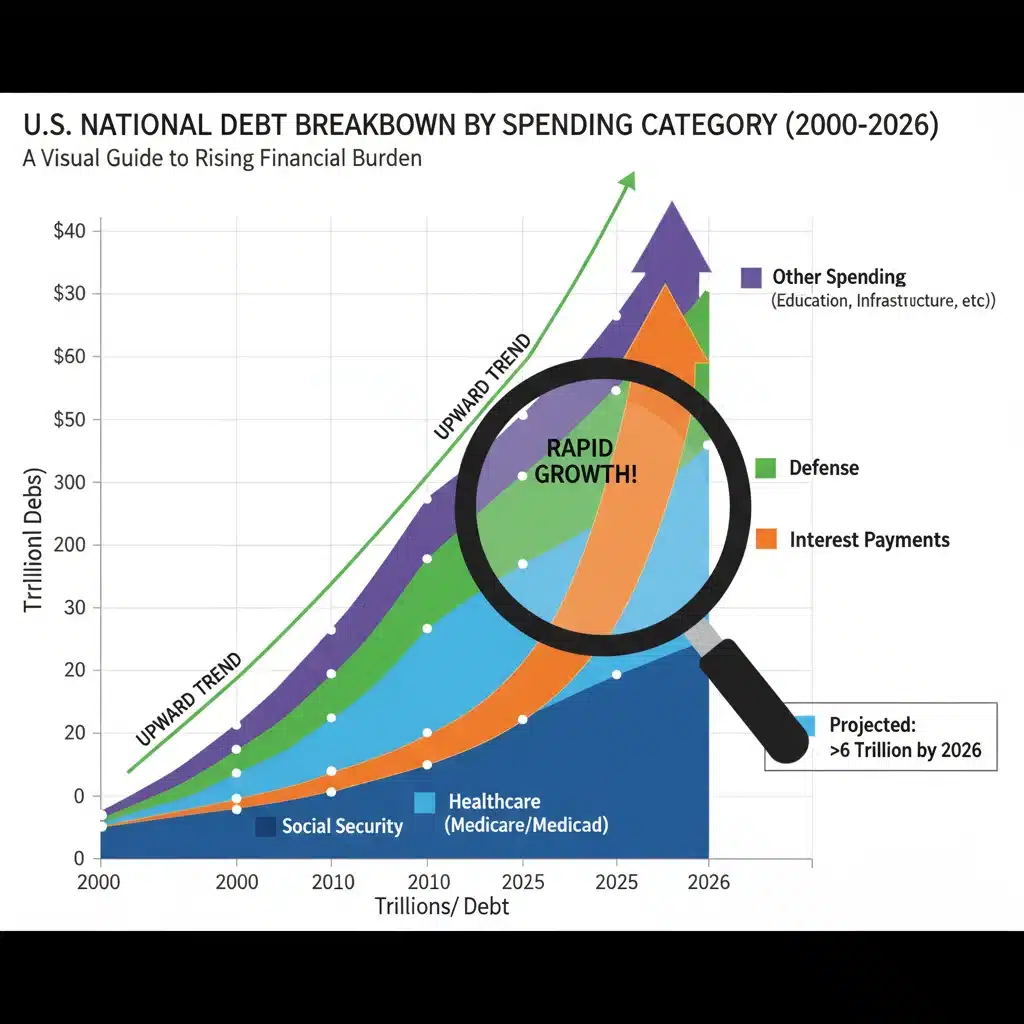
- Entitlement Programs: Social Security and Medicare are the largest components of federal spending. As the U.S. population ages, the number of beneficiaries increases, and healthcare costs continue to rise, these programs place an ever-growing strain on the federal budget. Their pay-as-you-go funding structure means current workers’ contributions largely fund current retirees’ benefits, making them highly sensitive to demographic shifts.
- Defense Spending: The U.S. maintains the largest military budget in the world, driven by global security commitments, technological advancements in weaponry, and ongoing conflicts. While essential for national security, these expenditures contribute significantly to the debt.
- Tax Cuts: Periods of significant tax cuts, if not accompanied by corresponding spending reductions, can reduce government revenue, thereby increasing the deficit and the national debt. The tax cuts enacted in 2001, 2003, and 2017 are often cited as examples of policies that have contributed to debt growth.
- Interest Payments: As the debt grows, so does the amount of interest the government must pay to its creditors. These interest payments become a larger line item in the federal budget, diverting funds that could otherwise be used for other programs or investments. In a rising interest rate environment, this component can accelerate debt accumulation even more rapidly.
- Economic Recessions: During economic downturns, tax revenues typically fall as unemployment rises and corporate profits decline. Concurrently, government spending on safety net programs (like unemployment insurance) increases. This combination exacerbates deficits and necessitates increased borrowing.
The cumulative effect of these factors has propelled the national debt to unprecedented levels. The projection of $35 trillion by 2026 is based on current spending patterns, economic forecasts, and demographic trends. It underscores a trajectory that, if left unaddressed, could have profound long-term consequences.
The $35 Trillion Burden: Economic and Social Implications
A national debt of $35 trillion is not just a bookkeeping entry; it has tangible effects on the economy, society, and the nation’s standing in the world. These implications are particularly salient for future generations, who will bear the brunt of managing and potentially reducing this colossal financial obligation.
Impact on Economic Growth and Investment
One of the primary concerns with a high national debt is its potential to stifle economic growth. This can occur through several mechanisms:
- Crowding Out Private Investment: When the government borrows heavily, it competes with private businesses for available capital. This increased demand for loans can drive up interest rates, making it more expensive for businesses to borrow money for investment in new factories, research, and development. This ‘crowding out’ effect can slow down innovation, job creation, and overall economic expansion.
- Higher Interest Payments: As mentioned, a larger debt means larger interest payments. These payments consume an increasing share of the federal budget, leaving less money for public investments in infrastructure, education, and scientific research—areas that are critical for long-term economic productivity and competitiveness. These payments are essentially a transfer of wealth, often from taxpayers to bondholders, some of whom are foreign entities.
- Risk of Fiscal Crisis: While the U.S. dollar’s status as a global reserve currency provides some insulation, an unsustainable debt trajectory could eventually lead to a loss of investor confidence. If investors become wary of the government’s ability to repay its debts, they might demand higher interest rates, further increasing borrowing costs and potentially triggering a fiscal crisis, characterized by rapid inflation or a sharp economic contraction.
Intergenerational Equity and Social Programs
The ethical dimension of the US national debt is particularly poignant when considering future generations. Current generations benefit from government spending—whether it’s through social security, healthcare, defense, or infrastructure—but future generations will be responsible for repaying the accumulated debt, often without having directly benefited from the spending that incurred it.
- Reduced Fiscal Flexibility: A high debt limits the ability of future governments to respond to crises, invest in new priorities, or maintain existing levels of public services. They may face difficult choices between raising taxes, cutting essential programs, or further increasing borrowing.
- Pressure on Entitlement Programs: The long-term solvency of Social Security and Medicare is already a significant concern. A growing national debt exacerbates these challenges, potentially forcing future generations to accept reduced benefits or higher taxes to sustain these vital programs.
- Increased Tax Burden: Ultimately, debt must be serviced and repaid, primarily through taxation. Future generations could face higher income taxes, consumption taxes, or other forms of taxation to cover the interest payments and principal on the national debt, leaving them with less disposable income and reduced economic opportunities.
Global Standing and Geopolitical Influence
The national debt also has implications for the U.S.’s role on the global stage. While the U.S. dollar remains the world’s primary reserve currency, and U.S. Treasury bonds are considered a safe haven, an ever-increasing debt could, over time, erode this privileged position.
- Dependence on Foreign Creditors: A significant portion of the U.S. national debt is held by foreign entities, including central banks and private investors in countries like China and Japan. While this relationship is symbiotic, excessive reliance on foreign creditors can raise concerns about economic sovereignty and geopolitical leverage.
- Reduced Soft Power: A nation grappling with a perceived unsustainable debt might find its ‘soft power’ diminished. Its ability to influence global economic policy, provide foreign aid, or lead on international initiatives could be constrained if its own fiscal house is seen as being in disorder.
- Currency Stability: Although unlikely in the short term, a persistent and unchecked rise in debt could eventually lead to concerns about the stability of the U.S. dollar, potentially leading to inflation or a loss of purchasing power, both domestically and internationally.
Addressing the Challenge: Potential Solutions and Policy Debates
Tackling a national debt of $35 trillion requires a multi-faceted approach, involving difficult political choices and a long-term commitment. There is no single, easy solution, and various proposals often come with their own economic and social trade-offs.
Revenue Enhancement Strategies
Increasing government revenue is one direct way to reduce deficits and slow the growth of the US national debt. Potential strategies include:
- Tax Increases: This could involve raising income tax rates, particularly for higher earners, increasing corporate tax rates, or introducing new forms of taxation, such as a value-added tax (VAT) or carbon tax. Each option has different economic impacts and political feasibility.
- Closing Tax Loopholes: Eliminating various tax deductions, credits, and exemptions that benefit specific industries or wealthy individuals could broaden the tax base and increase revenue without necessarily raising headline tax rates.
- Strengthening Tax Enforcement: Investing in the Internal Revenue Service (IRS) to improve its ability to audit and collect taxes could reduce the ‘tax gap’ – the difference between taxes owed and taxes paid.
These measures, while effective in principle, often face significant political opposition due to concerns about their impact on economic growth, investment, and individual taxpayers.
Spending Reduction Measures
Reducing government expenditures is the other side of the fiscal coin. This involves re-evaluating priorities and making cuts across various sectors:
- Entitlement Reform: Given that Social Security and Medicare constitute the largest portions of federal spending, any serious attempt to address the debt must consider reforms to these programs. Options include raising the retirement age, adjusting cost-of-living increases, means-testing benefits, or increasing contributions. These reforms are politically sensitive due to their direct impact on millions of Americans.
- Defense Spending Cuts: Reducing the defense budget, while often contentious, could free up substantial funds. Debates around defense spending typically revolve around national security needs versus fiscal responsibility.
- Discretionary Spending Reductions: This category includes funding for education, scientific research, infrastructure, environmental protection, and various government agencies. While these cuts might seem less politically charged than entitlement reforms, they can have significant impacts on public services and long-term national competitiveness.
- Waste and Efficiency: Identifying and eliminating government waste, fraud, and inefficiency is a perennial goal. While the potential savings are often debated, improving government operations can contribute to fiscal health.

Economic Growth Initiatives
A robust economy can help address the debt by increasing tax revenues organically without raising tax rates, and by making interest payments a smaller percentage of GDP. Policies that foster economic growth include:
- Investment in Infrastructure: Modernizing roads, bridges, public transit, and digital networks can boost productivity, create jobs, and enhance long-term economic capacity.
- Education and Workforce Development: Investing in human capital through improved education systems, vocational training, and lifelong learning programs can lead to a more skilled and productive workforce.
- Research and Development: Government support for basic and applied research can spur innovation, leading to new industries, products, and services that drive economic expansion.
- Regulatory Reform: Streamlining regulations without compromising essential protections can reduce burdens on businesses and encourage investment and entrepreneurship.
The Role of Future Generations in Fiscal Responsibility
While the current trajectory of the US national debt poses significant challenges for future generations, it also presents an opportunity for them to engage in shaping their economic destiny. Increased awareness and participation in fiscal policy debates are crucial.
Advocacy and Engagement
Younger generations, often burdened by student loan debt and facing uncertain economic prospects, have a vested interest in advocating for sustainable fiscal policies. This can involve:
- Educating Themselves: Understanding the complexities of government finance, the national debt, and its long-term implications.
- Engaging in Political Discourse: Participating in elections, contacting elected officials, and supporting organizations that advocate for fiscal responsibility.
- Promoting Bipartisan Solutions: Recognizing that addressing the debt requires cooperation across political divides and encouraging pragmatic, evidence-based policy choices.
Innovation and Economic Adaptability
Future generations will also play a critical role in driving the economic growth necessary to manage and potentially reduce the debt. Their capacity for innovation, entrepreneurship, and adaptability to new economic realities will be vital. Investing in STEM fields, fostering a culture of innovation, and supporting small businesses are ways to empower these generations to create a more dynamic and prosperous economy.
Conclusion: Navigating the Fiscal Future
The projected $35 trillion US national debt by 2026 represents a formidable challenge, but not an insurmountable one. It is a testament to decades of complex fiscal decisions, economic shocks, and evolving societal needs. The implications for future generations are profound, touching upon economic growth, social programs, and the very fabric of the nation’s fiscal health and global influence.
Addressing this challenge requires a sustained commitment to fiscal responsibility, a willingness to make difficult choices, and a broad consensus across the political spectrum. It will likely involve a combination of revenue enhancements, spending reductions, and policies designed to foster robust economic growth. Moreover, it demands an informed and engaged citizenry, particularly from those younger generations who will inherit this fiscal legacy.
The conversation around the national debt should not be one of despair, but rather one of strategic planning and collective action. By understanding the problem, exploring viable solutions, and fostering a spirit of intergenerational cooperation, the United States can work towards a more sustainable fiscal future, ensuring that the next generations are empowered, not encumbered, by the economic choices of today.
The path forward will be complex, but with thoughtful deliberation and courageous leadership, the U.S. can navigate these fiscal waters and secure a prosperous future for all its citizens.
Author