Child Tax Credit 2026: Enhanced $3,600 Benefit Eligibility Guide

Are you a parent or guardian looking ahead to the financial landscape of 2026? If so, understanding the nuances of the Child Tax Credit 2026 is paramount. This crucial tax benefit has been a cornerstone of support for millions of American families, and its potential enhancements for 2026 could bring significant financial relief. With discussions around increasing the credit to an impressive $3,600 per child, knowing the eligibility criteria and how to navigate the system will be key to maximizing your family’s benefits.
The Child Tax Credit (CTC) has a dynamic history, evolving with legislative changes to address the economic needs of families. While the $3,600 credit was temporarily available in 2021 under the American Rescue Plan, the standard credit reverted to $2,000 for subsequent years. However, various proposals are on the table to reinstate and even enhance this vital support for 2026 and beyond. This comprehensive guide will delve into what the Child Tax Credit 2026 might look like, who stands to benefit, and what steps you can take to prepare.
Understanding the Child Tax Credit: A Brief History and Future Outlook
The Child Tax Credit, first enacted in 1997, was designed to provide financial assistance to families with qualifying children. Initially, it offered a modest credit of $400 per child. Over the years, it has seen several adjustments, most notably with the Tax Cuts and Jobs Act (TCJA) of 2017, which increased the maximum credit to $2,000 per child, with up to $1,400 of it being refundable.
The most significant, albeit temporary, change occurred in 2021. The American Rescue Plan Act boosted the credit to $3,600 for children under age six and $3,000 for children aged six to seventeen. It also made the credit fully refundable, meaning even families with little or no income could receive the full amount. Furthermore, advance payments were distributed monthly, providing crucial ongoing support.
As we look towards the Child Tax Credit 2026, the landscape is once again ripe for potential changes. The provisions of the TCJA are set to expire at the end of 2025, opening the door for Congress to re-evaluate and potentially expand the credit. This expiration presents a critical opportunity for lawmakers to implement a more robust and permanent version of the CTC, potentially mirroring or even exceeding the 2021 enhancements. The focus is often on making the credit fully refundable and increasing the maximum amount, addressing concerns about child poverty and economic stability for low-income families.
Key Eligibility Requirements for the Child Tax Credit 2026
While specific details for the Child Tax Credit 2026 are subject to ongoing legislative discussions, certain core eligibility criteria are likely to remain consistent. Understanding these fundamental requirements is your first step toward determining if your family will qualify for this valuable benefit.
Qualifying Child Definition
For a child to be considered a ‘qualifying child’ for the Child Tax Credit, they must meet several tests:
- Age Test: The child must be under the age of 17 at the end of the tax year (i.e., 16 or younger). For the enhanced 2021 credit, this was extended to 17, and similar proposals for 2026 may also include this expansion.
- Relationship Test: The child must be your son, daughter, stepchild, foster child, brother, sister, half-brother, half-sister, stepbrother, stepsister, or a descendant of any of them (e.g., a grandchild).
- Residency Test: The child must have lived with you for more than half of the tax year. There are exceptions for temporary absences due to special circumstances like illness, education, business, vacation, or military service.
- Support Test: The child must not have provided more than half of their own support for the year.
- Joint Return Test: If the child is married, they cannot file a joint return for the year, unless they do so only to claim a refund of withheld income tax or estimated tax paid.
- Citizenship Test: The child must be a U.S. citizen, U.S. national, or U.S. resident alien.
It’s crucial to remember that each child must meet all these conditions to be considered a qualifying child for the credit. If you have multiple children, each child’s eligibility is assessed individually.
Income Thresholds and Phase-Outs
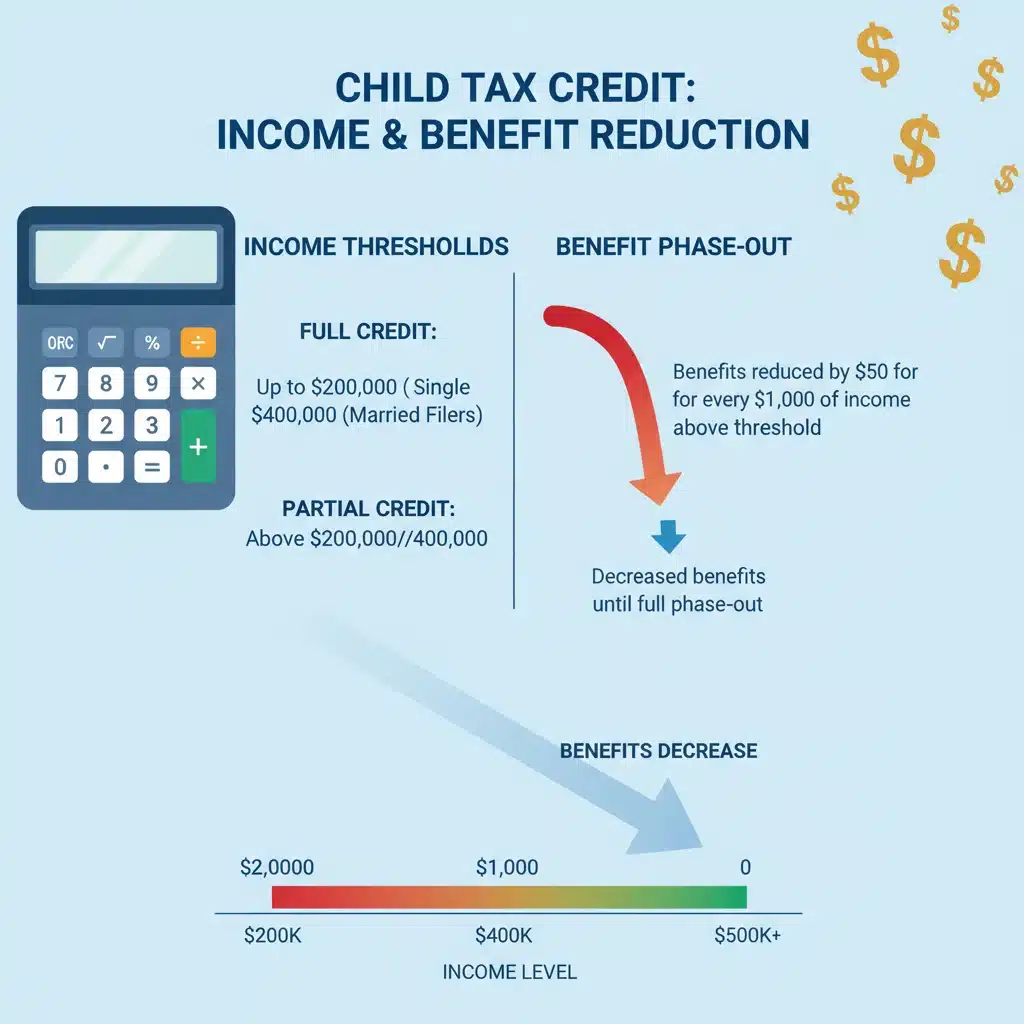
The amount of the Child Tax Credit 2026 you can receive is typically tied to your adjusted gross income (AGI). Historically, the credit begins to phase out once your income exceeds certain thresholds. For the $2,000 credit under current law, the phase-out thresholds are: $400,000 for married couples filing jointly and $200,000 for all other filers.
If the credit is enhanced to $3,600 as proposed, it is likely that different income thresholds would apply, potentially higher than the current ones, or there might be a tiered phase-out system. For instance, the 2021 expansion phased out the additional $1,600 or $1,000 (above the $2,000 base) at much lower income levels ($150,000 for joint filers, $112,500 for head of household, and $75,000 for single filers). Only after these additional amounts phased out did the base $2,000 credit begin to phase out at the higher TCJA levels.
Understanding these income limits is vital because exceeding them can significantly reduce or eliminate your credit. As 2026 approaches, staying informed about the final legislative details regarding income thresholds will be critical for accurate financial planning.
Potential Enhancements: The $3,600 Per Child Benefit
The prospect of an enhanced Child Tax Credit 2026, potentially reaching $3,600 per child, is a significant topic of discussion among policymakers and advocacy groups. This increase would mirror the temporary expansion seen in 2021, which had a profound impact on reducing child poverty and providing economic stability for families.
Lessons from the 2021 Expansion
The 2021 expansion of the CTC was widely praised for its effectiveness. Studies showed a dramatic reduction in child poverty, with millions of children lifted out of poverty. Families used the funds for essential needs such as food, housing, childcare, and educational expenses. The advance monthly payments were particularly beneficial, providing a steady stream of income that helped families manage their budgets more effectively.
These positive outcomes are a strong argument for advocates pushing for a similar, or even greater, enhancement in 2026. The economic benefits extend beyond individual families, contributing to local economies as families spend their increased funds on goods and services.
What Would an Enhanced CTC Mean for Your Family?
If the Child Tax Credit 2026 is indeed enhanced to $3,600 per child, the financial implications for eligible families would be substantial. Consider a family with two qualifying children. Under the current $2,000 credit, they would receive $4,000. With a $3,600 credit, this would jump to $7,200 – an additional $3,200 that could be used to:
- Offset rising childcare costs.
- Cover educational expenses, from school supplies to tutoring.
- Contribute to savings for college or other long-term goals.
- Ensure access to nutritious food.
- Help with housing costs or utility bills.
Furthermore, if the credit is made fully refundable, it would provide a lifeline to low-income families who currently receive only a partial credit or no credit at all due to insufficient tax liability. This full refundability is often considered the most impactful aspect of the proposed enhancements, as it targets those most in need.
Navigating Legislative Changes and Preparing for 2026
The exact form of the Child Tax Credit 2026 will depend on legislative action in the coming years. As the TCJA provisions expire, Congress will have to decide whether to extend them, modify them, or enact entirely new legislation. This period of uncertainty can make financial planning challenging, but there are steps you can take to stay informed and prepared.
Staying Informed on Policy Developments
Keep an eye on news from Capitol Hill, especially as the 2024 and 2025 legislative sessions unfold. Follow reputable financial news outlets, government publications, and non-partisan organizations that track tax policy. Key indicators to watch for include:
- Discussions around the expiration of the TCJA provisions.
- Proposals from both major political parties regarding family tax benefits.
- Statements from the IRS regarding potential changes and implementation timelines.
Subscribing to newsletters from tax advocacy groups or financial advisors can also provide timely updates.
Documentation and Record Keeping
Regardless of the final structure of the Child Tax Credit 2026, meticulous record-keeping will always be essential. Start now by organizing important documents:
- Children’s Social Security Numbers (SSNs): Ensure these are accurate and readily accessible.
- Birth Certificates: Proof of relationship may be required in some cases.
- Residency Records: Documents proving your child lived with you for more than half the year (e.g., school records, medical bills addressed to your home).
- Income Records: W-2s, 1099s, and other income statements will be necessary to determine your AGI.
Having these documents in order will streamline the tax filing process and help you quickly verify your eligibility once the 2026 rules are finalized.
Consulting with Tax Professionals
As tax laws can be complex and subject to change, consulting with a qualified tax professional is always a wise decision. They can provide personalized advice based on your specific financial situation and help you understand how potential changes to the Child Tax Credit 2026 might affect you. A tax professional can also assist with proper documentation, ensure you claim all eligible credits, and help you navigate any new forms or procedures that may arise.

Maximizing Your Child Tax Credit 2026 Benefit
Once the details of the Child Tax Credit 2026 are set, there are several strategies you can employ to ensure you maximize your benefit. Proactive planning and attention to detail can make a significant difference in the amount of credit your family receives.
Accurate Filing and Avoiding Common Mistakes
The most fundamental step to maximizing your CTC is to file your taxes accurately and on time. Common mistakes that can delay or reduce your credit include:
- Incorrect SSNs: Double-check all Social Security Numbers for yourself, your spouse, and your children.
- Miscalculating AGI: Ensure your adjusted gross income is correctly reported, as it directly impacts phase-outs.
- Missing Qualifying Children: Make sure all eligible children are included on your return.
- Filing Status Errors: Your filing status (e.g., Single, Married Filing Jointly, Head of Household) can affect your income thresholds.
- Not Claiming the Credit: While seemingly obvious, some eligible families simply overlook claiming the credit.
Using reputable tax software or a tax professional can help minimize these errors.
Understanding Refundability
The refundability of the Child Tax Credit 2026 is a critical aspect, especially for lower-income families. If the credit is made fully refundable, it means you can receive the full credit amount even if it exceeds your tax liability, effectively resulting in a refund. If it’s partially refundable (like the current $1,400 per child), there are limits to how much you can receive as a refund. Understanding this distinction is vital for accurately estimating your potential benefit.
Impact of Life Changes on Eligibility
Life events can significantly impact your eligibility for the Child Tax Credit. Major changes to consider include:
- Birth or Adoption of a Child: A new addition to your family will make you eligible for the credit for that child.
- Changes in Custody: If custody arrangements change, only the parent who claims the child as a dependent for more than half the year can claim the CTC.
- Changes in Income: A significant increase or decrease in household income could push you into or out of phase-out ranges.
- Changes in Residency: If a child no longer lives with you for more than half the year, they may no longer qualify.
It’s important to update your tax preparer or adjust your tax planning as these life changes occur to ensure continuous eligibility and maximum benefit.
The Broader Economic Impact of the Child Tax Credit
Beyond individual family finances, the Child Tax Credit 2026, particularly if enhanced, holds significant potential for broader economic impact. The credit is not just a handout; it’s an investment in the future workforce and the overall economic health of the nation.
Reducing Child Poverty
Perhaps the most compelling argument for an expanded CTC is its proven ability to reduce child poverty. The 2021 expansion demonstrated a direct link between increased credit amounts and a decrease in child poverty rates. By providing a financial safety net, families are better able to provide for their children’s basic needs, improving health outcomes, educational attainment, and long-term economic mobility.
Stimulating Local Economies
When families receive additional funds from the CTC, a significant portion is typically spent on essential goods and services. This increased consumer spending injects money directly into local economies, supporting small businesses and creating jobs. It’s a form of economic stimulus that benefits communities across the country, particularly in areas with higher concentrations of low-income families.
Investing in Future Generations
The benefits of the CTC extend beyond immediate financial relief. By enabling families to invest in their children’s well-being, the credit contributes to the development of a healthier, better-educated future workforce. Children who grow up in more financially stable environments tend to have better educational outcomes, higher earning potential as adults, and are less likely to rely on public assistance in the long run. This makes the Child Tax Credit 2026 a long-term investment in human capital.
Frequently Asked Questions about the Child Tax Credit 2026
Will the Child Tax Credit be $3,600 in 2026?
The exact amount of the Child Tax Credit 2026 is not yet finalized. While there are strong proposals and advocacy for reinstating the $3,600 per child amount (or even higher) seen in 2021, this would require new legislation. The current law, absent further congressional action, would revert the credit to $2,000 per child after 2025.
What are the income limits for the Child Tax Credit 2026?
Current law sets income phase-out thresholds at $400,000 for married couples filing jointly and $200,000 for all other filers for the $2,000 credit. If the credit is enhanced to $3,600, it is highly likely that new, potentially lower, income thresholds for the enhanced portion would be introduced, similar to the 2021 structure. These details will be confirmed once legislation is passed.
Do I need to apply for the Child Tax Credit 2026?
Generally, you do not need to ‘apply’ for the Child Tax Credit in a separate application process. You claim the credit when you file your federal income tax return. However, if there are provisions for advance payments (as there were in 2021), the IRS may require you to opt-in or provide updated information through an online portal.
What if I have a child born in 2026? Will they qualify?
Yes, typically, a child born at any point during the tax year will qualify for the full Child Tax Credit for that year, provided all other eligibility criteria are met. This includes children born in 2026.
Is the Child Tax Credit refundable in 2026?
Under current law, the Child Tax Credit is partially refundable, up to $1,400 per child. A key aspect of proposed enhancements for the Child Tax Credit 2026 is to make it fully refundable, similar to the 2021 expansion. This would mean that even families with no tax liability could receive the full credit amount. The refundability will depend on the final legislative outcome.
Conclusion: Preparing for the Future of the Child Tax Credit
The Child Tax Credit 2026 represents a critical juncture for family financial support in the United States. While the exact details are still taking shape, the potential for an enhanced $3,600 per child benefit offers a beacon of hope for millions of families. By understanding the historical context, current eligibility requirements, and the ongoing legislative discussions, you can proactively prepare to maximize this vital credit.
Stay informed about policy developments, maintain meticulous records, and don’t hesitate to consult with tax professionals. The Child Tax Credit is more than just a tax break; it’s an investment in our children, our families, and the economic strength of our nation. By staying engaged and prepared, you can ensure your family reaps the full benefits of the Child Tax Credit 2026, contributing to a more stable and prosperous future.
Author