Investing in 2026: S&P 500 Performance Predictions & Sector Opportunities
Investing in 2026: Analyzing S&P 500 Performance Predictions and Sector Opportunities
As we navigate the ever-evolving landscape of global finance, looking ahead becomes paramount for astute investors. The year 2026, while seemingly distant, is already a focal point for economic strategists and market analysts. Understanding the potential trajectory of the S&P 500, the benchmark for large-cap U.S. equities, is crucial for crafting robust investment portfolios. This comprehensive guide delves into the S&P 500 2026 outlook, exploring the macroeconomic factors, expert predictions, and identifying key sector opportunities that could shape investment decisions.
Understanding the S&P 500: A Brief Overview
The S&P 500 index, or Standard & Poor’s 500, is a stock market index that represents the performance of 500 of the largest publicly traded companies in the United States. It is a market-capitalization-weighted index, meaning companies with larger market values have a greater impact on the index’s performance. Often viewed as a bellwether for the overall U.S. economy, the S&P 500’s movements are closely watched by investors worldwide. Its diversity across various sectors provides a broad snapshot of the American corporate landscape, making its future performance a key indicator for broader market health and investment sentiment. Historically, the S&P 500 has demonstrated resilience and long-term growth, albeit with periods of volatility. Understanding its historical context and the factors that drive its performance is fundamental to predicting its future trajectory, particularly as we consider the S&P 500 2026 outlook.
Macroeconomic Factors Influencing the S&P 500 2026 Outlook
Forecasting the S&P 500’s performance in 2026 requires a deep dive into several interconnected macroeconomic factors. These elements collectively create the economic environment in which companies operate and investors make decisions. Each factor carries significant weight and can either bolster or hinder market growth. Understanding their potential evolution is key to grasping the S&P 500 2026 outlook.
Inflation and Interest Rates
Inflation, the rate at which the general level of prices for goods and services is rising, and interest rates, controlled by central banks like the Federal Reserve, are perhaps the most influential factors. High inflation can erode purchasing power and corporate profits, while aggressive interest rate hikes designed to combat inflation can increase borrowing costs for businesses and consumers, potentially slowing economic growth. Conversely, stable, moderate inflation coupled with accommodating interest rates can foster a healthy environment for corporate expansion and market appreciation. By 2026, the global economy’s success in normalizing inflation and interest rates will be a significant determinant of the S&P 500’s health. Analysts will be closely watching for signs of sustained disinflation and a more predictable rate environment, which could provide a solid foundation for the S&P 500 2026 outlook. Persistent inflationary pressures or unexpected rate hikes could introduce headwinds, making it essential for investors to monitor central bank policies and economic data closely.
Global Economic Growth
The health of the global economy directly impacts the S&P 500, as many of its constituent companies have significant international operations and revenue streams. Strong global GDP growth typically translates to higher demand for goods and services, benefiting multinational corporations. Conversely, slowdowns in major economies, geopolitical tensions, or trade disputes can dampen corporate earnings and investor confidence. The post-pandemic recovery trajectory of key global players like China, Europe, and emerging markets will be critical. A synchronized global recovery, supported by stable supply chains and international cooperation, would be a positive catalyst for the S&P 500 2026 outlook. Conversely, fragmentation or significant regional economic downturns could introduce volatility and uncertainty. Investors should consider the interconnectedness of global markets and how international events might ripple through the S&P 500.
Technological Innovation and Disruption
Technological advancements are a constant force reshaping industries and creating new investment opportunities. Areas like artificial intelligence (AI), biotechnology, renewable energy, and advanced manufacturing are poised for significant growth. Companies at the forefront of these innovations often experience rapid expansion and attract substantial investment. However, technology also brings disruption, potentially rendering older business models obsolete. The ability of S&P 500 companies to adapt, innovate, and integrate new technologies will be crucial for their long-term success and, by extension, the index’s performance. The pace and scale of technological adoption, as well as regulatory responses to new tech, will profoundly influence the S&P 500 2026 outlook. Investors should look for companies with strong R&D pipelines and a clear strategy for leveraging emerging technologies.
Geopolitical Stability and Policy Environment
Geopolitical events, ranging from international conflicts to trade policies and domestic political stability, can introduce significant volatility into financial markets. Uncertainty can lead to capital flight and reduced investment, while stability fosters confidence. Government policies related to taxation, regulation, infrastructure spending, and environmental initiatives also play a vital role. For example, policies supporting green energy or digital infrastructure could create tailwinds for specific sectors within the S&P 500. Conversely, protectionist trade policies or increased regulatory burdens could impede growth. The predictability and direction of these factors will significantly shape the S&P 500 2026 outlook. Investors need to remain vigilant about geopolitical developments and understand how policy changes might impact corporate profitability and market sentiment.
Expert Predictions for the S&P 500 in 2026
While no one possesses a crystal ball, financial institutions and economic analysts dedicate significant resources to forecasting market performance. Their predictions for the S&P 500 2026 outlook are often based on complex models, historical data, and current economic trends. It’s important to remember that these are projections and subject to change, but they offer valuable insights for strategic planning.
Consensus Views and Divergent Opinions
Many leading investment banks and research firms typically publish long-term S&P 500 forecasts. A common approach involves projecting corporate earnings growth, factoring in expected economic expansion, and applying a reasonable price-to-earnings (P/E) multiple. By 2026, a general consensus might emerge around moderate, sustained growth for the S&P 500, assuming a continued normalization of inflation and interest rates, and a stable global economic environment. However, divergent opinions are also common. Some analysts might project more aggressive growth, citing breakthroughs in technology or robust consumer spending, while others might adopt a more cautious stance, highlighting potential risks such as persistent geopolitical tensions, elevated debt levels, or unforeseen economic shocks. These differing perspectives are crucial for investors to consider, as they highlight various potential scenarios for the S&P 500 2026 outlook.
Key Factors Underpinning Forecasts
The forecasts for the S&P 500 2026 outlook are built upon several foundational assumptions. Corporate earnings growth is often the primary driver. Analysts will project how much S&P 500 companies are expected to earn, considering revenue growth, profit margins, and share buybacks. Valuations, specifically the P/E ratio, also play a significant role. If current valuations are considered high, future returns might be more modest, assuming a reversion to historical averages. Conversely, if valuations are depressed, there might be more upside potential. Technological advancements, particularly in AI and automation, are also increasingly integrated into long-term forecasts, as they are expected to boost productivity and efficiency. Furthermore, demographic shifts, such as an aging population in developed economies, can influence consumer spending patterns and labor market dynamics, indirectly impacting corporate profitability and the S&P 500 2026 outlook. Understanding these underlying assumptions helps investors evaluate the credibility and potential biases of various forecasts.
The Role of Historical Trends and Cycles
While past performance is not indicative of future results, historical trends and market cycles provide valuable context. The S&P 500 has experienced numerous bull and bear markets throughout its history. Analysts often look at the average length and magnitude of these cycles to inform their long-term projections. For instance, if the market has been in a sustained bull run, some might anticipate a period of consolidation or correction. Conversely, a prolonged downturn might suggest a greater potential for recovery. The impact of technological revolutions, such as the dot-com bubble or the rise of the internet, also offers lessons on how new paradigms can reshape market leadership and valuations. By studying these historical patterns, forecasters attempt to identify potential analogies or deviations that could influence the S&P 500 2026 outlook. However, it’s crucial to acknowledge that each economic cycle has its unique characteristics, and relying solely on historical data can be misleading without considering current conditions.
Promising Sector Opportunities for 2026
Beyond the overall S&P 500 2026 outlook, identifying specific sectors with high growth potential is key to strategic investing. While market conditions can shift rapidly, certain secular trends suggest particular industries are poised for outperformance.
Technology: AI, Cloud Computing, and Cybersecurity
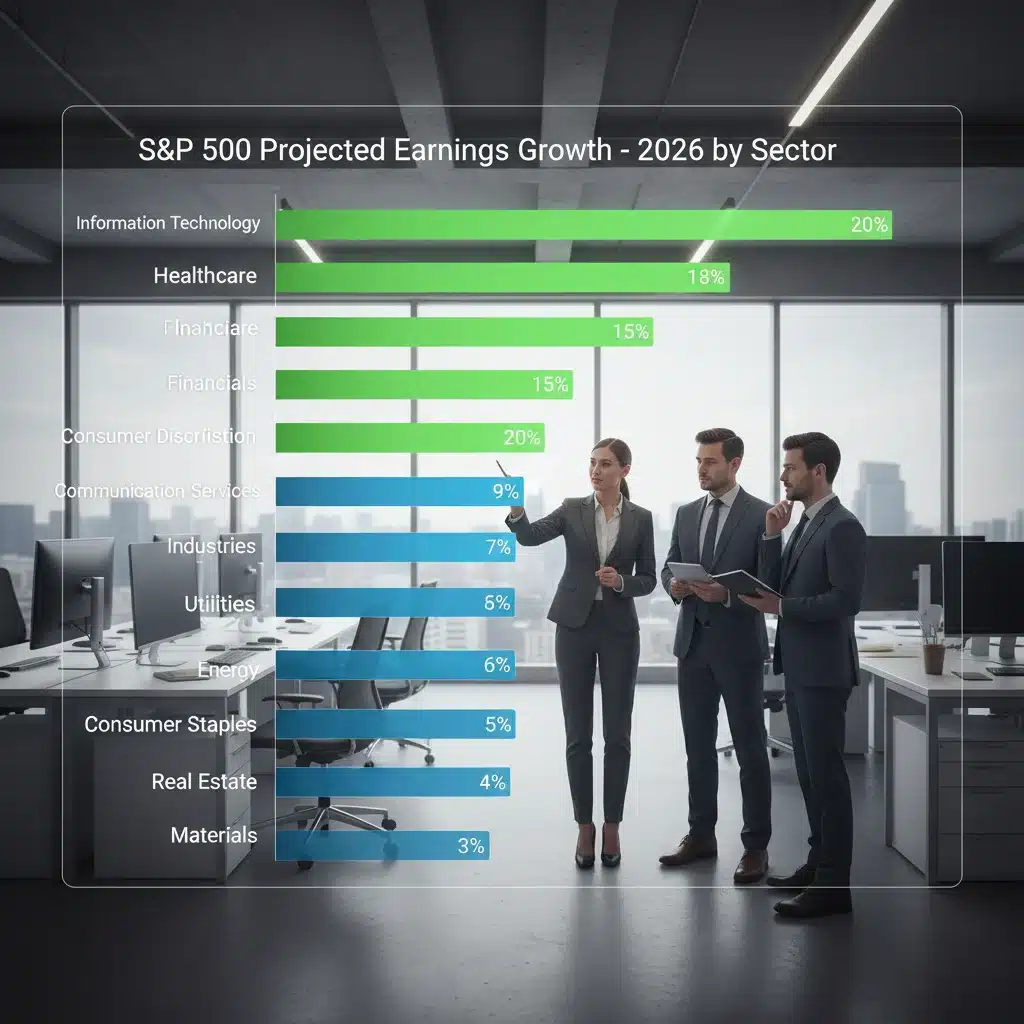
The technology sector is expected to remain a dominant force. Artificial Intelligence (AI) is not just a buzzword; it’s a transformative technology with applications across virtually every industry, from healthcare to finance to manufacturing. Companies developing AI algorithms, hardware, and applications are likely to see significant growth. Cloud computing continues its expansion, with businesses increasingly relying on scalable, flexible, and remote infrastructure. This trend fuels demand for cloud service providers and related software companies. Cybersecurity, in an increasingly digital world, is no longer optional but essential. As cyber threats become more sophisticated, demand for robust cybersecurity solutions will only intensify, making this a resilient growth area. Investors looking at the S&P 500 2026 outlook should focus on companies within these sub-sectors that demonstrate strong innovation, market leadership, and recurring revenue models.
Healthcare: Biotechnology, Digital Health, and Medical Devices
The healthcare sector is driven by demographic shifts, particularly an aging global population, and continuous scientific advancements. Biotechnology firms are at the forefront of developing new treatments and therapies for diseases, often with significant market potential if successful. Digital health, encompassing telehealth, wearable devices, and AI-powered diagnostics, is revolutionizing how healthcare is delivered and managed, offering convenience and efficiency. The medical device industry continues to innovate, creating advanced tools for surgery, diagnostics, and patient care. Companies in these areas with strong R&D pipelines, regulatory approvals, and effective commercialization strategies are likely to thrive. The S&P 500 2026 outlook for healthcare remains strong, fueled by both necessity and innovation.
Renewable Energy and Sustainable Technologies
The global push towards decarbonization and sustainability presents immense opportunities in the renewable energy sector. Solar, wind, geothermal, and hydropower technologies are becoming increasingly cost-effective and efficient, driving adoption worldwide. Beyond energy generation, sustainable technologies encompass areas like electric vehicles (EVs), battery storage, smart grids, and carbon capture solutions. Government incentives, corporate sustainability goals, and growing consumer awareness are powerful tailwinds for this sector. Companies involved in the production, deployment, and maintenance of these technologies are well-positioned for growth. As environmental concerns become more pressing, the long-term S&P 500 2026 outlook for this sector appears exceptionally bright, attracting significant investment capital.
Industrials: Automation and Robotics
The industrial sector, traditionally seen as cyclical, is undergoing a transformation driven by automation and robotics. Companies specializing in industrial automation, robotics manufacturing, and advanced materials are critical to improving productivity, efficiency, and safety across various industries. As labor costs rise and the demand for precision manufacturing increases, businesses are investing heavily in these technologies. This trend is not limited to factories; automation is also impacting logistics, warehousing, and even service industries. Companies that provide innovative solutions in these areas, particularly those with strong intellectual property and a global customer base, are expected to see robust demand. The S&P 500 2026 outlook for industrials will increasingly depend on their ability to embrace and lead in this technological evolution.
Financials: Fintech and Digital Payments
The financial sector is being reshaped by technological innovation, giving rise to Fintech (financial technology) and the rapid expansion of digital payments. Companies offering innovative solutions in areas like mobile banking, online lending, blockchain-based services, and payment processing are disrupting traditional financial institutions. As consumers and businesses increasingly prefer digital transactions, the growth trajectory for these areas remains steep. Traditional banks that successfully integrate these technologies or acquire Fintech innovators are also likely to adapt and thrive. The competitive landscape is intense, but companies that can offer secure, efficient, and user-friendly financial services are poised for significant market share gains. The S&P 500 2026 outlook for financials will be heavily influenced by how effectively the sector embraces and leverages these digital transformations.
Risks and Challenges to the S&P 500 2026 Outlook
While the future holds promising opportunities, it’s equally important to acknowledge the potential risks and challenges that could impact the S&P 500 2026 outlook. Prudent investors must consider these factors when constructing their portfolios.
Persistent Inflation and Higher Interest Rates
Despite expectations of inflation normalization, there’s always a risk that inflationary pressures could persist longer than anticipated. Supply chain disruptions, geopolitical events impacting commodity prices, or stronger-than-expected wage growth could fuel inflation. In response, central banks might be compelled to maintain higher interest rates or even implement further hikes, which could slow economic activity, increase borrowing costs for businesses, and reduce corporate profitability. A prolonged period of high interest rates could depress equity valuations and make fixed-income investments more attractive, diverting capital from stocks and negatively affecting the S&P 500 2026 outlook.
Geopolitical Instability and Trade Wars
Geopolitical tensions, including ongoing conflicts, new regional disputes, or heightened trade protectionism, pose significant risks. Such events can disrupt global supply chains, increase the cost of raw materials, reduce international trade, and erode investor confidence. Companies with extensive international operations are particularly vulnerable to these risks. Trade wars, characterized by tariffs and retaliatory measures, can reduce corporate earnings and create uncertainty, leading to market volatility. The interconnected nature of the global economy means that a significant geopolitical event in one region can have ripple effects across markets, impacting the S&P 500 2026 outlook.
Regulatory Scrutiny and Antitrust Concerns
As large technology companies and other dominant players continue to grow, they face increasing regulatory scrutiny. Governments worldwide are examining issues related to data privacy, market dominance, and antitrust concerns. New regulations or antitrust actions could lead to increased compliance costs, limitations on business practices, or even forced breakups of large corporations. This could negatively impact the profitability and growth prospects of some of the largest S&P 500 constituents, thereby affecting the overall index. The evolving regulatory landscape, particularly for the tech and financial sectors, will be a critical factor in shaping the S&P 500 2026 outlook.
Cybersecurity Threats and Data Breaches
While cybersecurity offers significant investment opportunities, it also presents a growing risk. As businesses become more digitized, they become more susceptible to cyberattacks and data breaches. A major cyber incident can lead to significant financial losses, reputational damage, legal liabilities, and a loss of customer trust. For S&P 500 companies, particularly those in technology, finance, and healthcare, robust cybersecurity measures are paramount. A widespread or highly damaging cyberattack could have systemic implications, impacting multiple sectors and potentially dampening the S&P 500 2026 outlook. Investors should assess a company’s cybersecurity posture as part of their due diligence.
Unforeseen Economic Shocks
The global economy is always susceptible to unforeseen events, often referred to as ‘black swans.’ These could include new pandemics, natural disasters of unprecedented scale, or sudden financial crises. Such events can trigger rapid and severe market downturns, disrupt economic activity, and challenge even the most robust forecasts. While impossible to predict, acknowledging the possibility of such shocks is crucial for maintaining a diversified and resilient investment portfolio. Building in a margin of safety and having a long-term perspective can help investors navigate these unexpected challenges to the S&P 500 2026 outlook.
Investment Strategies for the S&P 500 2026 Outlook
Given the opportunities and risks, a well-thought-out investment strategy is essential for navigating the S&P 500 2026 outlook. Here are some key approaches to consider.
Diversification Across Sectors and Geographies
Diversification remains a cornerstone of prudent investing. Rather than concentrating investments in a single sector or region, spreading capital across various industries (e.g., technology, healthcare, industrials, financials, consumer staples) and different geographical markets can mitigate risk. If one sector underperforms, others may compensate, leading to more stable overall portfolio returns. While the S&P 500 itself offers sector diversification within the U.S., considering international exposure, particularly in emerging markets with strong growth potential, can further enhance portfolio resilience. This strategy helps to hedge against specific sector downturns or regional economic weaknesses that could impact the S&P 500 2026 outlook.
Focus on Quality Companies with Strong Fundamentals
In any market environment, but especially one with potential volatility, investing in high-quality companies with strong fundamentals is a sound strategy. Look for companies with consistent earnings growth, healthy balance sheets, sustainable competitive advantages (moats), strong management teams, and a history of generating free cash flow. These companies are often more resilient during economic downturns and better positioned to capitalize on growth opportunities. They tend to be leaders in their respective industries and possess the resources to innovate and adapt. A focus on quality can provide a more stable foundation for your portfolio, regardless of how the broader S&P 500 2026 outlook unfolds.
Embrace Long-Term Investing and Dollar-Cost Averaging
Attempting to time the market is notoriously difficult and often leads to suboptimal results. A long-term investment horizon, typically five years or more, allows investors to ride out short-term market fluctuations and benefit from the compounding effect of returns. Dollar-cost averaging, which involves investing a fixed amount of money at regular intervals, regardless of market conditions, is another effective strategy. This approach reduces the risk of investing a large sum at an unfavorable market peak and allows investors to buy more shares when prices are low and fewer when prices are high, ultimately lowering the average cost per share. This disciplined approach is particularly beneficial when considering a multi-year outlook like the S&P 500 2026 outlook.
Consider Thematic Investing in Growth Areas
Beyond traditional sector allocation, thematic investing focuses on long-term, structural trends that are expected to drive significant economic change. Examples include the transition to a digital economy, the aging population, climate change mitigation, and the rise of artificial intelligence. By investing in companies that are direct beneficiaries of these powerful themes, investors can position their portfolios for secular growth. This might involve investing in specific ETFs or actively managed funds that focus on these themes, or selecting individual stocks within these areas. For the S&P 5026 outlook, themes like AI, renewable energy, and digital health are particularly compelling, offering opportunities for substantial returns.
Stay Informed and Adaptable
The financial markets are dynamic, and conditions can change rapidly. Staying informed about macroeconomic developments, geopolitical events, technological breakthroughs, and regulatory changes is crucial. Regularly review your portfolio and be prepared to make adjustments as circumstances evolve. While a long-term perspective is vital, rigid adherence to an initial plan without considering new information can be detrimental. Adaptability, coupled with a solid understanding of the S&P 500 2026 outlook, will empower investors to make informed decisions and navigate the complexities of the market effectively.

Conclusion: Navigating the S&P 500 Towards 2026
The S&P 500 2026 outlook presents a landscape of both exciting opportunities and potential challenges. While expert predictions generally lean towards continued, albeit moderate, growth, this trajectory is contingent on a complex interplay of macroeconomic factors. The successful management of inflation and interest rates, sustained global economic growth, ongoing technological innovation, and a stable geopolitical environment will all play pivotal roles. Investors who understand these dynamics and adopt strategic approaches are best positioned to capitalize on future market movements.
Key sectors such as technology (especially AI, cloud computing, and cybersecurity), healthcare (biotechnology, digital health), renewable energy, automation in industrials, and fintech in financials are poised for significant growth. These areas are driven by powerful secular trends that are likely to persist beyond 2026. However, potential headwinds like persistent inflation, geopolitical instability, increased regulatory scrutiny, and cybersecurity threats necessitate a cautious and diversified approach.
Ultimately, a successful investment journey towards and beyond 2026 will involve a commitment to diversification, a focus on high-quality companies with robust fundamentals, the discipline of long-term investing and dollar-cost averaging, and a willingness to embrace thematic opportunities. Staying informed and remaining adaptable to changing market conditions are not merely recommendations but essential practices for thriving in the dynamic world of finance. By carefully considering the S&P 500 2026 outlook and implementing these strategies, investors can build resilient portfolios aimed at achieving their financial goals.
Disclaimer:
This article provides general information and opinions related to the S&P 500 2026 outlook and investment strategies. It is not financial advice. Investing in the stock market involves risks, including the potential loss of principal. Readers should conduct their own research and consult with a qualified financial advisor before making any investment decisions.