Child Tax Credit 2026: Eligibility, Payouts & Future Outlook

Recent Updates to the Child Tax Credit in 2026: A Detailed Look at Eligibility and Payouts
The Child Tax Credit (CTC) has long been a cornerstone of financial support for families across the United States. Designed to alleviate the financial burden of raising children, the CTC has seen various iterations and adjustments over the years. As we look ahead to 2026, significant changes are on the horizon that could impact millions of households. Understanding these upcoming modifications to the Child Tax Credit 2026 is crucial for effective financial planning and ensuring your family receives the maximum benefits available.
The landscape of tax legislation is constantly evolving, and the CTC is no exception. The most recent substantial changes were largely influenced by the American Rescue Plan Act of 2021, which temporarily expanded the credit. However, many of those expansions are set to expire, reverting the credit to its pre-2021 structure unless new legislation is enacted. This article delves into the anticipated framework for the Child Tax Credit 2026, examining who will be eligible, what the potential payout amounts will be, and how these changes might affect diverse family structures. We’ll also explore the broader implications of these updates on household budgets, economic stability, and the overall well-being of children in America.
Understanding the Evolution of the Child Tax Credit
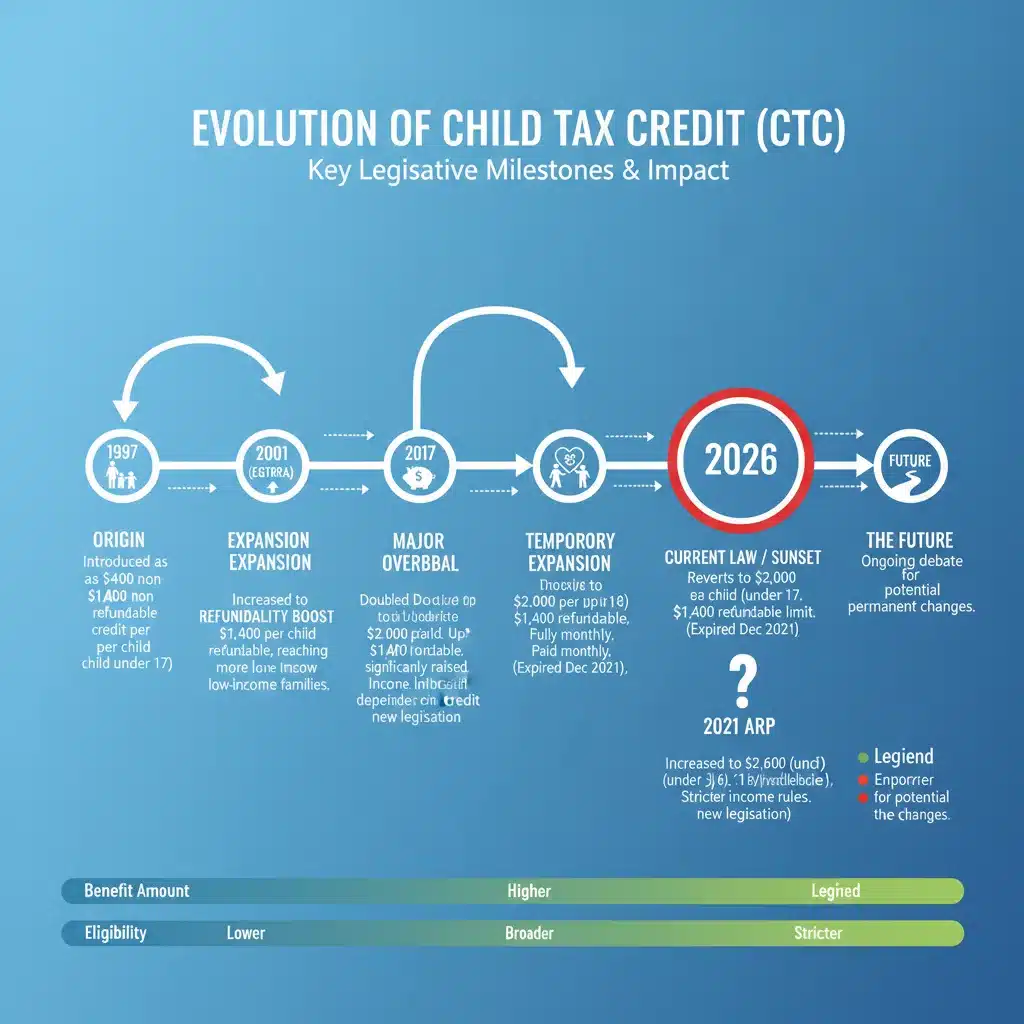
To fully grasp the implications of the Child Tax Credit 2026, it’s essential to understand its history. The CTC was initially introduced in 1997 as a non-refundable credit of $400 per child. Over the years, it has undergone several transformations, primarily aimed at increasing its value and expanding its reach to more low-income families. The Tax Cuts and Jobs Act (TCJA) of 2017 significantly boosted the credit to $2,000 per qualifying child and made up to $1,400 of it refundable. This was a major step in making the credit more accessible to families with lower tax liabilities.
The most dramatic, albeit temporary, expansion came with the American Rescue Plan Act (ARPA) of 2021. ARPA increased the credit to $3,600 for children under six and $3,000 for children aged six to seventeen. Crucially, it also made the credit fully refundable, meaning even families with no tax liability could receive the full amount. Furthermore, ARPA introduced advance monthly payments, providing families with regular financial assistance throughout the year rather than a lump sum at tax time. These changes had a profound impact, significantly reducing child poverty and providing a much-needed boost to household incomes during the COVID-19 pandemic.
However, the ARPA enhancements expired at the end of 2021. This means that for the 2022 and subsequent tax years, the CTC largely reverted to its TCJA structure. The looming question for 2026 is whether Congress will intervene to extend or modify the credit once again, or if it will continue under the TCJA framework. The political landscape and economic conditions will undoubtedly play a significant role in shaping the future of the Child Tax Credit 2026. Given the historical pattern of adjustments, it’s highly probable that discussions and potential legislative efforts to refine the credit will intensify as 2026 approaches, making it vital for families to stay informed about potential changes and their implications.
Child Tax Credit 2026: Eligibility Requirements
Determining eligibility for the Child Tax Credit 2026 will likely hinge on several key factors, primarily focused on the child’s age, relationship to the taxpayer, residency, and the taxpayer’s income. Based on the current framework, which is expected to prevail in 2026 unless new legislation is passed, here’s a detailed breakdown:
Qualifying Child Criteria:
- Age: The child must be under the age of 17 at the end of the tax year (i.e., 16 or younger on December 31, 2026). This is a crucial distinction from the ARPA expansion, which temporarily included 17-year-olds.
- Relationship: The child must be your son, daughter, stepchild, foster child, brother, sister, half-brother, half-sister, stepbrother, stepsister, or a descendant of any of them (e.g., a grandchild, niece, or nephew).
- Residency: The child must have lived with you for more than half of the tax year 2026. There are exceptions for temporary absences due to illness, education, business, vacation, or military service.
- Support: The child must not have provided more than half of their own support for the year.
- Joint Return: The child cannot file a joint return for the year (unless filed only to claim a refund of withheld income tax or estimated tax paid).
- Citizenship: The child must be a U.S. citizen, U.S. national, or U.S. resident alien.
Taxpayer Income Thresholds:
The Child Tax Credit 2026, under the current TCJA rules, is subject to income phase-outs. This means that as your income increases beyond certain thresholds, the amount of credit you can claim begins to decrease. For 2026, these thresholds are anticipated to be:
- Single Filers: The credit begins to phase out for single filers with a Modified Adjusted Gross Income (MAGI) above $200,000.
- Married Filing Jointly: For married couples filing jointly, the phase-out typically begins at a MAGI of $400,000.
- Other Filers: For all other filers (e.g., Head of Household), the phase-out generally starts at $200,000.
The credit amount is reduced by $50 for every $1,000 (or fraction thereof) by which your MAGI exceeds these thresholds. It’s important to note that these thresholds are not indexed for inflation, meaning their real value decreases over time, potentially impacting more middle-income families as wages rise.
Additional Considerations for Eligibility:
- Social Security Number (SSN): Both the child and the taxpayer must have a valid SSN issued by the Social Security Administration before the due date of your tax return (including extensions). This requirement became more stringent under the TCJA.
- Earned Income: While the full credit does not require earned income to be claimed, the refundable portion (Additional Child Tax Credit) does. Families with very low or no tax liability will need to meet specific earned income requirements to claim the refundable part of the credit. The exact threshold for earned income is subject to annual adjustments and will be crucial for understanding the full benefit of the Child Tax Credit 2026 payouts.
Staying updated on these eligibility requirements is paramount. The IRS often releases detailed guidance closer to the tax year, and consulting with a tax professional can provide personalized advice based on your specific financial situation. Any legislative changes before 2026 could alter these criteria, making continuous monitoring essential for families relying on the Child Tax Credit.
Child Tax Credit 2026: Anticipated Payouts and Refundability
The potential payout amounts for the Child Tax Credit 2026 are a primary concern for many families. Under the current law, which would apply in 2026 if no new legislation is enacted, the maximum credit amount is $2,000 per qualifying child. However, it’s crucial to distinguish between the non-refundable and refundable portions of this credit, as this significantly impacts how much a family truly benefits, especially those with lower incomes.
Maximum Credit Amount:
As per the TCJA, the maximum credit is $2,000 per qualifying child. This is the amount that can directly reduce your tax liability. For example, if you owe $3,000 in taxes and qualify for a $2,000 CTC, your tax bill would be reduced to $1,000.
Refundability – The Additional Child Tax Credit (ACTC):
A significant aspect of the Child Tax Credit 2026 is its refundability. Under current law, up to $1,600 of the credit is refundable for the 2023 tax year, and this amount is indexed for inflation. Therefore, for 2026, the refundable portion is anticipated to be slightly higher, likely around $1,700-$1,800 per child, although the exact figure will be announced by the IRS closer to the tax year. This refundable portion is known as the Additional Child Tax Credit (ACTC).
The ACTC is vital because it allows families to receive a refund even if they owe no federal income tax or if the credit amount exceeds their tax liability. However, to claim the ACTC, families must meet an earned income threshold. For example, for the 2023 tax year, this threshold was $2,500. This means a family must have earned at least $2,500 from wages, salaries, or self-employment to be eligible for the refundable portion of the credit. This threshold is also subject to annual inflation adjustments.
How the Payouts Are Calculated:
The calculation of your Child Tax Credit 2026 will involve several steps:
- Determine the maximum credit: Start with $2,000 per qualifying child.
- Apply income phase-outs: If your MAGI exceeds the relevant thresholds ($200,000 for single filers, $400,000 for married filing jointly), your credit amount will be reduced by $50 for every $1,000 over the threshold.
- Determine non-refundable portion: The remaining credit first reduces your tax liability dollar-for-dollar.
- Calculate refundable portion (ACTC): If you have any credit remaining after reducing your tax liability to zero, and you meet the earned income threshold, you can claim the ACTC. The ACTC is generally calculated as 15% of your earned income above the threshold, up to the maximum refundable amount (e.g., $1,600-$1,800 per child for 2026, depending on inflation adjustments).
This multi-layered calculation means that not all families will receive the full $2,000 per child. Lower-income families who don’t owe much in taxes but meet the earned income threshold will benefit primarily from the refundable portion, while higher-income families will see their credit reduced or eliminated due to phase-outs. Middle-income families will likely benefit from the non-refundable portion, reducing their tax bill directly.
No Advance Payments Expected:
Unlike the temporary ARPA expansion, it is not anticipated that there will be advance monthly payments for the Child Tax Credit 2026. Families will likely receive the credit as a lump sum when they file their federal income tax returns, similar to how it operated before 2021 and currently operates. This reverts to the traditional method of receiving tax credits, which requires families to plan their finances accordingly throughout the year without the benefit of periodic disbursements.
The absence of advance payments could pose challenges for families who benefited from the monthly support provided during 2021. This highlights the importance of budgeting and financial foresight for the upcoming tax years under the expected Child Tax Credit 2026 framework. Families should consider setting aside funds or adjusting their spending patterns to account for the lack of regular advance payments.
Potential Legislative Changes and the Future Outlook
While the current trajectory points to the Child Tax Credit 2026 operating under the TCJA framework, the political landscape is dynamic, and legislative efforts to modify the credit are always a possibility. Advocates for families and child welfare continue to push for a return to the expanded, fully refundable credit seen in 2021, citing its demonstrable impact on child poverty reduction and economic stability for countless households. The debate surrounding the CTC often centers on its design – whether it should prioritize horizontal equity (treating all families with children similarly) or vertical equity (providing more benefits to lower-income families).
Key Areas of Potential Debate:
- Full Refundability: One of the most significant changes under ARPA was making the credit fully refundable, removing the earned income requirement for the full amount. Proponents argue this is essential for reaching the poorest families who often have little to no tax liability. Opponents sometimes raise concerns about work incentives.
- Age Limits: The ARPA expansion increased the age limit to include 17-year-olds. Reinstating this could provide support for families with older teenagers.
- Credit Amount: A push to increase the maximum credit amount beyond $2,000, or to index it to inflation more robustly, is a recurring theme in legislative discussions.
- Advance Payments: The convenience and stability provided by monthly advance payments are often highlighted as a major benefit that many would like to see reinstated.
Impact of Political Climate:
The likelihood of any significant changes to the Child Tax Credit 2026 will heavily depend on the political control of Congress and the White House. Bipartisan agreement on tax policy can be challenging to achieve, especially on issues with substantial fiscal implications. However, the demonstrated success of the expanded CTC in reducing child poverty could serve as a powerful argument for its reintroduction or modification. Economic conditions leading up to 2026, such as inflation rates and employment figures, could also influence legislative priorities and the urgency of providing additional family support.
Families should remain vigilant about news from Capitol Hill and the Treasury Department. Organizations advocating for family benefits often provide timely updates and analyses of proposed legislation. Subscribing to newsletters from reputable tax policy organizations or government agencies can keep you informed about any developments that might alter the anticipated structure of the Child Tax Credit 2026.
Preparing Your Family Finances for the Child Tax Credit 2026
Proactive financial planning is essential to maximize your benefits from the Child Tax Credit 2026 and navigate any potential changes. Even if the credit reverts to the pre-2021 structure, understanding how it integrates into your overall financial picture is vital.
Review Your Eligibility Annually:
Your family’s circumstances can change from year to year. A child might turn 17, or your income might cross a phase-out threshold. Make it a habit to review the eligibility criteria at the beginning of each tax year to ensure you still qualify for the Child Tax Credit. Keep accurate records of your child’s age, residency, and support provided.
Monitor Your Income:
Since the Child Tax Credit 2026 is subject to income phase-outs and the refundable portion has an earned income threshold, monitoring your Adjusted Gross Income (AGI) and Modified Adjusted Gross Income (MAGI) throughout the year is crucial. If your income is close to the phase-out limits, strategic financial decisions (e.g., contributing more to a traditional IRA or 401(k) to reduce AGI) might help you retain more of the credit.
Understand the Refundable vs. Non-Refundable Portions:
Many families mistakenly believe they will receive the full $2,000 per child regardless of their tax liability. It’s critical to understand the distinction. If you have a low tax liability, you might only benefit from the refundable portion (ACTC), which has its own eligibility rules and maximum amount. Plan your budget accordingly, knowing that the full $2,000 is not guaranteed as a cash payment unless it’s fully refundable and you meet all criteria.
Adjust Withholding or Estimated Payments:
If you typically receive a large refund due to the CTC, you might consider adjusting your W-4 form with your employer or modifying your estimated tax payments. This can help you receive more of your money throughout the year rather than waiting for a large refund at tax time. However, be cautious not to under-withhold, which could lead to penalties. A tax professional can help you determine the optimal withholding strategy.
Keep Excellent Records:
Maintain thorough records for all dependents, including Social Security numbers, birth certificates, and documentation of residency. In case of an audit or questions from the IRS, having organized documentation will be invaluable for substantiating your claim for the Child Tax Credit 2026.
Seek Professional Advice:
Tax laws can be complex, and the nuances of the Child Tax Credit 2026 can be particularly intricate. Consulting with a qualified tax advisor or financial planner can provide personalized guidance. They can help you understand your specific eligibility, estimate your potential credit, and advise on strategies to optimize your family’s financial situation in light of these tax provisions.

Broader Economic and Social Impacts of the Child Tax Credit
The Child Tax Credit, in its various forms, has profound economic and social implications beyond individual family finances. The design of the Child Tax Credit 2026 will continue to shape these broader impacts, influencing everything from poverty rates to consumer spending and child development.
Impact on Child Poverty:
One of the most significant effects of the CTC, especially the expanded and fully refundable version under ARPA, is its proven ability to reduce child poverty. Studies from organizations like the Columbia University Center on Poverty and Social Policy demonstrated that the ARPA CTC significantly cut child poverty rates. A less generous or less refundable Child Tax Credit 2026 could see a reversal of some of these gains, potentially pushing more children back into poverty. This makes the discussions around full refundability particularly critical for advocates.
Economic Stimulus:
Tax credits for families often act as an economic stimulus. When families receive additional funds, they typically spend it on essential goods and services, such as food, housing, clothing, and education. This increased consumer spending can boost local economies and support businesses. The lack of advance payments for the Child Tax Credit 2026, and a potentially smaller overall credit, might reduce this stimulative effect compared to the 2021 expansion.
Family Well-being and Development:
Beyond direct financial relief, the CTC contributes to family well-being. Reduced financial stress can lead to better parental mental health, which in turn positively impacts child development. Access to additional funds can also allow families to invest in their children’s education, healthcare, and extracurricular activities, fostering long-term positive outcomes. The stability provided by a robust Child Tax Credit 2026 can be a critical factor in a child’s successful upbringing.
Work Incentives and Disincentives:
The design of the CTC, particularly its refundability and earned income requirements, can influence work incentives. Some argue that a fully refundable credit without an earned income requirement might disincentivize work, though studies on the ARPA CTC generally did not find significant negative impacts on parental employment. Conversely, an earned income threshold for refundability, as expected for the Child Tax Credit 2026, is intended to encourage work by tying the benefit to employment. This remains a point of ongoing debate among policymakers and economists.
Administrative Complexity:
The varying rules for the CTC over different tax years can create administrative complexity for both the IRS and taxpayers. Simplified, consistent rules would benefit everyone. However, the political nature of tax policy often means frequent adjustments, requiring continuous public education and outreach to ensure families understand and claim the benefits they are entitled to under the Child Tax Credit 2026.
Conclusion: Navigating the Child Tax Credit 2026
The Child Tax Credit 2026 stands at a crucial juncture, poised to revert to its pre-2021 structure unless new legislation intervenes. This means families should anticipate a maximum credit of $2,000 per qualifying child, with a refundable portion likely around $1,700-$1,800, subject to earned income requirements and income phase-outs. The popular advance monthly payments seen in 2021 are not expected to be part of the Child Tax Credit 2026, requiring families to adjust their financial planning accordingly.
Understanding the eligibility criteria – including the child’s age (under 17), relationship, residency, and the taxpayer’s income thresholds – is paramount. These details will dictate who qualifies and for how much. While the current outlook suggests a return to a more traditional CTC, the political discourse around family support and child poverty reduction remains active. It is not outside the realm of possibility for Congress to propose new changes before or during 2026, making continuous monitoring of legislative developments essential.
For families, proactive financial planning is key. Reviewing eligibility annually, tracking income, understanding the nuances of refundability, and considering adjustments to tax withholding can help maximize benefits. Seeking advice from tax professionals can provide tailored guidance for your specific situation. The Child Tax Credit 2026, regardless of its final form, will continue to be a vital component of financial stability for millions of American households, and staying informed is the best way to ensure your family fully benefits from this important provision.