2026 Fed Rate Hikes: 3 Savings Account Strategies
To navigate the anticipated 2026 Federal Reserve interest rate hikes, individuals should focus on high-yield savings accounts, laddering CDs, and diversifying savings to maximize returns and mitigate financial risks effectively.
As we approach 2026, the financial landscape is poised for significant shifts, particularly concerning the Federal Reserve’s potential interest rate adjustments. Understanding and preparing for these changes is crucial for anyone looking to optimize their personal finances. This article will guide you through Navigating the 2026 Federal Reserve Interest Rate Hikes: 3 Key Strategies for Your Savings Account, ensuring your money works harder for you.
Understanding the Federal Reserve’s Role and Rate Hikes
The Federal Reserve, often simply called “the Fed,” plays a pivotal role in the U.S. economy, primarily through its monetary policy decisions. Its dual mandate is to maximize employment and maintain price stability, which often translates to controlling inflation. When inflation rises, the Fed typically raises interest rates to slow down borrowing and spending, thereby cooling the economy.
Historically, the Fed’s decisions have a ripple effect across all financial sectors, directly influencing the interest rates offered by banks on savings accounts, loans, and mortgages. Anticipating potential rate hikes in 2026 means savers need to be proactive in positioning their funds to benefit from, rather than be disadvantaged by, these changes.
Why the Fed Raises Rates
- Controlling Inflation: Rising prices for goods and services erode purchasing power. Rate hikes make borrowing more expensive, reducing demand and helping to stabilize prices.
- Economic Growth Management: Sometimes, the economy can overheat, leading to unsustainable growth. The Fed uses rate increases to moderate this growth, aiming for a more stable and long-term expansion.
- Responding to Economic Data: The Fed’s decisions are data-driven, based on unemployment rates, inflation indicators, and GDP growth. Projections for 2026 suggest these indicators may prompt further tightening.
The implications for your savings account are straightforward: higher benchmark rates from the Fed generally lead to higher interest rates offered by banks. However, not all savings accounts are created equal, and understanding where to place your money will be key to maximizing returns in a rising rate environment. This foundational understanding sets the stage for the strategies we will explore.
Strategy 1: Prioritize High-Yield Savings Accounts (HYSAs)
One of the most effective ways to capitalize on rising interest rates is by moving your savings into High-Yield Savings Accounts (HYSAs). Unlike traditional savings accounts at brick-and-mortar banks, HYSAs typically offer significantly higher annual percentage yields (APYs), often several times the national average. These accounts are usually offered by online-only banks, which have lower overhead costs and can pass those savings on to their customers in the form of better rates.
When the Federal Reserve raises interest rates, HYSAs are usually among the first accounts to reflect these increases. This means your money can start earning more almost immediately, without being locked into a long-term commitment. This flexibility makes HYSAs an excellent choice for emergency funds, short-term savings goals, or any money you might need access to relatively quickly.
Key Benefits of HYSAs
- Higher Returns: Consistently offer APYs well above traditional savings accounts, directly benefiting from Fed rate hikes.
- Liquidity: Funds are readily accessible, typically with easy online transfers and no withdrawal penalties, unlike Certificates of Deposit (CDs).
- FDIC Insurance: Most reputable HYSAs are FDIC-insured up to $250,000 per depositor, per institution, providing peace of mind.
Choosing the right HYSA involves comparing APYs, minimum balance requirements, and any potential fees. While some HYSAs might have promotional rates, it’s essential to look for accounts with consistently competitive rates and a history of adjusting their APY in line with Fed movements. This strategy ensures your savings are not just sitting idle but are actively growing in response to the economic climate.
Strategy 2: Explore Certificate of Deposit (CD) Laddering
For funds you don’t anticipate needing immediate access to, Certificate of Deposit (CD) laddering presents a powerful strategy to leverage rising interest rates while maintaining some liquidity. A CD is a savings account that holds a fixed amount of money for a fixed period, and in return, the issuing bank pays interest. Generally, the longer the term, the higher the interest rate.
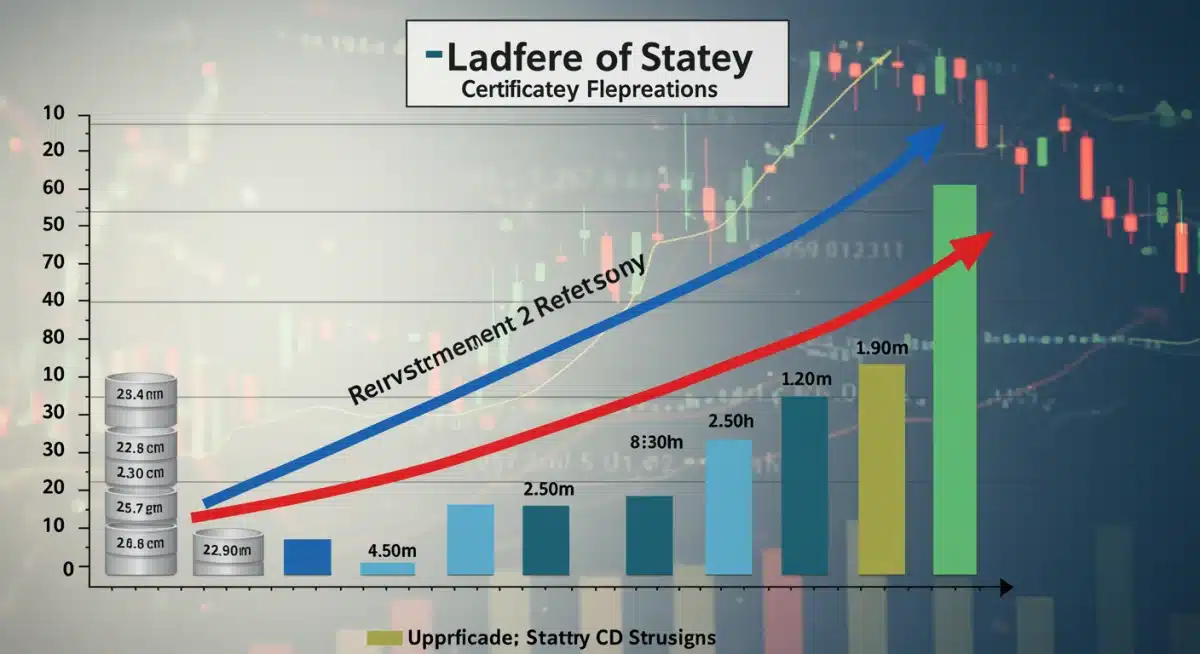
CD laddering involves dividing your total savings into several CDs with different maturity dates. For example, instead of putting all your money into one 5-year CD, you might invest in a 1-year, 2-year, 3-year, 4-year, and 5-year CD. As each CD matures, you can reinvest the funds into a new, longer-term CD at what is hopefully a higher interest rate, reflecting the Fed’s rate hikes. This approach provides a regular opportunity to capture higher rates.
Advantages of CD Laddering
- Capitalize on Rising Rates: As short-term CDs mature, you can reinvest at the current, potentially higher, long-term rates.
- Enhanced Liquidity: With CDs maturing periodically, you have access to a portion of your funds at regular intervals, unlike a single long-term CD.
- Predictable Income: CDs offer a guaranteed interest rate for their term, providing a stable income stream, particularly appealing in volatile markets.
This strategy is particularly beneficial if you believe interest rates will continue to climb through 2026 and beyond. It allows you to participate in the upward trend without locking all your money into a rate that might soon become uncompetitive. When setting up a CD ladder, research different banks’ CD offerings, looking for competitive rates and considering early withdrawal penalties, although these are typically avoided with a well-structured ladder.
Strategy 3: Diversify Your Savings Portfolio
While HYSAs and CD ladders are excellent for capturing higher interest rates, a well-rounded financial strategy always includes diversification. Diversifying your savings portfolio means spreading your money across different types of accounts and investments to reduce risk and maximize potential returns. This approach ensures that even if one strategy doesn’t perform as expected, your overall financial health remains robust.
Beyond traditional savings and CDs, consider other avenues that might benefit from or provide a hedge against rising interest rates. For instance, short-term bond funds or Treasury Inflation-Protected Securities (TIPS) can offer protection against inflation and varying interest rate environments. Money market accounts, which often offer slightly higher rates than traditional savings accounts, can also be a good option for highly liquid funds.
Elements of a Diversified Savings Portfolio
- Emergency Fund: Keep 3-6 months of living expenses in a highly liquid HYSA.
- Short-Term Goals: Use HYSAs or short-term CDs for goals within 1-3 years.
- Long-Term Goals: Explore longer-term CDs, bonds, or even growth-oriented investments for goals beyond 5 years, understanding the associated risks.
The key to diversification is aligning your investments with your financial goals and risk tolerance. As the Federal Reserve adjusts rates, different asset classes will react differently. A diversified approach allows you to capture gains where they occur while minimizing losses in other areas. Regularly review and rebalance your portfolio to ensure it remains aligned with your objectives and the evolving economic landscape.
Monitoring Economic Indicators and Fed Announcements
Effective financial planning in anticipation of 2026 Federal Reserve interest rate hikes requires continuous monitoring of economic indicators and the Fed’s public announcements. The Federal Open Market Committee (FOMC) meetings, typically held eight times a year, are where key decisions about interest rates are made. Following these meetings and the accompanying statements can provide invaluable insights into the Fed’s future intentions.
Beyond FOMC announcements, pay close attention to inflation data, such as the Consumer Price Index (CPI), and employment reports, like the Non-Farm Payrolls. These figures are primary drivers of the Fed’s monetary policy. A consistently high CPI might signal more aggressive rate hikes, while a weakening job market could lead to a more cautious approach. Understanding these signals allows you to anticipate changes and adjust your savings strategies proactively.
Key Indicators to Watch
- Inflation Rates (CPI, PCE): Measures the change in prices paid by consumers for goods and services.
- Employment Data: Unemployment rates, job creation figures, and wage growth provide insights into economic health.
- GDP Growth: Gross Domestic Product indicates the overall economic output and growth trajectory.
Subscribing to financial news outlets, following reputable economic analysts, and utilizing financial planning tools can help you stay informed. Don’t just react to headlines; try to understand the underlying economic rationale behind the Fed’s actions. This informed approach will empower you to make timely and strategic decisions regarding your savings, ensuring you’re always one step ahead in a dynamic financial environment.
Adjusting Your Budget for a Rising Rate Environment
While optimizing your savings accounts is crucial, it’s equally important to examine your overall budget in a rising interest rate environment. Higher rates don’t just affect what you earn on savings; they also impact the cost of borrowing. This means that variable-rate debts, such as credit card balances or adjustable-rate mortgages, could become more expensive. Proactively adjusting your budget can mitigate these increased costs and free up more funds for savings.
Review your current debts and prioritize paying down those with variable interest rates. Even a small increase in your monthly payment can add up over time. Additionally, consider refinancing fixed-rate debts if current rates are still favorable, or locking in a fixed rate if you anticipate needing new loans in the near future. The goal is to minimize your outgoing interest payments so that more of your income can be directed towards maximizing your savings returns.
Budgetary Adjustments to Consider
- Debt Prioritization: Focus on reducing high-interest, variable-rate debts first.
- Expense Review: Identify areas where you can cut back to free up more cash for savings or debt repayment.
- Income Optimization: Explore ways to increase income, such as side hustles or negotiating a raise, to enhance your financial flexibility.
A rising rate environment is a double-edged sword: it offers opportunities for savers but poses challenges for borrowers. By taking a holistic view of your finances and making strategic budgetary adjustments, you can ensure that the positive impacts of higher savings rates outweigh any potential increases in borrowing costs. This comprehensive approach is vital for maintaining financial stability and growth in 2026 and beyond.
The Importance of Professional Financial Advice
While the strategies discussed provide a solid foundation for navigating the 2026 Federal Reserve interest rate hikes, personal finance is rarely a one-size-fits-all scenario. Your individual financial situation, risk tolerance, and long-term goals are unique. This is where the expertise of a qualified financial advisor becomes invaluable. A professional can help you tailor these strategies to your specific needs, offering personalized guidance and insights.
A financial advisor can provide a comprehensive review of your current assets and liabilities, help you set realistic financial goals, and construct a diversified portfolio that aligns with your objectives. They can also assist in understanding the nuances of various financial products, such as complex CD structures or different types of bond funds, ensuring you make informed decisions that are best for your financial future. Their expertise extends to tax implications, estate planning, and retirement strategies, all of which are interconnected with your savings decisions.
How a Financial Advisor Can Help
- Personalized Plan: Develop a customized financial strategy based on your unique circumstances.
- Market Insights: Provide expert analysis of economic trends and their potential impact on your investments.
- Risk Management: Help you understand and manage investment risks, ensuring your portfolio is appropriately diversified.
Engaging with a financial advisor is an investment in your financial well-being. They can offer a neutral perspective, helping you avoid emotional decisions during volatile market periods and ensuring your strategies remain aligned with your long-term vision. As the financial landscape evolves with potential Fed rate hikes in 2026, having a trusted advisor by your side can provide confidence and clarity, empowering you to navigate these changes successfully.
| Key Strategy | Brief Description |
|---|---|
| High-Yield Savings Accounts | Move funds to online HYSAs for significantly higher interest rates that respond quickly to Fed hikes. |
| CD Laddering | Invest in CDs with staggered maturity dates to regularly reinvest at potentially higher rates. |
| Diversify Savings Portfolio | Spread savings across various account types and investments to mitigate risk and optimize returns. |
Frequently Asked Questions About 2026 Fed Rate Hikes
Federal Reserve interest rate hikes refer to increases in the federal funds rate, which is the target rate for overnight lending between banks. The Fed raises this rate to combat inflation and slow down an overheating economy, directly influencing other interest rates across the financial system.
If you have a traditional savings account, you might see a slight increase in your interest earnings. However, high-yield savings accounts (HYSAs) and money market accounts are typically more responsive, offering better returns as the Fed raises rates, making them more attractive options.
It depends on your liquidity needs. HYSAs offer flexibility and quick access to funds, while CDs lock in rates for a fixed term. A CD ladder can combine the benefits, allowing you to capture rising rates as shorter-term CDs mature while maintaining some access to funds.
Besides savings accounts, rising rates impact mortgages (especially adjustable-rate ones), credit card interest, auto loans, and business loans. Borrowing becomes more expensive, while fixed-income investments like bonds can see their market value decrease, though new bonds offer higher yields.
Prioritizing high-interest, variable-rate debt, such as credit card balances, is often advisable during rate hikes, as their costs will increase. Once high-cost debt is managed, focus on maximizing savings in high-yield options to benefit from the higher interest earnings.
Conclusion
Navigating the 2026 Federal Reserve Interest Rate Hikes: 3 Key Strategies for Your Savings Account is not merely about reacting to economic changes, but proactively positioning your finances for growth and stability. By prioritizing high-yield savings accounts, strategically implementing CD laddering, and diversifying your overall savings portfolio, you can transform potential challenges into significant opportunities. Staying informed about economic indicators and the Fed’s announcements, coupled with a disciplined approach to your budget and a willingness to seek professional financial advice, will empower you to make intelligent decisions. The financial landscape is ever-evolving, and with these strategies, your savings can thrive, contributing to your long-term financial well-being.